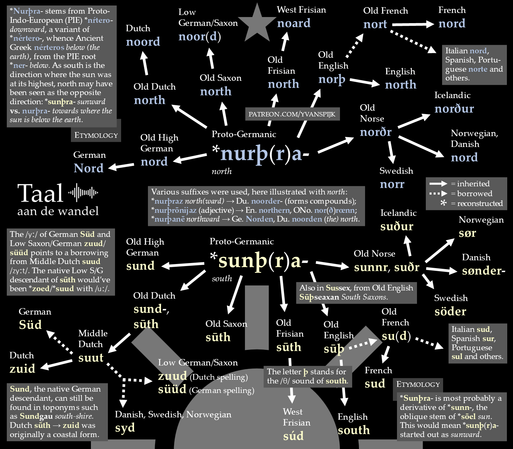
The French words ‘nord’ and ‘sud’ look a lot like English ‘north’ and ‘south’.

That’s not a coincidence: it’s because Old French borrowed these words from Old English ‘norþ’ and ‘sūþ’ – along with ‘est’ and ‘ouest’, which come from ‘ēast’ and ‘west’.

My new infographic tells you all about the fascinating theories about the history of ‘north’, ‘south’ and their cognates.

Next time: east and west.
@yvanspijk Do you have a theory on why this particular set of words spread from OE to French, Spanish, Italian, etc? It seems really rare
@avirr There was a lot of contact between southern England and Normandy, even before the Norman invasion. The further spread may have had something to do with navigation at sea.
@yvanspijk Something like: sun > there and nether > there.
Makes sense. Especially in times when GPS did not exist.
@yvanspijk
So the "original' french sud would be midi?
@wahoonie It looks like it didn't have that meaning until after the Middle Ages.
@yvanspijk @wahoonie In French, "septentrion" (https://dictionnaire.lerobert.com/definition/septentrion) is an word for "north" derived from Latin. But I cannot find when it was first used. Probably, it’s not as old as the more common "nord".
septentrion - Définitions, synonymes, prononciation, exemples | Dico en ligne Le Robert

Définition, exemples et prononciation de septentrion : Le nord.…

Dico en ligne Le Robert

@monsieurbecker @yvanspijk

So, the opposite to the seven northern stars would be méridional - according to LeRobert

@monsieurbecker @yvanspijk
I love the example:

La lente vie méridionale arrêtait sa nonchalance sur les bancs poussiéreux, dans le soir tiède.