Over the weekend, I did an interview about my forthcoming book *The Reverse Centaur's Guide to Life After AI* (a book about being a better AI critic), and the interviewer said she was surprised that I wasn't an AI booster, based on my demographics and work history:

https://us.macmillan.com/books/9780374621568/thereversecentaursguidetolifeafterai/

--

If you'd like an essay-formatted version of this thread to read or share, here's a link to it on pluralistic.net, my surveillance-free, ad-free, tracker-free blog:

https://pluralistic.net/2026/06/15/vernacular/#hypercardian

1/

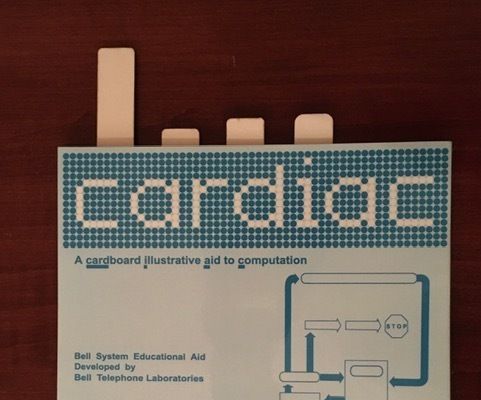
I could see where she was coming from. I encountered computers in the mid-seventies, as a small child. My first computer was a CARDIAC, a working, Turing-complete, mechanical computer made entirely of cardboard, that I spent endless hours with:

https://www.instructables.com/CARDIAC-CARDboard-Illustrative-Aid-to-Computation-/

2/

CARDIAC (CARDboard Illustrative Aid to Computation) Replica

CARDIAC (CARDboard Illustrative Aid to Computation) Replica: Back in the 1960's and early 70's Bell Labs made some very sophisticated educational kits available to high schools and colleges. Designed for classroom use, they included wonderful manuals written by some of Bell Labs best minds. One of these kits…

Instructables

Then I graduated to a teletype terminal and acoustic coupler connected to a minicomputer at the University of Toronto. My mom, a kindergarten teacher, used to smuggle home 1,000' rolls of paper towel from the kids' bathroom. I'd get 1,000' feet of computing up one side, then another 1,000' down the other side, then I'd carefully re-roll the paper towel so she could put it back in the bathroom for the kids to dry their hands on.

3/

After that, I got an Apple ][+ in 1979, and shortly thereafter acquired a modem, and that was it: I was hooked for life. I became an amateur programmer, then a professional programmer. I hosted forums on dial-up BBSes where I distributed software and offered support to strangers who wanted to connect their computers to the internet. I got a job as a gopher developer, then a web developer, then a CIO-for-hire, helping wire up small businesses and connect them to the net.

4/

Eventually, I co-founded a free/open source software startup, before transitioning to 25 years as a digital rights activist with the Electronic Frontier Foundation. And for most of that time, I was energetically writing science fiction, eventually becoming associated with a school sometimes called "post-cyberpunk":

https://en.wikipedia.org/wiki/Rewired:_The_Post-Cyberpunk_Anthology

5/

Rewired: The Post-Cyberpunk Anthology - Wikipedia

The force that energized all this work was a dialectical one, the contradiction that powered cyberpunk literature itself. For all that cyberpunk was undeniably enamored with the coolness and combustibility of new technology, it was also terrified of how technology could be a force for oppression, surveillance and control. As William Gibson says, "cyberpunk was a warning, not a suggestion."

6/

Gibson's more famous quote, of course, is "the street finds its own use for things." In Gibson's novels (and in my own life in technology) all the most interesting things happen when users of technology (often without formal training or credentials) find ways to adapt the technology they use to suit their needs:

https://pluralistic.net/2026/03/17/technopolitics/#original-sin

7/

Pluralistic: William Gibson vs Margaret Thatcher (17 Mar 2026) – Pluralistic: Daily links from Cory Doctorow

@pluralistic wait ... Was the super computer in Hackers named after this author??
@pluralistic 🤯. Hack the planet!!
@fullywoolly @pluralistic I was once asked if I had ever hacked a Gibson.... I quietly checked out of the conversation.
@daycoder @nuintari @fullywoolly @pluralistic instructions unclear have root on my guitar now
@pluralistic @fullywoolly @daycoder @nuintari Perhaps not, but *everyone* has hacked a Fender…
@jbohn @pluralistic @fullywoolly @daycoder @nuintari and then you get a nastigram from Fender...
@hub @jbohn @pluralistic @fullywoolly @daycoder @nuintari Especially if the guitar just *looked* like a Fender, but was from another company.
@michaelgemar @hub @jbohn @pluralistic @fullywoolly @daycoder @nuintari Which makes a lot of sense, Fender and Gibsons make for bad bases for mods due to horrible build quality.