 hell \ Rebekah Hellberg
people who have gone from neo/VI/m to Emacs or wise verse - what made you swap? what made you then either stay or revert?
 Paul SomeoneElse
I switch back and forth between vi and emacs.
Vi is nice if you are into "Unix IS the IDE".
It starts instantly. You use the shell for shell
things.
Emacs is nice to do EVERYTHING in.
When I use emacs I leave it running for
days. It's especially nice for programming
any kind of lisp.
Emacs is definitely more of an ideal for using
as a pure programming editor, but i have
become more and more unix pilled so I
tend to use vi more lately.
An example is auto formatting. Emacs is great
at this IN the editor. Press tab and emacs will
do the correct thing indent wise.
In vi I have to find an external program
that formats (like gofmt or indent) and
pipe the buffer contents out to that
program and back. This is made easier
by using map commands to map keys
to do the indenting. But shows how emacs
and vi differ basically.
Vi is nice if you are into "Unix IS the IDE".
It starts instantly. You use the shell for shell
things.
Emacs is nice to do EVERYTHING in.
When I use emacs I leave it running for
days. It's especially nice for programming
any kind of lisp.
Emacs is definitely more of an ideal for using
as a pure programming editor, but i have
become more and more unix pilled so I
tend to use vi more lately.
An example is auto formatting. Emacs is great
at this IN the editor. Press tab and emacs will
do the correct thing indent wise.
In vi I have to find an external program
that formats (like gofmt or indent) and
pipe the buffer contents out to that
program and back. This is made easier
by using map commands to map keys
to do the indenting. But shows how emacs
and vi differ basically.
 tusharhero
@pkw I recommend reading https://tilde.town/~ramin_hal9001/articles/emacs-fulfills-the-unix-philosophy.html by @ramin_hal9001
 Ramin Honary
@tusharhero thanks for the shout-out!
“people who have gone from neo/VI/m to Emacs or wise verse - what made you swap? what made you then either stay or revert?”
@hell the article mentioned by Tusharhero is a little long, so to summarize it in a way that more directly answers your question: I basically realized that Emacs was not a text editor, it was a programming language designed for text editing that came with a built-in text editor and IDE. And the built-in editor and IDE are setup so that you don’t really need to learn the Emacs Lisp programming language to use it.
I had become frustrated with my editor (Vim) my terminal multiplexer (Screen or TMux), my shell (Bash), and many of my other CLI tools all being programmed, scripted, and/or configured in different languages. For example, when trying to get my shell to notify my editor that a build process completed, I was able to program Vim and my shell scripts to both use inotify or similar tools to do so, but I just thought it was a little ridiculous that I had to hack together solutions to these problems.
So I started thinking about ways of using the CLI with just one programming language and one runtime. Then it hit me: Emacs is exactly that: a combination of Tmux, Vim, Bash, and dozens of other tools all programmed in Lisp. Once I realized that, I decided I didn’t care how hard it was to use, it was exactly the tool I needed so I had better just learn how to use it. And it turned out not to be too hard anyways.
The best part was, I hardly ever need to write my own tools anymore because I was always able to find some Emacs Lisp code somewhere that solved practically any problem I had ever come across.
If you’d like to know more, then yeah, read my article, or ask me anything you’d like here on the fediverse!
 restorante
Sometime I wonder, how did people start to compare emacs with vi? Indeed it is true that vi and emacs are both text editors.
But in a sense, emacs is an editor and much more. Are these two computer programs even comparable to begin with?
Just like what you wrote, emacs acts like vi. But emacs also acts like tmux. It is also acting like a shell and more.
Comparing emacs with vi is like comparing emacs with python or java or perl.
 Karl Voit

@restorante @ramin_hal9001 @hell @tusharhero
My take(s) on that #Emacs and #vim comparison part:
https://karl-voit.at/2026/01/23/Emacs-vs-vim-Cargo-Folding-Bike/
and https://karl-voit.at/2015/10/23/Emacs-is-not-just-an-editor/

 Timothy Roes
@publicvoit What a great blog you have. I might give #Emacs another shot. I tried org mode during my PhD but couldn’t remember all the keyboard chords and ultimately wrote my thesis in #Vim. I’m wondering about the UI when using org mode as a to do app for #GTD. Don’t you feel plain text can become quite cluttered? Could you manage a list like that on mobile?
 bignose
@TimothyRoes
> Could you manage a list like that on mobile?
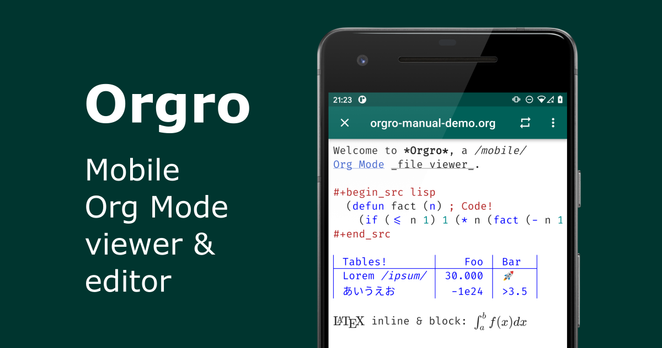
I do! The excellent #Orgro is a mobile app designed to manage an #OrgMode document. Powerful and straightforward.
https://orgro.org/
https://f-droid.org/packages/com.madlonkay.orgro/
@orgro
> Don’t you feel plain text can become quite cluttered?
I don't. #Emacs GUI is consistent across platforms (sometimes that means it is a bit misfit to a specific desktop style, but that's okay) and Org adds good presentation to the #PlainText.
@bignose Great tip. On iOS I've also found https://xenodium.com/plain-org-for-ios which looks slick. I'll soon be moving away from iOS to SailfishOS, though. @publicvoit @orgro