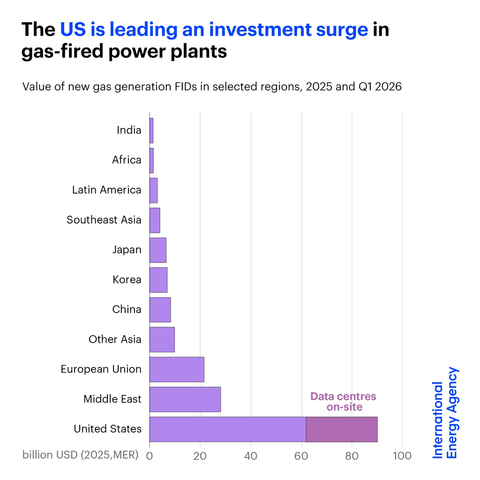
The planned gas-fired capacity **JUST FOR DATA CENTRE ON-SITE USE** in the US is the same as *all* planned gas capacity in India, Africa, Latin America, Southeast Asia, Japan, Korea and China *combined*.

But sure, 'ChatGPT is just like 10 seconds of watching Netflix' ๐Ÿซ  ๐Ÿซ  ๐Ÿซ  ๐Ÿซ  ๐Ÿซ  ๐Ÿซ  ๐Ÿซ  ๐Ÿซ  ๐Ÿซ  ๐Ÿซ  ๐Ÿซ  ๐Ÿซ  ๐Ÿซ  ๐Ÿซ  ๐Ÿซ  ๐Ÿซ  ๐Ÿซ  ๐Ÿซ  ๐Ÿซ  ๐Ÿซ  ๐Ÿซ  ๐Ÿซ  ๐Ÿซ  ๐Ÿซ  ๐Ÿซ  ๐Ÿซ 

https://www.iea.org/reports/world-energy-investment-2026

@ketan

No stop them!

Is the only sane response.

@ketan The AI bubble canโ€™t burst soon enough to stop this stupidity.
@bjn @ketan I would, personally, rapier the balloon myself if I could.
@ketan this is really alarming but Netflix is part of that pot. They run their services on this infrastructure.
@jorge @ketan
Nope please, don't spread misinformation. The service that any on-demand streaming platform like netflix provide for millions of people (usually 2~3 million clients) can be handled by a single CDN server. That server can stream up to 200Gb/s of video spending less that 400 W of electric power. Also those servers don't need big datacenters to work, they use to be placed at the telecommunication nodes of the internet service providers in order to have better connectivity.
@paelnever @ketan it was not my intention to compare them in terms of power demand - just wanted to mention that data centres โ‰  chatbots. Netflix doesn't only stream media, they also run their own models on their user data.
@jorge
Ok but the scale of the operation is crucial here. I am very aware of the technical advances in AI and never heard before about netflix doing something in that field. Probably they don't build whole datacenters for it. You can do a lot of things at enterprise level with a setup of servers running in a single rack that drains about 20~30KW depending on how advanced are the chips inside the servers. I also run models and train LORAs with my own data on a device in my home that consumes 60 watts, no kidding.
@jorge @ketan this is irrelevant to the point the original post is making.
@ketan
This shit is not a joke - they are trying to kill us all and destroy the planet. We have to stop them. NOW!
@ketan the data centre that is going into a town near me (allegedly) will require the equivalent of 50% of the electricity demand of Adelaide. The State and region is excited, because, $4 BiLlIOn
@ketan to temperate the numbers: capacity is not actual production.
@SciencesPoulet @ketan they're not building it not to use it
@stooovie @SciencesPoulet @ketan You may build it hoping never using it : as a backup power source in case of regional blackout.
Every datacenter got those, as hospitals.
@ketan govts should require stricter air and sound emissions reguations - and push a high percentage of regional renewable energy to supply them. That way when the AI bubble bursts - there will be lower cost power source built for the future
@metaphase agree, while fearing that investor decisions are all about speed. In that hype, any requirement sounds just like an obstacle. Your local government needs tough balls to hold this ground!
@ketan
@ketan are people trying to measure by query? To state the obvious a data centre doesnโ€™t work like that. The entire exists as off or on. So if there is only one user you are still burning 20Gw or whatever ridiculous number it is today.
@ketan While the rest of the world goes Solar, USA goes Russian-style.
@gimulnautti @ketan Run by a Russian agent, what did you expect? Originality?
@ketan disgraceful that this is happening

@ketan This is utterly insane. When I was taught about programming the whole point was to optimise algorithms to use as little resource as possible. The Art of Computer programming by Donald Knuth for example analyses algorithms in minute detail to see how efficient they are. We (well cleverer people than me) have developed extremely efficient and deterministic search algorithms over the years - we can access knowledge quickly and with precision.

But no.

Instead we have a bunch of morons with lots of money who want to ignore all that (mainly because they probably don't understand it) and instead want to cram vast amounts of information into hugely inefficient models and sell it back to everyone.

It is a classic example of capitalism destorying people and the planet for the sake of greed.

@ketan the good news is, this is all bottlenecked on gas turbines and their entire worldwide production is sold out for at least a decade, so there is no way these pie-in-the-sky plans will ever materialize. The data center developers with a clue are all planning on captive solar with battery storage.
@fazalmajid @ketan afaik german company Siemens makes the best gas turbines in the world still. So at least europe profits there? #economics
@seepr @ketan there's also the French Arabelle steam turbine, which was an Alsthom product acquired by GE and renationalized by the French government. I'd prefer turbines be used for nuclear power plants, not fossil-fueled ones.

@fazalmajid @ketan Are the gas turbines used exactly the same as the ones powered by hot water steam? Wow did not know.

Also these same turbines can be used for geothermal? I assumed different temperatures and chemicals would need different materials...

@seepr @ketan no, gas turbines operate in a harsher environment than supercritical steam as they are burning the gas in the turbine, but both need very special metallurgy for the turbine blades, just like jet aircraft engines, that is mastered by a very small number of specialist firms worldwide, and that is the bottleneck for the world supply of turbines. Some are getting so desperate they are repurposing turbines from mothballed jetliners, even though that is incredibly inefficient and polluting.

@ketan since the us has a lot of access to fracking gas, that otherwise would be flared off as waste, now they burn it in turbines instead?

I assume this is one of the reasons why natural gas (methane) is so cheap in the us.

@seepr @ketan

No gas flaring from oil extraction is still common. We extract gas deliberately from fracking and offshore deposits for the market which is mostly separate of gas as byproduct of oil extraction.

@InkySchwartz @ketan Is the gas obtained as a byproduct of oil extraction more volatile because of its chemical composition? Or the same as would be extracted in a gas-fracking project?
@seepr @ketan From what I know it is not. The reason flaring happens is economic only: Meaning to retrofit an oil platform to harvest the gas cost too much for the oil companies.
@ketan I think this might be our Easter Island moment where we continue to consume resources building totems until all of the resources are gone.
@ketan
USA is less than 13% of world population yet consumes more resources of almost all kinds?

@ketan

The most stupid direction ever witnessed, it will backfireโ€ฆ

@ketan Another profit center for the fossil fuel industry.
@ketan As an aside, that Netflix "study" was absolute BS. The amount of energy to read from a hard-drive and send the data to a tablet is tiny compared to AI.

@ketan
@jorge
@sean_ae
I did a bit of research and tracked down where that myth about video streaming fueling the surge of datacenters comes from. This article https://www.harun-farocki-institut.org/en/2020/04/16/streaming-video-a-link-between-pandemic-and-climate-crisis-journal-of-visual-culture-hafi-2/ written by Laura U. Marks back in the days of COVID 19 pandemic has been widely cited over internet and became viral.

When that woman with zero IT background was looking for something to confirm her bias she found this other article https://www.aceee.org/files/proceedings/2012/data/papers/0193-000409.pdf published by David Costenaro and Anthony Duer in 2012 when they were both working for an utility company. David Costenaro https://www.linkedin.com/in/davidcostenaro was a "mechanical engineer" with an MBA in "business administration" and Anthony Duer https://www.zoominfo.com/p/Anthony-Duer/1887784092 was a "Bachelor of Science" with a "Master of Arts" so neither do any of them have knowledge in IT, much less in communications over internet.

So what do they do in their article? They pick info about energy consumption for every single device connected to networks (not only internet) and then sum it all. They sum the power consumed by all the people's computers, all datacenters, all the servers no matter what those servers are doing, all the internet infrastructure and even other networks infrastructure like cell phone towers.

Then obviously they get a monstrously big number of gigawats (141) and divide that by an estimation of the data usage on the internet made by Cisco in 2011. That way they arrive to the magic number of "5.12 kWh per GB". When i read that i was doubting between ripping my eyes off or start laughing like crazy for the rest of the year.

Anyone with a minimal knowledge about IT who had seen that number would automatically heard alarms and seen red flashing lights in the head, but Laura U. Marks took that number for granted as if it came from "experts" and used it to make calculations about how much energy burns to stream a Netflix series. And then we have people today comparing video streaming with the energy consumed by hyperscale datacenters.

@ketan investment surge in stranded assets ๐Ÿ™ƒ