 Whatisgoingon
 Hailey
rsync was basically done until the maintainer discovered vibecoding
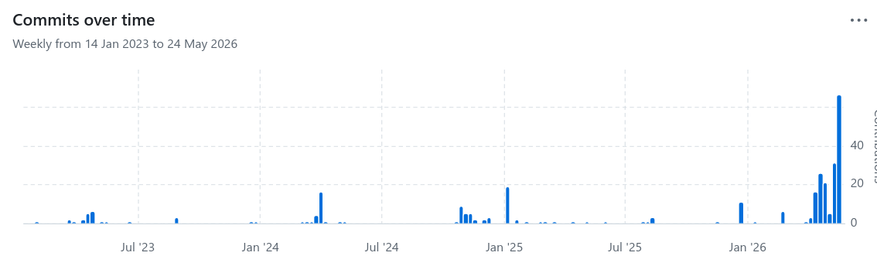
@hailey Gonna lock the version on all my systems (altough Debian, Void and FreeBSD might do that too and I don't even have to)
EDIT: FreeBSD has 3.4.3 and there's no easy way to downgrade – so I just manually got 3.4.1 tarball, configure/make/doas make install
@speaktrap @hailey What is the last slop-free version?
@daks has replied:
3.4.1. Although it has some not fixed CVE's. So there is no good alternative unless your distro's team back ports fixes.
@daks @speaktrap @hailey oh that's great!
I've been happily using debian since forever, but I'm slowly warming up to the idea of moving to gentoo..
@noodle @dieweltist Open Arse, Inc. :D
honestly I think this is a plus 🤣
@hailey FFS can we fork rsync and have a non-AI coded version?!
Why don't intelligent people get this: AI (LLM) coding takes vast amounts of power and resources and puts control in the hands of totally unethical mega-corps and billionaires. Not too mention the copyright infringement and lack of attribution that comes with LLM-coded slop.
+1 informative
Given a choice between freezing all packages before vibe coding was "discovered" and packaging upstream releases, the former is not fully practical. The Gentoo social contract requires following council mandated policies about how one interacts with the Gentoo project, but doesn't control what other projects merge.
The kernel is slopcoded too, but we can't exactly do without that, now can we? Well, okay, we recently added experimental GNU Hurd support. :P
That doesn't mean we have to put up with horrid slop, it just means that blanket forbidding all LLM assisted software is in practice unenforceable outside our community (where we cannot analyze PRs and require assertion of non-use).
Inevitably the result of slop is that the software deteriorates and doesn't work, and Gentoo may respond by freezing updates or removing it entirely (see chardet being frozen).
We do what we can, and we make our disapproval clear regarding the rest.
The fact that Gentoo, unusually among distros, actually supports (unlimited) multiple versions of a package and for users to pick and choose their versions, means there is a *lot* of latitude for isolating the dangers of slopcoding destroying a package. It's generally always possible to discover that the project fell apart and stopped working, and just tell portage to reinstall the old version. Removing slopcoded trash from the distro is "simply" a matter of removing one choice.
That has always been a risk even before slopcoding, and the risk has indeed become greater now that people who formerly were known to be careful craftspeople have abandoned the notion of craft.
I don't run ~amd64 myself except for particular packages I'm interested in (including ones I maintain). Take that as you will. :)
So my systems recently updated to rsync 3.4.3, and as soon as that happened my backup system - which does incremental backups using multiple --compare-dest= arguments - started to fail on anything but a full backup. Revert to 3.4.1 and it works. So I go look at the source in GitHub to see what might have changed, because there doesn't seem to be anything relevant in the changelog. Since 3.4.1, 36 commits by "tridge and claude" Oh for fuck's sakes.
@SReyCoyrehourcq @hailey @khinsen @civodul @zimoun
related
@joriki I know this one for open source projects. https://codeberg.org/small-hack/open-slopware
 F4GRX Sébastien
 mathew
 Speaktrap
 Zillion
 Daks
Daks 
 bazkie 👩🏼💻 bitplanes 🎵
 zl2tod
 Έλλεν Εμίλια Ά.ζ.
 viq
viq Alex Rosenberg
 Dźwiedziu
 Luna Lactea
 Graham Sutherland / Polynomial
 Rainer Müller
 Ember is so tired of people.
 Die Welt ist
 noodle
 jonny (nonvenomous)
 Fiona Bianchi
 EndlessMason
 Erik Ableson
 Sean Lynch
 mirabilos🐈⬛
 byte::Arc<Eepy>
  :rabiesPride:
 Arch
Arch 
 Erwin
Erwin DeepBlue V7.X
 Eli Schwartz
 Caden
Caden propapanda
 glitchcake⚡🍰🇵🇸
 Julianoë
 coldclimate
 jan Ki | 奇
 Ms Ngo
 Hel 🪷🏳️🌈
 SReyCoyrehourcq
 Paul 夏央 Kishimoto
 joriki
 WTL
WTL Eric Goodwin