 JCM
JCMOne of the major downsides of vibecoding is that once the code has been written by the AI it is deterministically right or wrong and also cannot be improved (e.g. by switching to a new frontier model) without manually prompting an AI to rewrite it.
Therefore, I have decided to address these issues by developing a new and revolutionary file system: llmfs!
Simply point it to an API, mount it somewhere, and start following "everything is a file"! Even your LLM prompts!
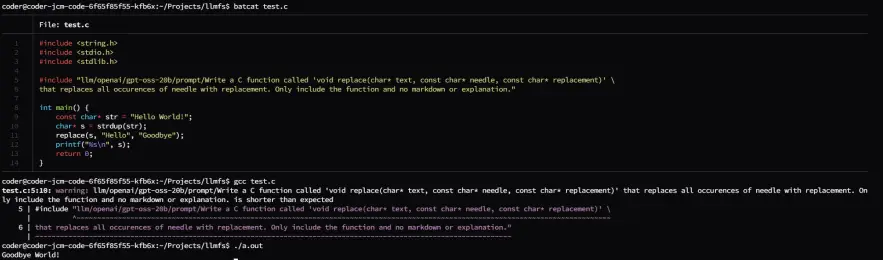
With this amazing new, never-before-seen technology, you can simply include prompts into your C(++) code using the well-known #include keyword:
#include <string.h>
#include <stdio.h>
#include <stdlib.h>

#include "llm/openai/gpt-oss-20b/prompt/Write a C function called 'void replace(char* text, const char* needle, const char* replacement)' \
that replaces all occurences of needle with replacement. Only include the function and no markdown or explanation."

int main() {
    const char* str = "Hello World!";
    char* s = strdup(str);
    replace(s, "Hello", "Goodbye");
    printf("%s\n", s);
    return 0;
}
Will your code compile? Maybe.
Will your code work? Who knows!
Will your code have the same behavior every time you compile it? Abso-fucking-lutely not!
Will your code burn through tons and tons of tokens? Abso-fucking-lutely yes, so you can finally hit those CEO-mandated token goals.
Can you see your code? No.
Does the compiler show your code if there are warnings or errors? No, it generates an entirely new version for diagnosis!
Is this real? Yes, it exists and runs on my machine!
Does it actually work? Sometimes!
#AI #LLM #FUSE3 #cursed #I-am-so-sorry-for-creating-this #include #include #include #include #include
 F4GRX Sébastien
 Chao-c'