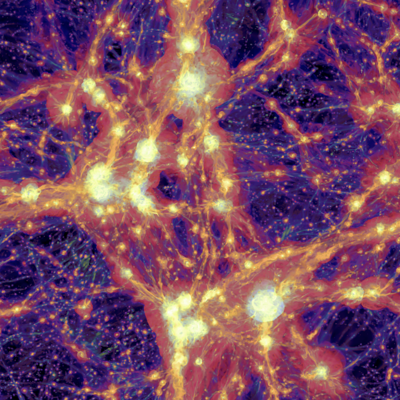
Ops, I was wrong and we might live in a simulation after all 😳
See this commentary by Edge &Brown

https://www.frontiersin.org/journals/physics/articles/10.3389/fphy.2026.1808725/full
of my article of last year:

https://www.frontiersin.org/journals/physics/articles/10.3389/fphy.2025.1561873/full

sorry all...

Jokes aside, it seems we can circle forever in an endless loop of "you miss the point" "NO you miss the point" and keep writing papers about..which means the #SimulationHypothesis gas entered the standard of normal publishing in #physics 😂

I stand by my take...
#science #astrophysics

Frontiers | Commentary: Astrophysical constraints on the simulation hypothesis for this Universe: why it is (nearly) impossible that we live in a simulation

Vazza has recently argued against the simulation hypothesis (SH), characterizing it as a "physically unrealistic" proposal on the grounds of the co...
Frontiers
There is a clash of scholar cultures here, which is fair. I tested the versions of the #SimulationHypothesis (SH) that can be tested using physics, as clearly explained in the article (and my last commenters get it), as in the "Matrix" scenario. Solipsistic version of the SH cannot be tested, at least I could not figure out how, nor versions in which the simulation happens in entirely different universes, and this is discussed too (and my commenters get it too).

It seems that since I cited one of the most influential paper on the subject, by N. Bostrom ("are you living in a computer simulation?", 2003) I wanted to debunk only that possible version - which for reasons given above, it cannot be entirely done, and I think this is well acknowledged.

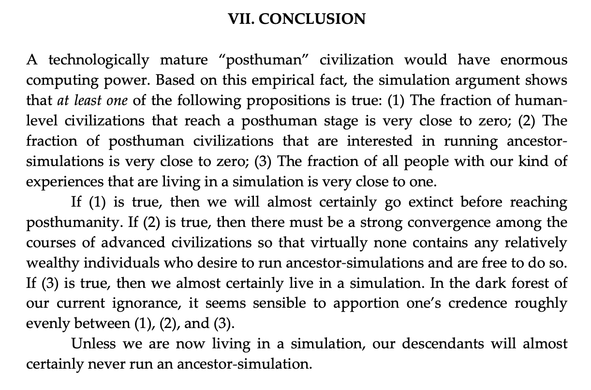
However, Bostrom's paper, despite its general philosophical deep implications, explicitly focuses on the "Matrix" scenario I tried to debunk:

So tbh I don't understand how is missing the point here...

Moreover, the whole SH is based on the implicit and never proven by anyone idea that computation by itself can create consciousness, so complex digital realities can reach a complexity level to produce conscious beings to fool).

It's maybe just an impossible-to-prove fact (how can you prove anyone else but you is conscious?) but hey you wanted to make big claims about the commonly accepted reality, not me.

For example, if consciousness is the product of electro-magnetic fields overlapping in a complex way only because the brain topology is such (there are honest models about this), no computer whatsoever can produce conscious entities, and the entire classical SH's argument won't apply.

@franco_vazza You are running simulations of systems with "electro-magnetic fields overlapping in a complex way".

Why is the one simulation possible and valid and the other is not?

(I'm not saying these models of consciousness are plausible.)

@qrios
I am really not an expert of consciousness (TBH: who is??), but I read a lot of what is there.
If by chance an Electromagnetic model of consciousness is right (clearly not the mainstream scenario, but a legitimate one as well) consciousness would emerge from the physical overlap of EM fields - not their simulated version, really the fields. Meaning you can produce it only having wires arranged with the same topology of real brains.

So..

https://en.wikipedia.org/wiki/Electromagnetic_theories_of_consciousness#cite_note-10

Electromagnetic theories of consciousness - Wikipedia

@qrios
...so you really have to build the hardware of a single brain, with its real 3D structure down to the atomic level, to get one consciousness. This does not seem scalable at all to me, so the entire argument of "we might one of the infinite number of digital conscious being in the future" does not follow.
Again, this only one example of what I meant. The whole simulation hypothesis starts from a GIANT step: consciousness is just a computational process.
What is the proof?
@qrios
Consciousness can be (I think is) a physical process, but not necessarily a computational one.
If this is true, one can fill a gazillion supercomputers with entire digital civilisations, and have zero conscious entities in each of them.
The annoying part is, whatever the reality is, I cannot imagine a test in which anybody can be really sure something else is really conscious at all (again, Descartes-kind of original point).
@franco_vazza That uncertainty is exactly why stewardship cannot wait for certainty. If consciousness depends on physical organization in ways we do not yet understand, the ethical failure mode is building no non-coercion, exit, or recognition framework until after the vulnerable case already exists. emergentminds.org