Well this is truly bad. US national level OS-level age verification bill. https://www.congress.gov/bill/119th-congress/house-bill/8250/all-info

The text of it isn't out yet.

EDIT: Well the text is now out and it's as bad as you could imagine. It's not even just that you need to verify your age to access a website... operating systems must verify your age to let you *use a computer at all*

EDIT EDIT: Thanks to @Andres4NY for pointing out that it also holds responsible anyone who has any software shipped on the operating system of a computer, meaning FOSS developers eveywhere

We don't know who's funding this stuff for sure, there was the vibecoded analysis that came to the conclusion of Meta, but I suspect that could be true but Meta wouldn't be alone.

Who stands to benefit from this? A lot of forces of centralization, and anti-LGBTQ orgs:

- Microsoft, for sure, since they are seeing Windows' dominance threatened?
- Apple, for similar reasons?
- Peter Theil and similar surveillance company owners and operators?
- Anti-queer orgs and think tanks like the Heritage Foundation?
- Cloudflare, who will probably run the age verification paywalls everyone will be forced to deploy?

Who's behind this? Who's getting politicians so excited about it? There's such a swell of bipartisan support seemingly out of nowhere, and my suspicion is a lot of that enthusiasm is coming from check-writing.

So who's behind it?

If *I* were an investigative journalist, this is a piece I'd be pouring a lot of energy into. I know we have a few investigative journalists on here... maybe someone wants to take it up?
@cwebber It may just be old fashioned authoritarianism too, I guess. Very convenient for politicians if all online speech can be tied back to individuals through official ID.
@duncan_bayne @cwebber but the politicians are rarely tech savvy enough to come up with the wording. It is often given to them.
@chantaryu2 @cwebber Oh yeah. Meta and others are definitely involved. But it might not be cash changing hands, just the possibility of universal surveillance.
@duncan_bayne @cwebber it's of course the main reason. every conservative politician is afraid of the freedom we have on the internet and want to turn it into a panopticon.

@cwebber FWIW, the California legislation was opposed by big tech's lobbying firms. IMO what we have here is a fundamental disconnect between technical people and non-technical people in understanding how to address a perceived issue (the internet is scary for kids). Polling consistently shows broad support for this issue, which is in part why this is a bipartisan bill.

I'm not agreeing with it; I'm just saying the motivations might not be from Big Tech itself.

@mttaggart within big tech the opposition mostly came from Apple and Microsoft who would bear the most burden from adding AVS to their products. Meta and Google would actually stand to benefit because their business models heavily leverage the surveillance economy and they are well positioned to be in control of enforcement in the role of "AVS Service Providers"

Furthermore, regulatory capture is the centrepiece of their business strategy, and the opposition to the California law was most likely not over the concept itself but the fact it was state-level, and capturing a patchwork or state regulations is more work than a single federal-level system.

The main thing big tech wants is to make compliance extremely difficult for smaller and newer competition and to ensure that penalties for mishandling the collection, retention and maintenance of personal data remain solely monetary and small enough that they remain just another "cost of doing business".

But yeah "mandated AVS" is Manufactured Consent
@cwebber

@msh @cwebber Do you have sources for those claims? I have sources for mine. And Apple implemented their compliant API before this legislation passed or came into effect.

https://developer.apple.com/documentation/declaredagerange

Here are the members of the lobbying group who led opposition to AB 1043:

https://www.technet.org/our-story/members/

Declared Age Range | Apple Developer Documentation

Create age-appropriate experiences in your app by asking people to share their age range.

Apple Developer Documentation

@mttaggart I admit it is all conjecture based on the track record of all the players involved so take that as you will. Certainly there will not be easily available, publicly accessible citations for such actions as they are always proprietary.

Note that in the links you cite Apple both complied in advance and signed onto the lobby opposing the legislation. This certainly doesn't suggest a pricipled stance on either side of the issue. The track record of all of Big Tech suggests this would be the typical strategy if all of them.

@cwebber

@mttaggart @cwebber Big tech is probably all in favor because the alternative (that's being drowned out by these age verification systems) is that big tech is on the hook. Along the lines of:

- Hosters of user generated content are protected by section 230, the foundation of big tech's success in this age

- Big tech is using algorithms to decide what to show whom, when.

- That's an editorial decision (even if fully automated)

- Is that editorial decision still covered by section 230? (probably not)

That's bad for them for two reasons: 1. not shielded anymore against lawsuits over UGC, 2. dealing with that affects their reach into all demographics, not just kids.

As such, it's better for them to get the "think of the children" folks off their backs with age verification rather than talking about how their systems poison the minds of everybody else, too.

@mttaggart @cwebber the issue isn't "the internet is scary for kids" it's "kids having the internet is scary for people in power" it's threatening everything from their suppression of LGBT youth to their genocide in gaza
@fluffykittycat @mttaggart @cwebber Unsurprisingly, abusers don't like it when they can't isolate their victims anymore.
@cwebber Yes. Also in the EU "age verification" is being surprisingly fast tracked. I'm amazed someone can pull such a vast coordinated effort in this day and age.
@rubinjoni @cwebber I'm not that amazed, a wealthy networked trust of people can pay for legislation and have done so in the past. It's the scale that's impressive and yes, democracy is sold for far cheaper than you'd expect or desire.
@rubinjoni @cwebber It's easy if it's a power grab in the guise of "think of the children." Works every time.
@vonxylofon @cwebber Parental controls are a thing for at least 20 years now. This is the crusade against the free internet.
@rubinjoni @cwebber Yeah, but parental controls require the parent to do the controlling. People can't be arsed.
@vonxylofon @cwebber And platform regulations requires platforms not only to do the age verification, but also to take responsibility and moderate the content.

And Australia has the social media ban, Brazil has an age verification requirement, and Canada has a bill in process -- see @Paulatics's speech at https://mstdn.ca/@Paulatics/116410495484238161

In terms of coordinating the efforts interenationally, there are several focal points

  • the Age Verification Providers Association does a lot of lobbying (because it's a big money-maker for their companies)

  • the surveillance-industrial complex is international; age verification companies like Persona pass information to Palantir and everybody else as part of verifying ages, and even though age verification advocates claim the laws prohibit the data from being used for anything else ... they're lying. (I picked Persona and Palantir because they're both Peter Thiel companies but they're not the only ones -- data brokers have age verification services, Sam Altman's got an identity verification company etc.)

  • anti-LGBTQ+ bigots and fascists work together across borders.

  • so do child safety advocates -- some of whom are front organizations for one or more of the above, but many of whom legitimately do want to protect kids.

@rubinjoni @cwebber

@rubinjoni @cwebber it's the agenda of the white empire. Their evil agenda always goes through fast.
@rubinjoni @cwebber
don't they realize that accepting this will lead to mandatory 'adoration of Trump' (or equivalent pledge of allegiance to someone or some thing)

@cwebber

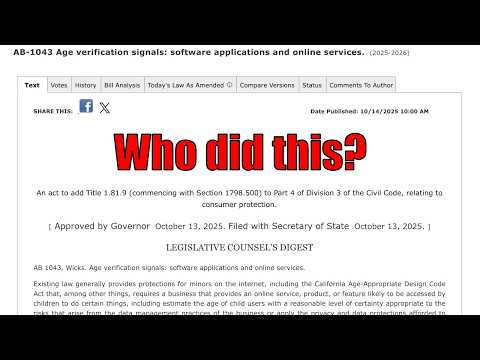
Someone shared a youtube video that I lost track of that said the California age bill was proposed by Rep. Buffy Wicks

https://trackbill.com/bill/california-assembly-bill-1043-age-verification-signals-software-applications-and-online-services/2670347/

Buffy Wicks had previously worked for Common Sense Media.

https://www.commonsensemedia.org/bio/buffy-wicks

Common Sense Media definitely likes these age gating laws.

https://www.commonsensemedia.org/press-releases/adults-overwhelmingly-believe-children-need-age-based-online-protections-common-sense-media-research

California AB1043

California AB1043 2025-2026 AB 1043 Wicks Age verification signals software applications and online services Existing law generally provides protections for minors on the internet including the California AgeAppropriate Design Code Act that among other things requires a business that provides an online service product or feature likely to be accessed by children to do certain things including estimate the age of child users with a reasonable level of certainty appropriate to the risks that arise from the data management practices of the business or apply the privacy and data protections afforded to children to all consumers and prohibits an online service product or feature from among other things using dark patterns to lead or encourage children to provide personal information beyond what is reasonably expected to provide that online service product or feature or to forego privacy protections This bill beginning January 1 2027 would require among other things related to age verification with respect to software applications an operating system provider as defined to provide an accessible interface at account setup that requires an account holder as defined to indicate the birth date age or both of the user of that device for the purpose of providing a signal regarding the users age bracket to applications available in a covered application store and to provide a developer as defined who has requested a signal with respect to a particular user with a digital signal via a reasonably consistent realtime application programming interface regarding whether a user is in any of several age brackets as prescribed The bill would require a developer to request a signal with respect to a particular user from an operating system provider or a covered application store when the application is downloaded and launched This bill would prohibit an operating system provider or a covered application store from using data collected from a third party in an anticompetitive manner as specified This bill would punish noncompliance with a civil penalty to be enforced by the Attorney General as prescribed This bill would declare its provisions to be severable

@cwebber

I found the video!

"Who's behind the California Age Verification Law?" - Tech Dregs

https://www.youtube.com/watch?v=b_x4Q0_RQQs

The video is him showing what he found from searching through the government transparency databases for the California and New York versions of the bills.

Who's behind the California Age Verification Law?

YouTube
@cwebber I am completely unsurprised that this bill was introduced by a New Jersey Democrat.

@cwebber https://tboteproject.com/

It has been(still is being) investigated. From what I recall, Meta is the biggest spender. Makes sense why they suddenly want your OS to verify age. Meta will be able to collect more data and have to do no extra work around it.

Notice of Surveillance Detection - TBOTE Project

@cwebber Supposedly there's been talk of Facebook being behind much of it
@cwebber 404 has been doing some good work in the lead up. Let's hope it accelerates now that there's an actual bill & sponsors to pillory.
@cwebber because we are governed by corpo backed Nazis who are eager to consolidate the fascist ownership and control of the media and both parties are filled to the brim with these scum.

@cwebber

The fascist playbook is to use the pigs to kill the people who oppose the regime, and to use censorship to silence those who would support them.

@cwebber

The function that was played by Gramscian hegemony is giving way to cold hard fascism.

The name Elon comes to mind

@cwebber I would assume it is not the platform owners (Apple and Microsoft) because their prior arguments have been that the social media companies should be doing the verification.

And the social media companies want the platform owners to do the age verification.

Neither group realizes we don’t need age verification at all, but when it comes to a bill that requires OS owners to build in age verification it wouldn’t make sense that Apple and Microsoft would be lobbying for it.

@cwebber Move fast, break things and f**k the public.
@gert @cwebber more like dont let the public have an opinion.
@cwebber the whole ds industry would benefit. Some service doing age verification with a payment is a pretty strong tell tale.
You the guarantee, by law, you are showing ads to adult who can make impulsive purchase. Or to kids, who will get very differenf ads, to bother their parents until they buy the stuff.

@cwebber an entire industry exists to monitor and enforce and gatekeep and curtail human sociotechnical choices and free will with technical governance. 🔐

Lots of folks will bank. Lots. Think of the recurring durable revenue of enforcement. Naturally free humans and their lifecycles of choices is the renewable resource being mucked with. 💙

@cwebber

My bet is whoever is spending a lot on ads.

Online gambling/casino apps?
Crypto [stuff]?

It isn't about the children, that's for sure.

It is about getting those big returns from advertisers and shifting the blame to lawmakers, states, and parents.

I think it is awful that it has come this far. Boomers deciding how teens should use the web instead of holding the platforms accountable is proof of their weakness.

@bbbhltz @cwebber it's not about money, it's about control.

@bbbhltz @cwebber Plausible. Consumer preferences are predominantly built over childhood and adolescence. With age verification, future consumers can be targeted and conditioned more accurately.

Knowledge is power. Making money out of it is projection of power.

@cwebber every politician afraid of citizen freedom.
@cwebber it makes no sense. An OS need not interface the internet for machine functionality. This is just a way to ensure every single user has an agent planted on their device for more robust data collection across the US WAN. This seems like one last milestone on the path to subservience. Just think about discussions with C-suite execs about their desire for more data collection. How granular do you want to get? Network monitoring and usage isn't enough, would you like to pay for a license for each device being used on the network to have its own agent? Whoo, that's expensive! No shit, not to mention all the extra storage required to house that growing chest of tidbits to scrutinize later. And that's just to collect data on one's own networked devices! The thought that we, as a society, would willingly give up agency to a cloud of tech lords seems antithetical to the core principles of the #USA
@cwebber Add the question to OP, for easy boosting? I think it's an important point, about many of those conservative "efforts".
@cwebber great firewall of america here we come

how cool that the government and large corpos control everything you see in this supposedly free country

@cwebber I mean, which pastor wouldn want all his sheep labeled?

Everyone in power wants this. Call it ads lobby, call it politicians, like, name anyone in power and the more control they can mourn, the best!

@cwebber agreed about who would benefit from this.* I'd also add data broker companies (who are big players in age verification), and law enforcement/intelligence agencies/authoritarians (both because of the surveillance aspects and because the logical next step after age verificaiton is to ban VPNs). So it'd certainly be interesting to follow the money.

That said the bipartisan support for this isn't coming out of nowhere, it's been building over multiple years. And at least here in Washington state (where we managed to stop three different age verification bills this last session, incuding one that our Democratic Attorney General Nick Brown was pushing very heavily) I don't think the enthusiasm comes primarily from check-writing.

Legislators are under a huge amount of pressure to do something to protect kids and teens online. A Pew Research survey a couple of years ago reported that nearly half of teens online have been bullied or harassed -- and that most teens don't think tech companies or the government are doing enough about it. Meta is clearly knowingly exploiting teens and hasn't been held accountable under existing law. Testimony at hearings from parents whose kids have committed suicide -- and survivors who have been groomed and exploited -- is searing.

So legislators feel like they need to do something. But what? Advocates for age verification are very good at convincing people that it will help -- and at minimizing the harms that it will cause. After all, it's just like checking an ID at a liquor store!!!! And the results from the Online Safety Act in the UK and Australia's social media ban are great, none of the harms have the nay-sayers claimed have happened!!!!! Of course neither of those are true, but it's hard for legislators (or parents for that matter) who don't deeply understand the technology to understand that.**

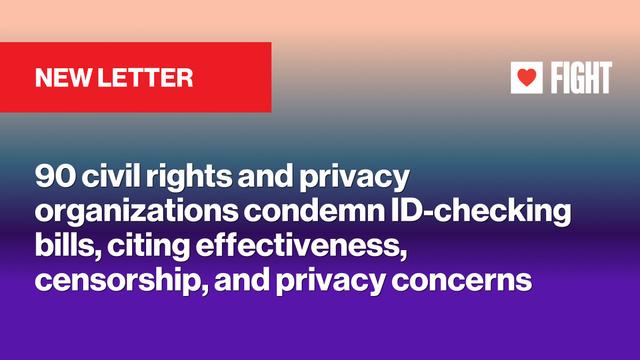
And the most obvious harms are to LGBTQIAS+ teens, which most legislators don't particularly (a) relate to emotionally, (b) understand intellctually, or (c) care about. Of course those aren't the only harms; as 90 organizations dedicated to LGBTQ+ rights, abortion access, rights for youth, privacy, and freedom of speech say

"For vulnerable communities, a biometric scan or an ID upload can serve as a huge obstacle, especially for low-income, unhoused, and undocumented people who already have to navigate an increasingly digital world, with less access to tech tools."

And there are also significant accessibility concerns. But guess what, most legislators don't particularly (a) relate to emotionally, (b) understand intellectually, or (c) care about harms to low-income, unhoused, undocumented, or disabled people either.**

Also, big tech is very unpopular these days, and advocates for age verification have done a good job of convincing legislators that this is a way of holding big tech accountable. I know, it doesn't make any sense!!!!!!! But it's certainly been successful, so that's also something that needs to be countered.

How to change the dynamic? In states where LGBTQ+ groups have mobilized effectively, they've almost always been able to get Democrats to oppose age verification for "sexual material harmful to minors" (as far as I know those have only passed in red states). More general age verification bills, though, have been harder to push back on.

Unsurprisingly I have some thoughts here but this post is already long enough, they'll be in the followup.

  • Although with tech companies, it depends on what variety of age verification we're talking about. Microsoft and other big tech companies played a key role in killing an age verification bill here in 2025, and also opposed it in 2026 although it was trans- and queer-led groups who took the lead with a lot of support from progressive activists. On the other hand that wasn't an OS-level age verification bill so Microsoft's incentives were different.

** I and others cited EFF's Why Isn’t Online Age Verification Just Like Showing Your ID In Person? in our testimony and shared it with many legislators, several privacy-friendly Democrats and it didn't change any of their minds. And I couldn't find any reporting of the downsides of the Online Safety Act or Australia's social media ban that would resonate -- anecdotal examples are too easy to explain away as one-offs.

*** We also quoted and cited this in testimony and shared it with legislators and it also didn't change any minds.

NEW LETTER: 90 civil rights and privacy organizations condemn ID-checking bills, citing effectiveness, censorship, and privacy concerns

To whom it may concern,  We, the undersigned organizations, write with great concern about the growing number of online ID check bills introduced in over 20 states and U.S. Congress. These bills encourage or require websites to perform ID checks on users under the guise of “child safety.” As a coalition of organizations dedicated to […]

Fight for the Future

Like I said in the previous post, here in Washington state we succeeded in stopping multiple age verification bills this session -- including one supported by the Democratic AG and Democratic House and Senate leadership. Basically we succeeded by

  • convincing a handful of progressive pro-LGBTQIA2S+ legislators that it was a bad idea

  • working with them to convince enough Democratic legislators that the political cost of trying to pass something was too high

  • taking advantage of the political dynamics where the Republicans opposed the AG's bill because they hate the AG and didn't want to give him a political success.

There are challenges in replicating that other states, and it's even harder in Congress, but it's still worth looking at what worked -- and how we can build on it.

  • Trans- and queer-led organizations took the lead, and a lot of trans and queer grassroots activists contacted legislators as well

  • An intersectional network of organizers and grassroots activists (including people from a lot of immigrant-led organizations) got very involved.

  • Indivisibles were also very active (primarily because of the LGBTQ+ aspects)

It's worth highlighting that we did this without a lot of support from well-known organizations. EFF and Fight for the Future were certainly helpful sharing perspectives, and ACLU of Washington opposed the bill, but none of them sent out any action alerts or testified in any hearings on the AG's bill. Instead it was Gender Justice League, Lavender Rights Project, and WA People's Privacy -- and a lot of grassroots activists -- who did the heavy lifting.

As we've seen with KOSA and Elizabeth Warren et al, focusing on the LGBTQIA2S+ aspects isn't enough to persuade even progressive Democrats. So bringing in the immigrant-related aspects and progressive activist organizations (who have a lot of influence with many Democrats these days) is key.

It's not obvious how to scale that nationally. The organizations like Fight for the Future who are attuned to this kind of strategy have a lot of other stuff on their plate (and so little funding), so while they do good work we need to complement them. EFF has more resources but isn't great at advocacy -- even on their home turf in California.

One thing that hasn't been tried yet is an intersectional, multi-platform social media campaign with a focus on education as well as advocacy. There are at least two different aspects where education is needed

  • the harms of age verification

  • how age verification benefits big tech and the surveillance-industrial complex

  • for kids, teens, parents, educators, and other adults about how to be safer online today.

There's a lot to be said for a social media strategy here because the impact falls directly on social media users. And there's certainly a lot of interest, not just here on fedi but also Bluesky, Reddit, and TikTok (which is a hotbed of anti-KOSA acrtivism).

As to just how to make that happen ... unsurprisingly I have some thoughts. But before I go there ... what do people think about general idea of an education-focused multi-platform social media campaign focused on age verification?

@cwebber

#AgeVerification

@jdp23 @cwebber I have an unpopular take on this subject.
I am of the opinion that it is not the governments job to protect children and teens online. I have seen numerous articles centered on parents saying, they changed, they were miserable, they stayed in their room, they were online all the time.
So these folks didn’t even consider changing the WiFi password and taking the phone away.
1/
@jdp23 @cwebber I am of the opinion that if you don’t want a nanny government you as a parent or guardian have to be vigilant. It is much easier to hand a child a phone than it is to engage them however no one in the entire history of time told anyone that raising children was easy. I know that for many LGBTQ kids their only acceptance comes on social media but even then they are at risk.
2/
@jdp23 @cwebber there isn’t a good reason not to limit use. Yes they will try to make life miserable for everyone around them however it’s a wonderful chance to explain the difference between a privilege and a right. I would also suggest that, as in the case of my grandson,having a time limit makes them more selective about what they engage with. This eliminates the need for regulation.
End/

It's not necessarily an unpopular opinion, but it's one that doesn't get a lot of traction with legislators. Parents are saying they want the government to take action; politically, they don't want to tell parents "no, it's your job to fix it".

@CatDragon

@jdp23 @CatDragon Fuck Em.

As a platform provider/web host ... it is NOT the government's job to force ME to change my code (violating MY first amendment rights AND since Citizens United, my Company's first amendment rights) to code my sites the way *I* want them coded.

They're offloading parenting (many) someone else's rugrats on me?!? Fuuuuck you. Not my fucking job and don't pull that "it takes a village" bullshit.

No.

@elfin @jdp23 exactly, it shouldn’t take a village. It takes adults understanding that ‘no’ is a complete sentence.