…I said yesterday I would do this, so here goes. Follow or mute or ignore #Oil201.

As a follow-on to #Oil101 above, the following 27 posts are the words of Nate Hagens from the 14 minutes of https://www.thegreatsimplification.com/frankly-original/136-oil-201
Oil 201: What Happens When the Oil Stops Flowing - The Great Simplification

This week’s Frankly is the second in a three-part series on the role oil plays in modern civilization, prompted by the recent flow disruptions and geopolitical conflict surrounding the Strait of Hormuz.

The Great Simplification

#Oil201: 1/27

“In the last part [#Oil101], we explored what oil is and how it’s effectively acting as invisible fossil pixie dust through many of our lives.

But the parallel associated risk is that we have built everything: our institutions, governments, stories and expectations about the future on this cheap energy input. And now its scale and affordability is no longer guaranteed…

#Oil201: 2/27

…“When energy prices spike, entire systems can become fragile and often break because oil’s been so cheap, pretty consistently. The economic logic has been to imagine and then engineer thousands of mechanical processes around that cheapness.

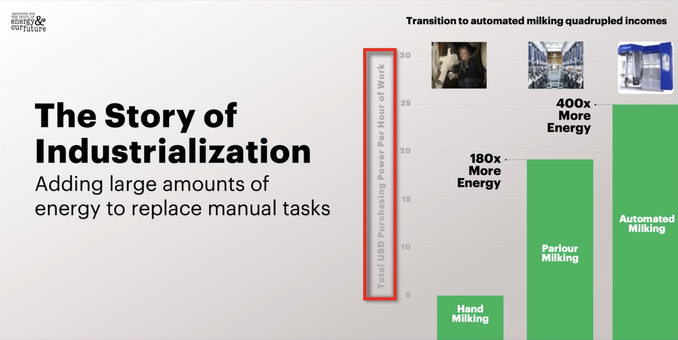
The industrial evolution is really the story of adding hundreds or thousands of units of fossil energy to tasks that humans used to do by hand…

#Oil201: 3/27

…“A dairy farmer milking cows by hand was limited to a few dozen animals. Modern industrial dairy applies enormous quantities of diesel, electricity, refrigeration, and transport to the same basic task producing. Orders of magnitude more milk at a much lower price and higher profits, but importantly at a very different cost sensitivity.

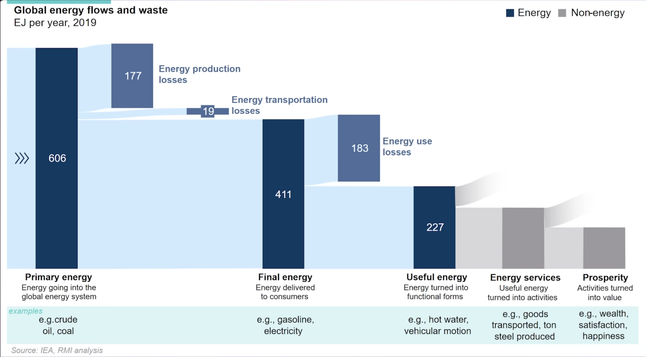
The energy payoff of processes like this is terrible in pure physics and efficiency terms, because lots of energy is wasted…

#Oil201: 4/27

…“However, the *financial* payoff has been enormous because the primary input to the process is energy that effectively costs almost nothing.

This is why energy price spikes hit so hard in the global economy.

Our processes around the world were designed around cheap energy, especially oil…

#Oil201: 5/27

…“Even at $500 a barrel oil would still be a remarkable gift for the work it performs for us. But our current industrial system could not function at anything close to those prices because every margin, every business model, every supply chain was calibrated to cheap, stable energy inputs.

The margins were always thin and when cheap energy turns expensive, the margin disappears and often turns negative…

#Oil201: 6/27

…“And nowhere would this be more consequential than in the thing we all do three times a day…

Eat.

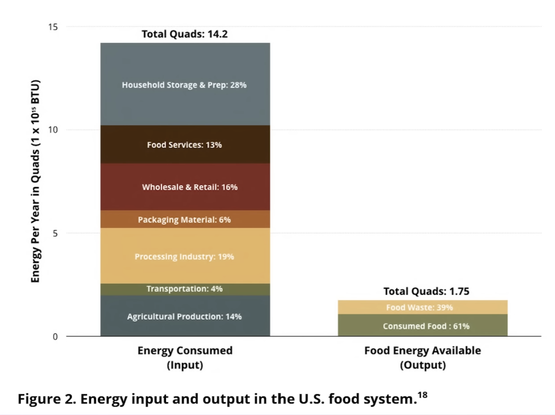
To some of you, this might sound like an exaggeration, but when we sit down for a meal, what most of us are really eating is processed fossil fuels.

Contrary to all of human history, our food system now runs in energy deficit and a huge one at that.

Roughly 10 calories of fossil hydrocarbons go into every one calorie of food on your plate…

#Oil201: 7/27

…“The tractors run on diesel. The fertilizer comes from natural gas, the pesticides from petrochemicals, and the food is packaged and shipped on trucks and container ships and kept cold the entire way. And here’s the truly staggering part…

Roughly half the nitrogen in your body today carries a chemical signature from the Haber Bosch process, which makes synthetic fertilizer from natural gas. That single industrial process is what allows us to feed about 4bn of our 8 bn humans…

#Oil201: 8/27

…“And beyond food, our clean water pumping, treating, desalinating and distributing also all requires fossil fuel inputs.

So when people say oil and gas, most think of our cars. We should also be thinking of groceries and dinner.

But even food is only one part of the story. Oil is woven into virtually everything we touch…

#Oil201: 9/27

…“Only about 40% of a barrel of oil becomes gasoline. The rest is diesel, jet fuel, heating oil, bunker fuel, asphalt, and feed stock for roughly 6,000 other products like medicines, plastics, surgical devices, synthetic clothing, electronics, contact lenses, tents, kayaks, the interior of our cars, and the list goes on.

The assumption that electric cars would eliminate our need for oil misses the overwhelming majority of what non-gasoline oil actually does…

#Oil201: 10/27

…“And these products are woven into global supply chains now of extraordinary complexity. Tiny invisible components. Each with its own petrochemical ancestry, each manufactured somewhere, shipped somewhere else, assembled somewhere else, and only then is it shipped to the stores and to us.

When people talk about supply chain disruptions, what they usually mean at the root is energy and material disruptions, which brings us to why geography is destiny…

#Oil201: 11/27

…“The United States sits on ancient ocean beds once filled with water and life millions of years ago, ultimately resulting in immense reservoirs of oil and gas, which is a primary reason why the USA has produced and consumed more oil than any country in history.

But remaining ‘conventional’ reserves are mostly concentrated elsewhere.

Around 60% of the world’s remaining conventional oil sits inside a 600 mile triangle in southwest Asia, AKA, the Middle East…

#Oil201: 12/27

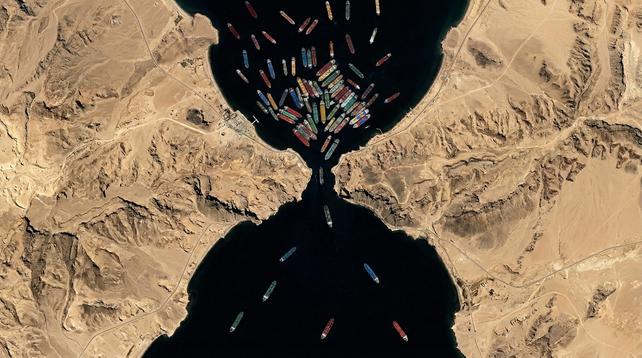
…“Much of [that 60%], around 20% of global oil supply – which is around 40% of what’s actually available for purchase internationally – passes through the narrow strait of Hormuz, which has become the center of the world’s attention for the last few weeks.

And as we’re quickly realizing there are no alternative routes at anything close to that capacity, and now we’re seeing a war for its control…

#Oil201: 13/27

…“A side note here. People like to blame Exxon and Shell and the like for both oil price spikes and climate change, and so on.

The reality is that only about 12% of global oil reserves belong to publicly traded oil companies.

The other 88% belong to national oil companies like Saudi Aramco, Rosneft, and the national companies of Iran, Iraq, China and Venezuela.

So swapping out Exxon’s executive for Greenpeace leadership would change almost nothing about global oil production…

#Oil201: 14/27

…“Oil is a story of nations and geology, not corporations. So the oil is concentrated in a few places, many of which are the center nodes of global conflict today.

But there’s a deeper problem.

Earth’s crude oil isn’t running out – well, technically it’s always been running out – but today’s availability and low priced oil is running out faster than most people and our financial system realizes…

#Oil201: 15/27

…“Most people are unaware of the depletion rate at which we’re drawing down and drying up oil fields and wells.

It’s accelerating.

Especially in the United States, conventional oil globally has been on a production plateau for about 15 years. Exxon itself shows existing global production will decline to 10 to 20% of its current level if there’s no new drilling or tertiary extraction…

#Oil201: 16/27

…“The growth in global oil of the last decade or so is mostly from US shale, but shale is a fundamentally different beast.

We widened the straw with fracking technology, so it looks like plenty is flowing, but we have to drill more.

We have to drill deeper and faster just to keep production flat, and that brings us so much closer to the eventual slurping sound from the straw, because shale oil is found in the source rock, which is where all the other oil migrated from…

#Oil201: 17/27

…“and after that, there’s nothing left.

Okay. Some of you might be thinking that I’ve been ignoring other forms of energy throughout this brief analysis: hydro, nuclear, and especially solar and wind, but there’s a reason substitutes can’t simply step in.

Energy quality matters almost as much as energy quantity.

Oil is liquid at room temperature, energy dense, portable, and storable. And these qualities are what made modern civilization possible…

#Oil201: 18/27

…“Replacing oil isn’t a matter of just matching kilowatt hours from another source.

Our entire mining, shipping, rail, trucking, and personal transport system runs on oil.

And despite the headlines about solar and electric vehicles, that is likely not going to change.

But here’s a key distinction.

Energy is the total amount of work available. Power is the rate at which you get that energy per unit of time…

#Oil201: 19/27

…“Biological creatures on Earth do not optimize for energy. We optimize for power.

Organisms and economies that get more energy sooner out-compete those that don’t.

Oil and its products – like gasoline, diesel, heating oil and jet fuel – contain unbelievable power when burned. They give us ginormous work *fast*, and importantly, whenever and wherever we want it…

#Oil201: 20/27

…“Wind and solar deliver energy intermittently when the sun shines and the wind blows. Sometimes giving an enormous power burst, but sometimes giving us nothing, especially depending on your location.

Nuclear power can give us a constant stream of high power, but it’s difficult to ramp up and down and requires connection to a larger grid and is capital intensive and costly…

#Oil201: 21/27

…“Alternative energy sources will play a role in the human energy portfolio, but our current system was built around the qualities of oil.

These time, land and material dimensions are almost never discussed, but they’re some of the main reasons that direct substitution is so much harder than people assume, and why there are now warships in the Persian Gulf…

#Oil201: 22/27

…“So if oil is this hard to replace, what is this energy transition?

We keep hearing about solar panels and wind turbines but they do not reproduce themselves. The sun and the wind are renewable, but the technology we use to harness them is best labeled ‘rebuildable’, not renewable.

Because they require massive inputs of material and energy and complexity to build, and they need to be rebuilt every 20 or 30 years…

#Oil201: 23/27

…“Most alternative energy tech only produces electricity, which is very important, but represents only a fraction of what fossil hydrocarbons do in the world – currently around 20%.

Diesel for shipping, jet fuel, aviation, petrochemical, feedstocks, none of these have clean substitutes at scale.

But beyond these limits, there’s a deeper pattern. The current popular stories of an energy transition are built upon a myth, a false narrative about the history of humans and energy…

#Oil201: 24/27

…“The reality is we have never in human history fully transitioned off an energy source. We always *add*.

There’s a name for this pattern. It’s based on Jevon’s paradox.

When we find a more efficient way to use a resource, we don’t use less of it. We use *more*.

Coal efficient steam engines didn’t reduce coal consumption. They made coal available for more things, so demand exploded…

#Oil201: 25/27

…“The same pattern has played out with almost every energy efficiency gain since.

- LED light bulbs use less electricity per bulb, so we put them everywhere.
- Fuel efficient engines made driving cheaper, so we drove more and built suburbs further out.

Paradoxically, in the same way that you will spend most of your pay raise, energy efficiency doesn’t shrink our demand.

It expands the bounds of what we can extract. It actually *feeds* our demand…

#Oil201: 26/27

…“This is why technological efficiency alone cannot solve an energy and resource problem.

So the deeper question is about what happens when there might be less energy overall.

And here’s where we are:

- Cheap energy builds complex systems.
- Complex systems depend on cheap energy.
- When energy gets tight, complexity unravels.
- Current alternatives cannot replace what cheap oil does *at the scale and speed* that our current system requires…

#Oil201: 27/27

…“In the final part of this trilogy, I’ll explain what all this means for money, for civilization, and for what comes next for us as individuals and societies living through the down slope of…

the carbon pulse.”

- - -

Transcription ends for

https://www.thegreatsimplification.com/frankly-original/136-oil-201
Oil 201: What Happens When the Oil Stops Flowing - The Great Simplification

This week’s Frankly is the second in a three-part series on the role oil plays in modern civilization, prompted by the recent flow disruptions and geopolitical conflict surrounding the Strait of Hormuz.

The Great Simplification

#Oil201 postscript.

When I posted the transcript of #Oil101 yesterday, part 3 was not yet out, so I hadn’t listened to it.

But I since have.

It’s longer again than its preceding 2 parts, and it doesn’t have answers. It seeks to clarify the predicament we are in, in the hope that we might throw off our delusions of *more*.

Where it leaves us is unavoidably really hard work. And I’m not yet decided if I will add #Oil301 to this thread

Well, I’ve decided now not to do for #Oil301 what I did today for #Oil201 and yesterday for #Oil101.

I’ll probably post some excerpts from Nate’s part 3, but I’ll draw more from https://lifepod.transistor.fm/episodes/s01e00-an-introduction-to-lifepod/transcript because how Adam is framing our moment is more enabling, more agency affirming, more practical 💚

Lifepod | Transcript: S01e00 An introduction to Lifepod

Host Adam Greenfield welcomes you to Lifepod with an overview of the show’s themes and central concerns, rooted in his book Lifehouse: Taking Care of Ourselves in a World On Fire (Verso, 2024). In ...

Lifepod

…Coming back to this thread with just a few excerpts from #Oil301’s 2,000 words or so. The whole of it would make another 27 posts, but I’ll be taking a detour and ending up in a better place.

But first, to tie this in with the above…

From Nate Hagens:
The World After Cheap Energy
https://www.thegreatsimplification.com/frankly-original/137-oil-301

#Oil301: 1/n

“This is the third and final part of this series, briefly covering the basics of oil. From what it is, to how we’ve built our civilization around it and why it can’t last. And now in this one, we’ll look to the future of our systems in a world with less. Everything I’ve described is part of a single phenomenon for a brief window in geologic time…

Oil 301: The World After Cheap Energy - The Great Simplification

Today’s Frankly is the final installment in a three-part series on the role oil plays in modern civilization, prompted by the recent flow disruptions and geopolitical conflict surrounding the Strait of Hormuz.

The Great Simplification

#Oil301: 2/n

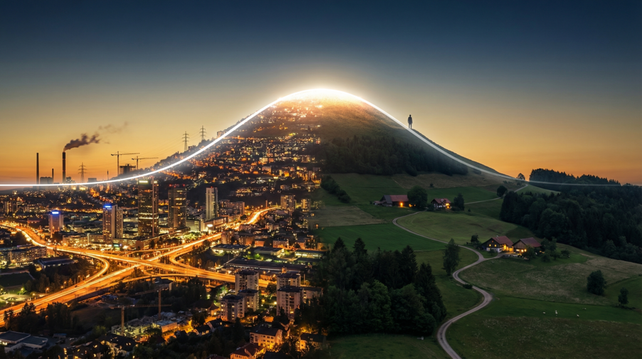
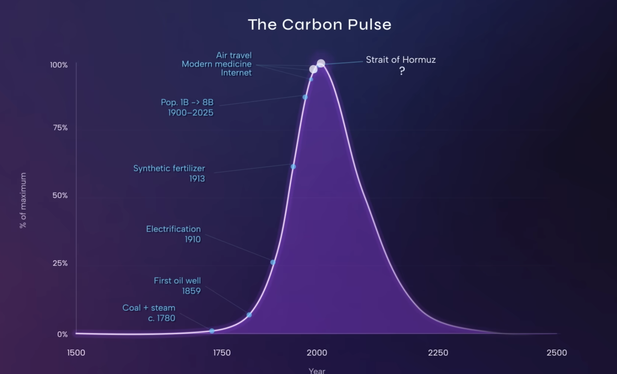
…“Humans have discovered, accessed and burned through an extraordinary one-time inheritance of ancient stored sunlight. I call this…

the carbon pulse…

a bell curve stretched out over around 300 years.

We’re somewhere near the peak right now, and what’s unfolding in the Strait of Hormuz may prove to be a marker of that peak or an accelerant past it on the way up…

#Oil301: 3/n

…“The carbon pulse gave us abundant cheap energy to power modern civilization population growth from 1 billion to 8 billion – industrial agriculture, global supply chains, modern medicine, electrification, the internet, air travel, and the complexity of modern governance.

The human economy measured by people times, goods and services per person is now 1,000 times bigger than 500 years ago…

#Oil301: 4/n

…“This is the lens that’s missing from virtually all mainstream economic and political discussions and analysis.

We are making long-term plans, taking on long-term debts, building long-term institutions and financial systems, all based on the assumption that the energy and material largesse at the top of the carbon pulse is a permanent plateau.

It isn’t.

It goes up and it will come down, likely soon…

#Oil301: 5/n

…“The down slope has implications for every dimension of civilization, but especially our economic system. The economy runs on energy and material flows full stop.

We think it runs on money, but money is just a marker, a claim on the real physical work. And when money is created, it does so without referencing how much oil or gas or forests or copper or orangutans or butterflies exist in the world…

#Oil301: 6/n

…“As events in the world cause oil to get more expensive or less available, or both, we will respond out of necessity by governments and central banks, offering guarantees, writing checks, printing more money.

Yes, we can and will print money.
But we cannot print energy.

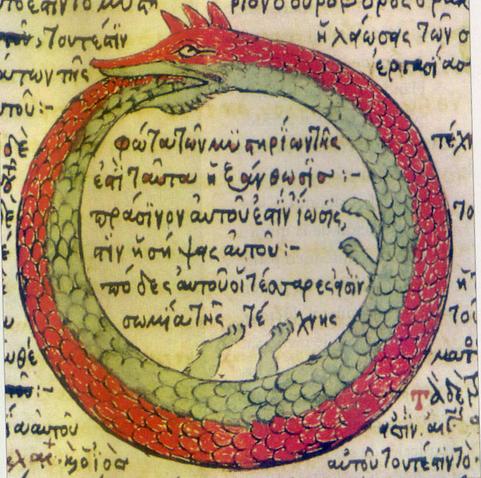
We can only extract it faster, and extracting it faster requires us to print more money. It’s kind of a biophysical Ouroboros.

https://en.wikipedia.org/wiki/Ouroboros

Ouroboros - Wikipedia

#Oil301: 7/n

…“The current growth-based financial system and its Byzantine array of financial claims is all predicated on having more ‘affordable’ energy every year, and the entire structure of debt, interest and repayment assumes a future that is bigger and materially richer than today.

When the energy supply contracts, those monetary claims don’t just take a time out. They crack, along with the associated bonds and currencies and markets…

#Oil301: 8/n

…“We’ve been drawing down the principal of the main input to our economies, but our universities, stories, institutions and media treat it as if it were interest.

The geology of shale has punishing rapid depletion, constant drilling just to stay *flat*.

What’s less discussed is that shale is as much a financial phenomenon as a geological one.

Cheap money made expensive oil temporarily viable. And when capital tightens or interest rates rise, the financial scaffolding collapses”

…Ok. So far, so bleak.

The rest of #Oil301 is mostly just ramming home the point about *where we are* without actually getting into “what comes after”.

Crucially, it’s that last bit that @adamgreenfield narrates so beautifully on his recently launched Lifepod: https://lifepod.transistor.fm/episodes/s01e00-an-introduction-to-lifepod/transcript

Lifepod | Transcript: S01e00 An introduction to Lifepod

Host Adam Greenfield welcomes you to Lifepod with an overview of the show’s themes and central concerns, rooted in his book Lifehouse: Taking Care of Ourselves in a World On Fire (Verso, 2024). In ...

Lifepod

…Adam addresses the bleak too, but since we’ve already gone there above, I’ll skip to where he opens the path ahead instead of cognitively closing it:

Adam 1/n:

“Maybe we could learn to think of this time of climate-system breakdown not as something that happens to us, but as something we can actively intervene in, and for the better.”

…These are excerpts, not read-ons.

Adam 2/n:

“What’s harder to imagine is making shelter against the hard times that’s capacious enough for everyone who needs it. That chooses trust in our own strength over passivity, invitationality over exclusion, and love over fear.

That both calls on and nurtures qualities in us we’d almost given up any dream of developing, and maybe even tutors us in joys we’d never thought to claim as our own.”

…Adam 3/n:

“The answer I keep coming up with — and maybe, if you’re here, that’s your answer too — is… speaking from experience, I at least don’t think the state is terribly likely to be there for us, in the way we need it, in this time of #longEmergency.

And that leaves us, and whatever care and shelter and power we’re able to make for ourselves, together.”

…Adam 4/n:

“If we want to survive the hard times to come together, we need to stop investing our faith and energy in institutions that are demonstrably failing us.

We need to admit that we’ve reached a moment at which we can no longer afford to wait for some external process to save us, whether mechanism, movement or deus ex machina.

What we need, in other words, is to get beyond hope. We’ve got to stop waiting for someone else to do something and start doing for ourselves.”

…Adam 5/n, following an account of self-organising New Yorkers after Superstorm Sandy:

“What if organizing ourselves in this way also helps to repair other, more chronic insults to our well-­being – the overwhelming sense of powerlessness we so often contend with, the dread of the future we barely manage to tamp down, even the damage inflicted upon us by the ordinary disasters of everyday late-capitalist life?…

…Adam 6/n:

“What if the experience of coming to the aid of our community affirms us in ways we might not have dared to ask for, or even imagined possible?”

What if “we are the ones we’ve been waiting for”?

This gives you a taster of why I encourage you to listen to @adamgreenfield and the folks he’s talking with.

A very good place to start, and for this thread of over 50 posts of transcribed words to wind down:
https://lifepod.transistor.fm/episodes/s01e00-an-introduction-to-lifepod

Lifepod | Transcript: S01e00 An introduction to Lifepod

Host Adam Greenfield welcomes you to Lifepod with an overview of the show’s themes and central concerns, rooted in his book Lifehouse: Taking Care of Ourselves in a World On Fire (Verso, 2024). In ...

Lifepod