Hi! Can we entertain each other with our fun stories about the oldest or weirdest tech we've come across?

Please boost for science or cows or something. TELL US YOUR COOL STORY!

edit: as suggested, adding the hashtag #WeirdOldTech to keep this stuff going a bit (hint: you can follow hashtags).

#technology #WeirdOldTech

@Pepijn

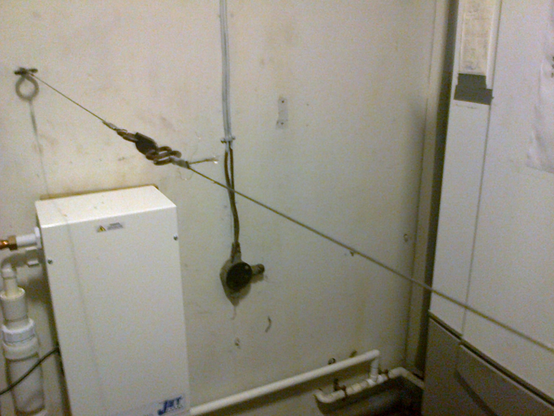
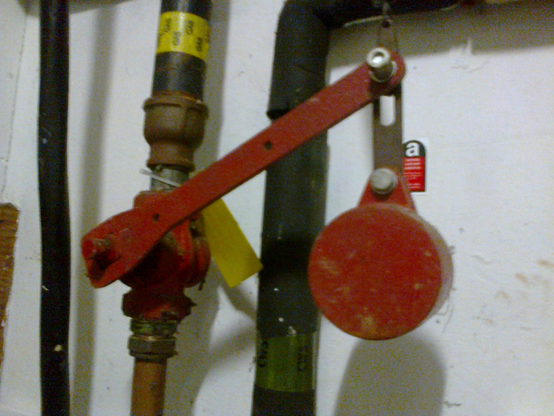
When I worked on maintenance team for senior homes, we had this in one of the boiler rooms (I am short and the wire is exactly at neck height for me - so I always had to beware of it.

But there is good reason for it being present, there's a lead link at one end and a pulley and weight ; if a fire starts the lead would melt, and then the weight pulls down the lever and shuts off the gas supply to the building (to prevent gas feeding the blaze)

@vfrmedia @Pepijn Simple, yet clever - and fail proof. I wonder why they hang it at neck height, because in case of fire the temperature would be the highest closer to ceiling. But maybe the purpose was a natural selection of careless maintenance operators ;)

@kravietz @Pepijn

maybe because you *have* to keep an eye on it, and it encourages maintenance staff to check that its usable (and not block the wire with any items).

The same area is shared with the 400V three phase incoming service cable (which isn't as common nowadays - instead the gas and electricity supplies are in different parts of the building)

@vfrmedia Interesting! And thanks for the photos as well!
I love it when complex "if and then" situations are solved down to a solution that is as minimal as that.
@Pepijn @vfrmedia A similarily clever mechanism in the railways comes to my mind: electric trains with overhead line equipment (OLE) use pantographs (you know, these metal rod constructions at the roof of the train) to collect current from the overhead line. The part that actually touches the overhead line is called contact strip, is made out of graphite and is very much a wear part.
@Pepijn @vfrmedia The contact strip continually looses material and thus at a certain point there is the risk that it breaks, wreaking havoc with the OLE installation - the pantograph is pressed towards the overhead line with considerable force to ensure optimal contact with the wire because otherwise electric arcs can form which damage both the line and the contact strip.
@Pepijn @vfrmedia To avoid destruction of OLE due to a failing contact strip, the contact strip is actually hollow and the mechanism keeping the pantograph streched up is working with pressurised air passing through the contact strip. When the contact strip breaks, pressure is lost and the pantograph is automatically lowered.

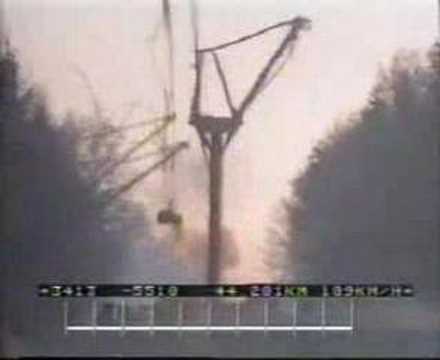
@Pepijn @vfrmedia What can happen to your OLE installation if you don't have such a system in place can be seen in this video:
https://www.youtube.com/watch?v=9UiukIch79g

(Link found on https://de.wikipedia.org/wiki/Schleifleiste )

Athína Train

YouTube
@vfrmedia @Pepijn in this era of electronic sensors and switch gadgetry I'm always impressed to see the best solution is usually the simplest. A really clever design.