Solar panels are creating an unexpected effect by forming rainfall clouds and thriving oases in the middle of the desert

#Erneuerbare #Renewable #GoodNews
ecoportal.net/en/solar-panels-…

The article published in Science has detailed how massive solar arrays in the Sahara Desert have started to trigger increased rainfall and vegetation growth.

They drastically lower the temperature around the sand that they sit on, effectively “greening” the desert. As the warm air around the panels has nowhere else to go but up, they naturally form massive rainclouds in a part of the world known for its dryness.


Solar panels are creating an unexpected effect by forming rainfall clouds and thriving oases in the middle of the desert

A recent study has found an unexpected benefit from the undisputed king of the renewable energy sector as solar panels are creating rain clouds in the desert.

ecoportal.net
@hoergen anyone have a link to the Science article? Couldn’t find it here

@rubbel @tsyum @hoergen

Thanks for this, I waited to boost until it was a source I knew was reliable.

@lucybeahere @rubbel @tsyum @hoergen the science article only talk about computer model, not real effect at all. The AI generated text is completely misleading.

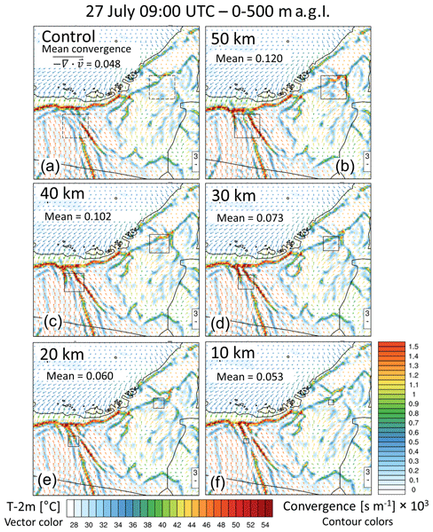
And the source linked article in science https://esd.copernicus.org/articles/15/109/2024/ is also about model, not actual observed effects

Scaling artificial heat islands to enhance precipitation in the United Arab Emirates

Abstract. Potential for regional climate engineering is gaining interest as a means of solving regional environmental problems like water scarcity and high temperatures. In the hyper-arid United Arab Emirates (UAE), water scarcity is reaching a crisis point due to high consumption and over-extraction and is being exacerbated by climate change. To counteract this problem, the UAE has conducted cloud-seeding operations and intensive desalination for many years but is now considering other means of increasing water resources. Very large “artificial black surfaces” (ABSs), made of black mesh, black-painted, or solar photovoltaic (PV) panels have been proposed as a means of enhancing convective precipitation via surface heating and amplification of vertical motion. Under the influence of the daily UAE sea breeze, this can lead to convection initiation under the right conditions. Currently it is not known how strong this rainfall enhancement would be or what scale of black surface would need to be employed. This study simulates the impacts at different ABS scales using the WRF-Noah-MP model chain and investigates impacts on precipitation quantities and underlying convective processes. Simulations of five square ABSs of 10, 20, 30, 40, and 50 km sizes were made on four 1 d cases, each for a period of 24 h. These were compared with a Control model run, with no land use change, to quantify impacts. The ABSs themselves were simulated by altering land cover static data and prescribing a unique set of land surface parameters like albedo and roughness length. On all 4 d, rainfall is enhanced by low-albedo surfaces of 20 km or larger, primarily through a reduction of convection inhibition and production of convergence lines and buoyant updrafts. The 10 km square ABS had very little impact. From 20 km upwards there is a strong scale dependency, with ABS size influencing the strength of convective processes and volume of rainfall. In terms of rainfall increases, 20 km produces a mean rainfall increase over the Control simulation of 571 616 m3 d−1, with the other sizes as follows: 30 km (∼ 1 million m3 d−1), 40 km (∼ 1.5 million m3 d−1), and 50 km (∼ 2.3 million m3 d−1). If we assume that such rainfall events happen only on 10 d in a year, this would equate to respective annual water supplies for > 31 000, > 50 000, > 79 000, and > 125 000 extra people yr−1 at UAE per capita consumption rates. Thus, artificial heat islands made from black panels or solar PV offer a means of enhancing rainfall in arid regions like the UAE and should be made a high priority for further research.

@fanf42 @rubbel @tsyum @hoergen

Thanks for the important clarification!