 Phil Stooke
Back to the south pole. An example of a 900 km, 7 day sortie from the polar outpost was described by Mike Gernhardt in 2007. 4 crew would travel in two pressurized rovers, in cabins lined with ice for radiation protection and thermal control. In the event of a rover failure, all 4 could travel back in the other rover. 6 sites would be examined during 3.25 hour EVAs, three per rover, in pairs close together in areas shown here.
#moon
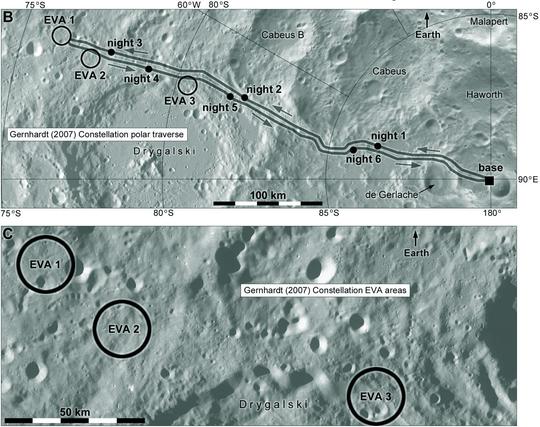
The sortie proponents had lots of great sites to visit - Marius Hills, Aristarchus, Bode, Orientale... In comparison the south pole looked very bland except for the possibility of ice and other frozen goodies. Those EVA sites seem rather arbitrary, not very special. The map uses the name Constellation, which I forgot to mention earlier. It was NASA's program to achieve the goals of the Vision for Space Exploration laid out by the President.
#moon
#moon
There were many presentations at meetings during 2008 about possible sortie missions for the Constellation program. We will look at a few before we say goodbye to this round of studies. Here are several by Pam Clark, who was very busy on plans like this at the time. These are all on the farside in the giant South Pole-Aitken basin, which was finally starting to be understood. Clementine showed it clearly for the first time in its global topography data in 1994.
#moon
#moon
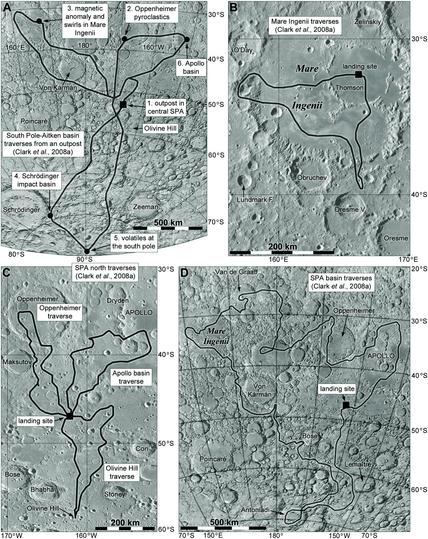
Clark mapped very long traverses, up to thousands of km long. One map includes an outpost site near Bose crater. The third map indicates 'Olivine Hill', shown in orbital data to have an unusual composition. It might include material from below the lunar crust, excavated by the massive impact which formed the basin or erupted as lava (it looks a bit like a volcanic plateau). It has been of interest ever since, and is currently given the informal name Mons Marguerite.
#moon
#moon
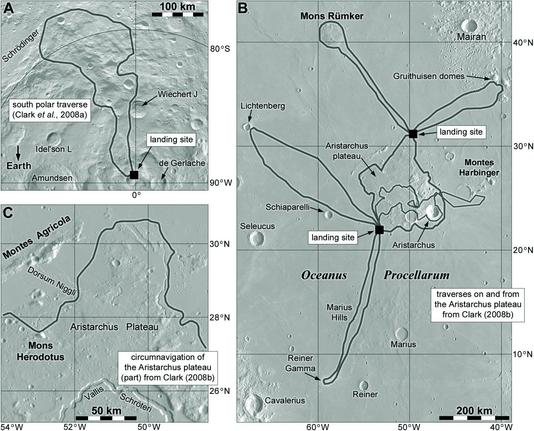
These sites were not all on the far side. Here are some more from Pam Clark. We have one at the south pole - part of the last set, really - but the main set of traverses here is in Oceanus Procellarum. At lower left is a modifiedl detail from the larger one showing part of a route around the Aristarchus Plateau. Other long drives visit points of scientific interest, and this is a very target-rich region of the Moon.
A final pair of non-polar sortie scenarios from the Constellation period - there were lots of others. These were presented by Laurie Leshin (Goddard) and Gordon Johnston (NASA) at a Planetary Science Subcommittee meeting in October 2008. The top map shows multiple traverses on the floor of Tsiolkovskiy crater on the farside. The lower map shows Alphonsus on the nearside. The latter set were done in pairs by 2 teams with a chance of help if problems arose.
#moon
#moon
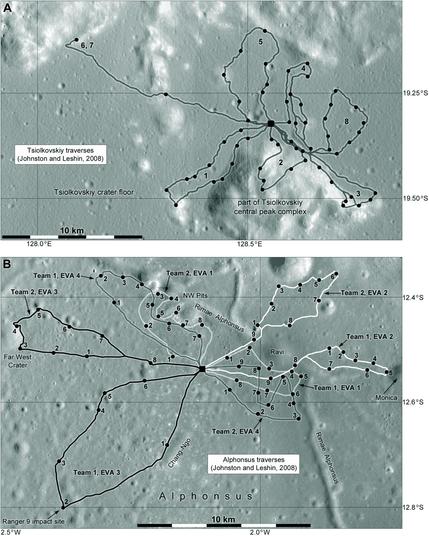
The Alphonsus map shows a visit to the impact site of Ranger 9. We have never had a human or robotic visit to a spacecraft impact site like that, though the idea has been suggested before. An impactor might be used to expose fresh material from a shallow depth for analysis. I would like to see one of the Apollo Lunar Module ascent stage impact sites, which look very unusual in LRO images, long troughs cut into the surface by an oblique impact rather than circular craters.
#moon
#moon
John Gruener of JSC presented details of planning by the Constellation Architecture Team-Lunar at the LEAG meeting in 2008. Would NASA build an outpost or do sorties to different places? A bit of both. Each year 2 or 3 flights with crew and cargo would add to the outpost and allow progressively longer surface stays. In addition, sorties would be flown to unspecified locations every 2 years or so. Long surface traverses from the outpost would explore the region bit by bit, as we will see.
#moon
#moon
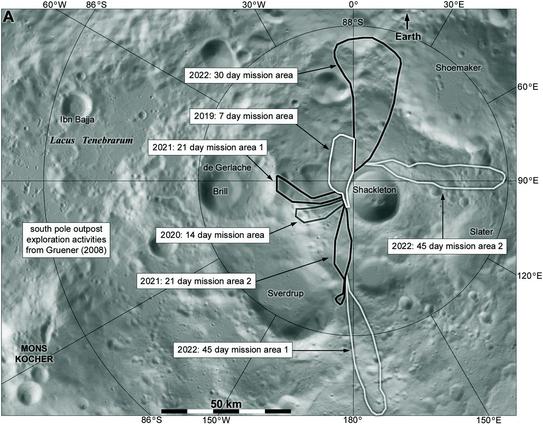
Here is a map of Gruener's thoughts about surface exploration around the pole. This is much less ambitious than the 1000 km plus routes we have been looking at, but still a lot more than I can imagine from Artemis in the next decade or two. Look at the timeline here - first excursion in 2019, going up to 2022. The plan extended up to 2026 but would continue beyond that.
Remember all this planning preceded LRO, but as it approached launch some new ideas arose - see them tomorrow!
#moon
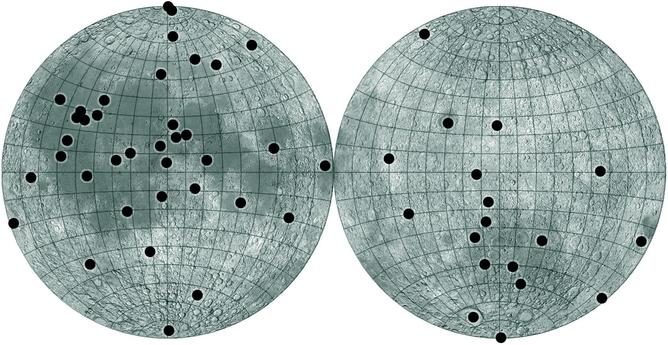
LRO, the Lunar Reconnaissance Orbiter, was designed specifically to help choose and characterize Constellation landing sites in its first year of operation, before being passed to the science side of NASA where it has been ever since. But which sites would it look at in that year? The Constellation Program Office combined the lists we have already looked at and sifted them to produce a list of 50 sites (and soon added a few more). This little map shows their locations.
#moon
#moon
For each site they produced a map showing square areas 10, 20 and 40 km across around the target of interest. The middle square got the best data coverage (full stereo imaging) and the surrounding areas got the best coverage thy could manage in the time. LRO went on to image the entire Moon under multiple lighting angles (though not all in stereo) but expectations were lower at first. Here is a typical set of these target maps (the full set is in Moon Chronicle part 8).
#moon
#moon
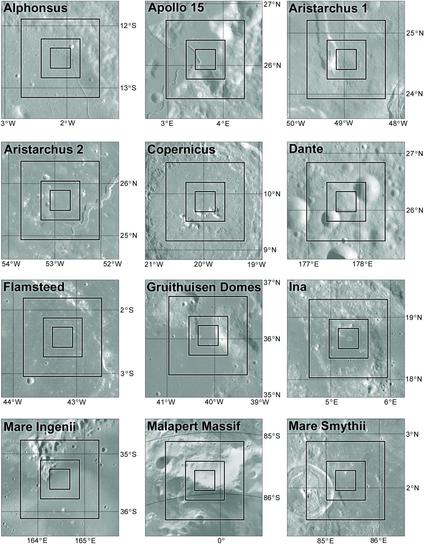
Naturally after this, much of the planning focused on those sites. Strictly speaking these were for planning purposes, exploring surface slopes and roughness etc. for a wide range of terrain types to help plan landers and rovers. But inevitably they were also regarded as semi-official landing targets. Eventually LRO vastly outperformed expectations and in the new global data many new targets were found as well. You might suppose that Constellation had a rosy future... but no.
#moon
#moon
LRO launched in June 2008. 8 months later, bowing to economic reality, President Obama called an end to Constellation. The plans I have illustrated came to nothing at the time. But they form a foundation from which new plans can grow, and indeed we are now in a new phase of mission planning. Events in just the last week are enough to give the most seasoned observer whiplash... but they don't really change the landing site planning I will look at next. We will start with Artemis tomorrow.
On to Artemis. Constellation planning didn't end where I stopped it here - studies already done go on to be written up for a while afterwards. Other studies continue - it's a full time job just trying to keep up. Eventually they become studies for the new program. From the beginning Artemis had as its main focus the south pole, so here are some sites from the Artemis Science Definition Team 'townhall' in October 2020. A mix of high illumination and access to volatiles sites.
#moon
#moon
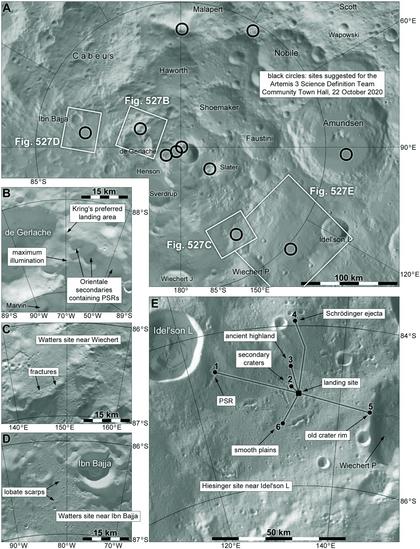
The arguments for polar sites are well known, but to summarize - a few very small points on hills and ridges offer prolonged illumination, breaking the tyranny of the 2-week lunar night to some extent. There are no 'peaks of eternal light' but there are places where sunlight is available uninterrupted for several months at a time. Nearby, crater floors which never see the sun may trap and preserve volatiles like water, carbon dioxide and other substances, a possible resource.
#moon
#moon
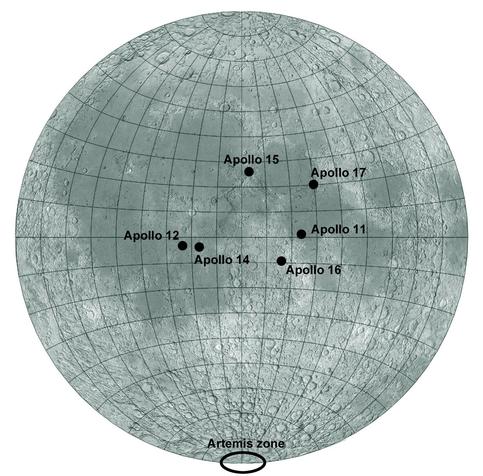
I want to emphasize just how different Artemis will be compared with Apollo. This map shows the Apollo sites, and it is surprising to some that Apollo sites span such a small area of the Moon. That's partly because maps of the sites often use an orthographic map projection which exaggerates the middle of the disk and foreshortens (and so shrinks) the edges. This is an equidistant (nearly but not quite equal area) projection which shows the situation more realistically.
#moon
#moon
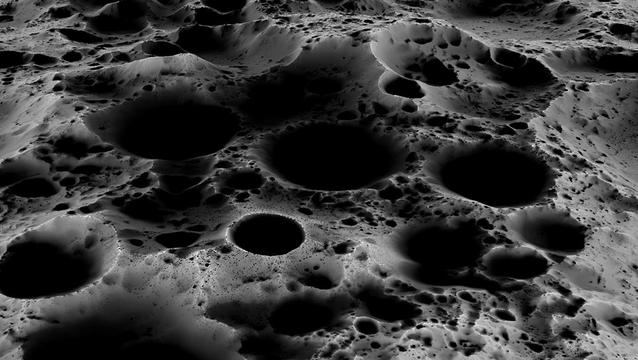
Here is a nice view of the south pole - a map of illumination conditions draped over topography. There is some vertical exaggeration but I don't have a number for it. Dark areas get very little or no sunlight at all. Bright patches - mostly very small strips on peaks and crater rims - get a lot of light, as much as about 75-80% of a lunar day in a very few places. The relief here exceeds Mt. Everest in height. Not your grandad's Moon (I speak as a grandad).
#moon
#moon
The Artemis Science Definition Team settled on a south polar target for Artemis. In early 2022 lunar scientists drew up a list of 27 candidate landing regions in the south polar part of the Moon, from the pole to 84 degrees south. This map shows them. Some with numbers are from earlier studies. The others are identified by the initials of the people who proposed them (NP: Noah Petro, SL: Sam Lawrence, DM: Dan Moriarty and so on). There is some overlap with the previous set.
#moon
#moon
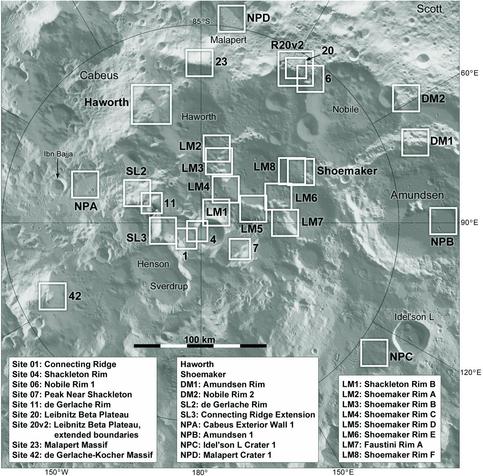
These are candidate landing regions, not landing sites. A site is the actual place a landing might occur and each of these landing regions could contain multiple landing sites. This somewhat mirrors the Apollo experience of site selection. Note too - most of these are on relatively well-illuminated ridges or peaks, but a few like NPB in Amundsen crater are near permanent shadows in places where a week or so of sunlight is enough for a landing mission.
#moon
#moon
Later in 2022 a reduced set of 13 candidate regions appeared, with new names. This map will be more familiar to most people than the previous one. Again, each region could contain multiple landing sites, so work soon began to identify some of them. Note the name Leibnitz Beta Plateau. Now we call it Mons Mouton. Where does the name Leibnitz Beta come from? Leibnitz crater is far away on the farside, so there is no direct connection. This goes back to the mid-19th Century...
#moon
#moon
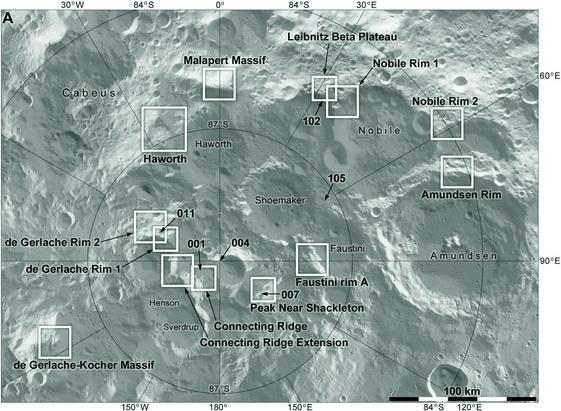
... when the limb areas were being studied. Large peaks on the southern limb were called the Leibnitz Mountains and Beta was one of those peaks. The mountain range as a whole does not have an official name today but some of the peaks have been given names recently: Mons Mouton, Mons Malapert, Mons Cabeus and (more on the farside) Mons Kocher. Lunar nomenclature is constantly evolving, and Quickmap offers a good way to keep up with it.
#moon
#moon
2022 also saw many studies of specific landing sites and activities which might be undertaken at them. These show up in journal papers and in conference abstracts and presentations, often 20 or 30 in a year (not all for Artemis). I am trying to record as many as I can find in my Chronicle. Here is an example from LPSC in 2022, on a much-studied site called the Connecting Ridge. It runs between Shackleton and de Gerlache craters. The map shows several points suggested around this time.
#moon
#moon
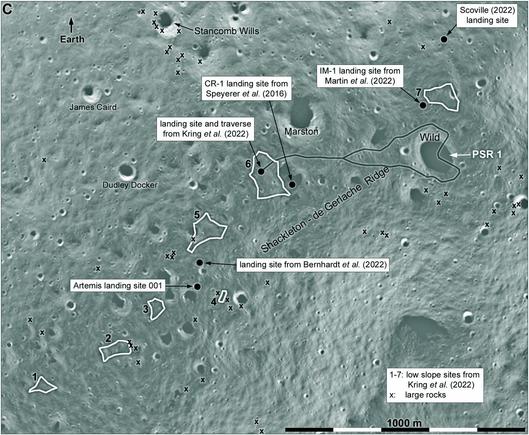
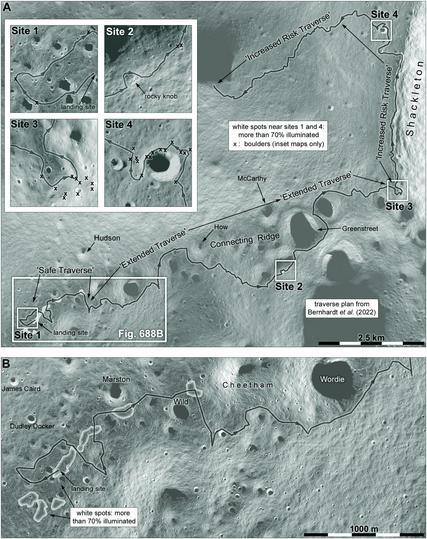
That map shows several crater names, none of them official. The Apollo crews named features at their sites to make it easier to refer to them (and it's nicer than having to say Crater X or Hill 7). They were unofficial at the time but were made official later. These names (inspired by the Shackleton expedition) come from the LROC team, I think, and they are on Quickmap. This is the site with most of these names but a few are starting to creep in elsewhere.
#moon
#moon
Here is another idea about activities starting at the same place as the previous map, the ridge between Shackleton and de Gerlache craters. This time it is a long traverse requiring a rover, divided into sections of increasing difficulty and risk. There are some more unofficial names - James Caird was the small boat Shackleton used for his almost unbelievable rescue mission (itself named after a sponsor of the expedition).
#moon
#moon
In 2024 the set of 13 early Artemis landing regions was reduced from 13 to 9 for Artemis 3 (then expected to be the first landing). This is not really correct - the 13 regions were reduced to 6 and 3 new ones were added. This map shows them. You can see that the older regions closer to the pole are almost all dropped (don't worry - this was for the first landing, later landings still get the full set). Two of the new ones are at about 84 south. Why?
#moon
#moon
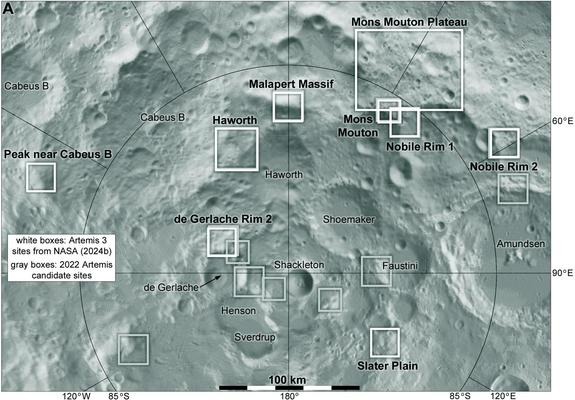
Being at lower latitude (84 instead of 89) gives a higher sun angle which might be easier to cope with. Also Earth is above the horizon for longer periods. This makes more dates available for landings, so there is more program flexibility.
Notice that one area is much bigger than the rest - Mons Mouton Plateau (Leibnitz Beta). It is c. 50 by 100 km and was the site for Intuitive Machines 2 and will be for VIPER and Chandrayaan 4. I think it is likely to be the first Artemis site too.
#moon
Here's a happy fellow. This is Jack Schmitt in his Lunar Module, on the Moon, so he has good reason to be happy. But he is not so happy about the Artemis sites. Jack is still very active, presenting at conferences, writing papers, trying to understand his landing site. In 2020, in a Lunar Surface Science Workshop, he said the first new landing needed an easier target - a non-polar target. Then he set about suggesting potential candidates.
#moon
#moon

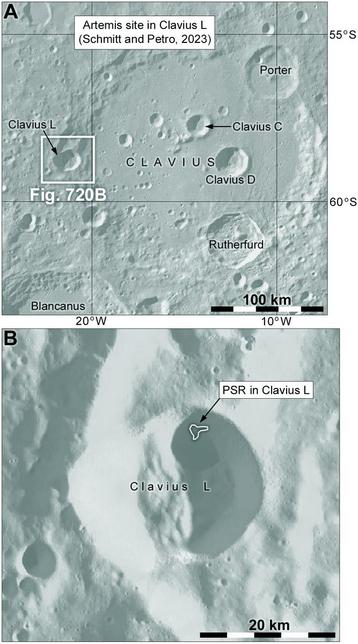
This is Schmitt's first suggestion from LPSC in 2023, a crater on the rim of Clavius at about 60 south. He chose it because there might be a small area of permanent shadow (PSR on the map) under the northern wall of Clavius L. I think there may be too much reflected light there to allow volatiles, but it's an interesting thought. I am troubled by the rough terrain - not an ideal site in my view. His next ideas were better...
#moon
#moon
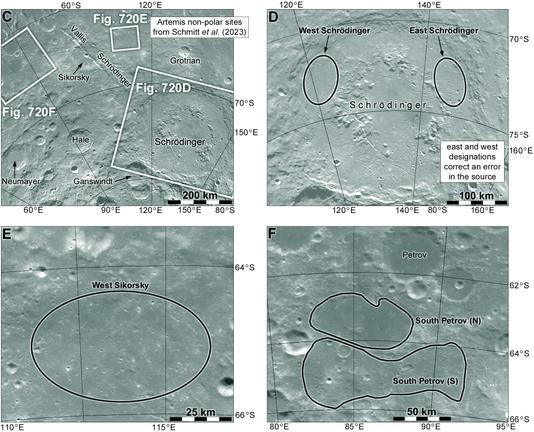
Later in 2023 Schmitt suggested new sites at a Candidate Artemis III Landing Sites Workshop. At top left 3 boxes represent the other 3 maps. The sites are relatively smooth and lie between 62 and 75 south. The sites in Schrödinger are probably the most geologically interesting and are a bit further south, increasing the chance for traces of volatiles.
I have not seen anything more from Schmitt since then, but the faintest whispers of a rumour are beginning to suggest he may get his wish.
#moon
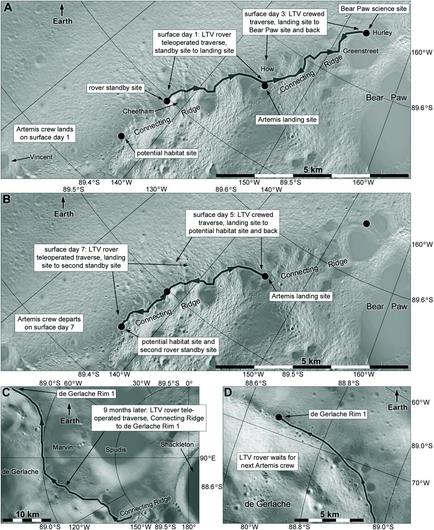
Back to the south pole now, because most studies still put us there. An Artemis mission scenario was shown in a 2023 video
https://ntrs.nasa.gov/citations/20230001847
also available at
https://www.youtube.com/watch?v=-k08Yql4Z5I
A generic lander leaves the orbiting Gateway and lands on the Connecting Ridge on day 1 of the mission. A pre-landed Lunar Terrain Vehicle (LTV) was driven remotely from a standby site to the landing site. Day 2 had the crew inside the lander preparing for surface operations.
#moon
In 2023 David Kring of the Lunar and Planetary Institute and colleagues used LRO LOLA topography to identify an example of a landing site within each of 12 Artemis landing regions. The landing sites were required to have slopes of no more than 8° in a circle of 100 m radius, and each region may contain other suitable sites. This set of small maps identifies the 12 sites. This and other surveys are finding the actual places astronauts may land in the coming years.
#moon
#moon
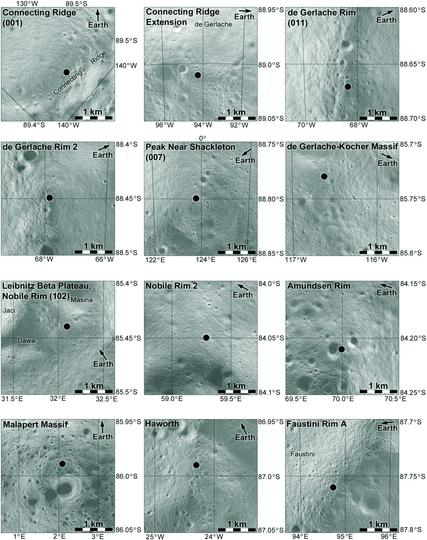
Kring's study was an effort to assess the ability of astronauts to function at each site. They found that workloads would not exceed the Apollo 14 EVA 2 - the climb up Cone Ridge and back - and so should be well within what astronauts would be capable of in early missions without a rover.
Here is another study by David Kring and others - he works a lot with groups of interns at LPI and presents results at LPSC and elsewhere. This was presented at LPSC in 2024 and publisher here (open access) in 2025:
https://agupubs.onlinelibrary.wiley.com/doi/10.1029/2024JE008905
This is on top of Mons Malapert, a mountain about 8 km above the floor of Haworth crater immediately to it south. It would be quite a place to stand. Several walking EVAs are illustrated.
#moon
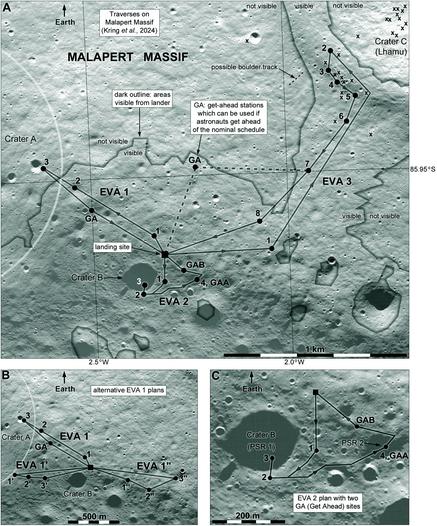
Kring's Malapert mission assumed a SpaceX Starship lander and mapped areas visible from its very high crew cabin. The long EVA 3 is almost entirely visible from the lander. This landing site is a few kilometres west of the Malapert site in the previous map.
#moon
#moon
Here is another view of Mons Malapert illustrating 2 different studies. The main one with multiple EVA paths illustrates a grid sampling strategy. In addition to the main science targets, lots of small samples are collected on a rough grid pattern (aiming for a fairly regular distribution of samples, not a perfect grid pattern). It's supposed to reduce bias in sampling. The landing site is not the same as the previous one. A second study looks at rocket exhaust contamination...
#moon
#moon
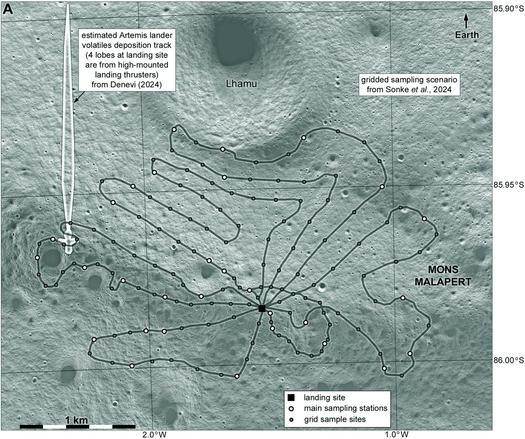
A second study reported by Brett Denevi (Johns Hopkins) looks at how volatiles like water or carbon dioxide from rocket exhaust might contaminate the surface. This is based on the Starship lander. A north-south streak on the map shows the area of volatile deposition from the main landing rocket. At the landing site four high-mounted thrusters take over for the final touchdown to reduce surface erosion. This landing site is the same as on the previous map.
#moon
#moon
Back at the Connecting Ridge (AKA Shackleton-de Gerlache Ridge or Spudis Ridge - it doesn't yet have an official name). These maps show names for small craters on the ridge and around Shackleton, as they were shown on Quickmap in 2024. Careful comparison with earlier maps will show that a few names have changed. They are all related to the Shackleton expedition to Antarctica. These are from the LRO camera team and might become official at some point. Tomorrow - some whimsical names.
#moon
#moon
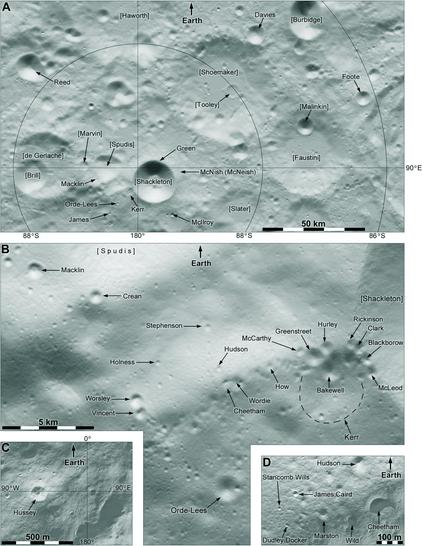
I linked to a mission simulation video earlier. The people who made it have published numerous papers on their landscape visualization methods, which start with LRO images and topography. For realism in the foreground of their views they add fictitious small craters and rocks (statistically matching real surface images). They have their own set of names, some of them quite whimsical. This map shows them and some routes from their studies.
#moon
#moon
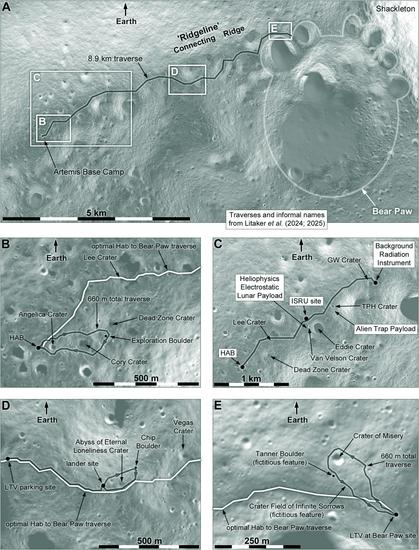
The one name here which might have some lasting impact is Bear Paw. Admittedly the poor creature is polydactylic, but the idea is good and I find it very appealing. There will be a lot more of these informal names popping up and I am always on the lookout for more. Even ones which are not adopted are part of the story, a way people interact with their world. Meet you at Mermaid Rock! (no, it's not on the Moon, it's in Ontario, a real place but an unofficial name I made up).
#moon
#moon
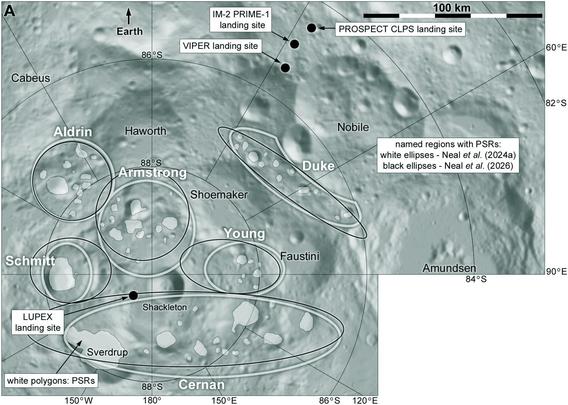
Speaking of unofficial names, how about these? The names of several lunar astronauts assigned to clusters of permanently shaded areas around the south pole. These are from Clive Neal (U. Notre Dame) in recent presentations. I feel Schmitt got cheated here... and what about the other 'moonwalkers'. Still, it shows another aspect of this whole story of naming things. I don't think these will have much staying power (but don't tell Clive I said so).
#moon
#moon
We saw 27 potential Artemis landing regions reduced to 13, then to 9 for the first landing. We have seen a variety of specific landing site suggestions, EVA activities etc. (and could add many more), and informal feature names. Where are we today in this process? Right now we are still at the stage of assessing possible sites within the candidate regions. An important goal now is to identify these sites systematically. We will look at 2 significant studies now.
#moon
#moon
The first of these Artemis landing site studies is:
Peña-Asensio, E. et al., 2025. Evaluating potential landing sites for the Artemis III mission using a multi-criteria decision making approach. Acta Astronautica, v. 226, pp. 469-478. https://doi.org/10.1016/j.actaastro.2024.10.049
Eloy Peña-Asensio (Politecnico di Milano) et al. looked the 13 regions plus the south pole itself, considering topography and lighting. This map shows the many small sites they found and the best ones (white).
#moon