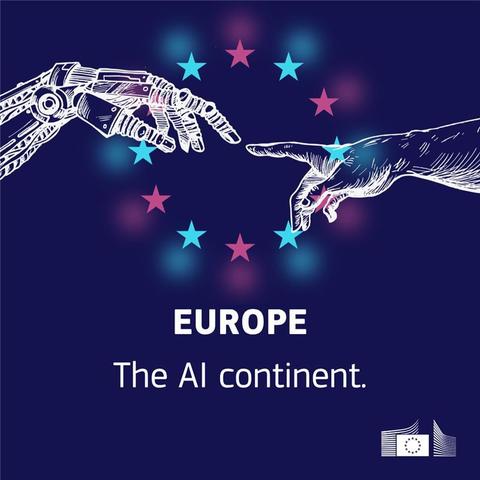
Europe, the AI Continent.

One year ago, we launched the AI Continent Action Plan. Since then, we have made huge strides:

✅ 19 AI factories are now live across EU countries.
✅ We established the AI Skills Academy to train experts.
✅ The AI Omnibus is cutting costs for business.
✅ We have earmarked €1 billion to support AI adoption in industry.

We are building a secure and innovative AI future for Europe.

Here's how 👉 https://link.europa.eu/nj3VH9
@EUCommission no one wants this stuff
Hi @peachymist! Artificial intelligence already plays a crucial role in our daily lives, and as AI develops, it holds even greater potential to improve the lives of EU citizens: enhancing disease prevention, reducing traffic fatalities, anticipating cyber threats, and much more. That's why we are proposing rules and actions for AI, enabling us to harness its full potential and maximise its benefits.
@EUCommission @peachymist I'd like Europe to be the AI-free continent.
@Gargron @EUCommission @peachymist much as I don’t want AI in everything- that ship has sailed. Given the problem at the heart of the EU is translation - having “boxed” llms that only work on a specific corpus of work and can translate is something that could be useful. The open web scraping nonsense can get in the sea.

@dianshuo @Gargron @EUCommission @peachymist

Products can fail and disappear from the marketplace.

Here's an entire museum dedicated to the history of commercial failures.

https://museumoffailure.com/

Museum of Failure

Museum of Failure
@Gargron @EUCommission @peachymist I think it’s important to differentiate between Generative AI (ChatGPT et all) and machine learning (ML) AI. ML can help automate and optimise loads of tasks across industries, and Europe should be on the edge of this instead of eating whatever the US spits out.

It makes sense to invest, and it makes sense to explore.

@kevin @Gargron @EUCommission @peachymist

Fully agree, there is a (big) difference between the two.

As an example, ML is extremely useful and good at translation languages — and that’s already since well before the chatbots started. Also a lot of other breakthroughs in science are done or improved with ML, and not GenAI, like protein folding.

While ML can be considered as a part of AI, it should be clearly separated from the LLMs which are, simply put, just random word combiners.

@kevin @Gargron @EUCommission @peachymist you are too hopeful, all the investments mentioned in the OP link are for GenAI. That AI skills academy? Aims for GenAI degrees, those investments? GenAI https://digital-strategy.ec.europa.eu/en/policies/genai4eu
The action plan? AI Factories for genAI https://ec.europa.eu/newsroom/dae/redirection/document/114523
GenAI4EU: Funding opportunities to boost Generative AI “made in Europe”

The European Commission has launched a first wave of EU funding opportunities to integrate generative Artificial Intelligence (AI) in Europe’s strategic sectors, and keep their competitive edge.

Shaping Europe’s digital future
@Gargron
to late people are using it they are already addicted
@EUCommission @peachymist

@Gargron @EUCommission @peachymist

+1 if AI is basically a synonym for LLMs.

If it’s about finally taking data quality serious, thinking hard about our underlying algorithmic problems and then applying heuristical methods, then yes please let’s do that and support institutions in this journey.

@Gargron @EUCommission @peachymist I understand the sentiment, but it’s militarily and economically untenable. Europe’s militaries would fall behind. Most economic sectors, where not already a victim of Baumol’s cost disease, would become victims of Baumol’s cost disease. The genie is out of the bottle, and to put it back in would require unanimous participation, including bad actors.
@Gargron @EUCommission @peachymist for real, Europe don’t be stupid like us here in the USA destroying our communities for data centers and driving power rates and consumption into the stratosphere for LLMs and generative AI.

@Gargron @EUCommission @peachymist I’m afraid I can’t agree with you here. Europe is not a separate planet, isolated from the rest of the world. If we, as Europe, do not adopt and develop the most advanced solutions, we will simply lose our competitiveness - both in terms of products and the workforce.

We can already see this very clearly in the automotive industry. If we turn away from innovation, Europe risks falling into a deep economic crisis instead of strengthening its position.

@mczachurski @EUCommission @peachymist AI 1) deskills workers 2) makes access to information and knowledge harder 3) concentrates wealth within big tech. Europe would be MORE competetive without AI.
@Gargron @EUCommission @peachymist AI will undoubtedly change how we build software. In some ways it will help, in others it will harm. But this has already begun and cannot be stopped. Europe cannot simply opt out, or companies will move to Asia or the US, leaving us with rising unemployment. We must build something better: ethical, competitive AI. Europe has the talent and resources to do it. 😉
@mczachurski @EUCommission @peachymist You are not listening to what I am saying.
@Gargron @mczachurski @EUCommission @peachymist to further the discussion, please provide some clarity as to what AI is, or at least the definition by which you abide. Then, please elaborate on your points that Al 1) deskills workers 2) makes access to information and knowledqe harder 3) concentrates wealth within big tech. Such that any country would be MORE competetive without Al.

@Gargron @EUCommission @peachymist 1) Work will shift: less manual coding, more reviewing, directing, and managing AI agents. 2) AI adds tools; it does not remove search engines or other ways of accessing knowledge. 3) Wealth is concentrated for now, but that is temporary - smaller local models are already emerging, even on phones.

You cannot be more competitive if you refuse to offer the services the market demands.

@mczachurski @Gargron @EUCommission @peachymist Absolutely and utterly disagree with point (1). That is entirely a choice, not a given, and plenty of people are chosing well to continue writing code (for a variety of crucial reasons).

As for (3), local models do *not* solve many of the ethical problems with how these models are built, trained, and propagated.

I really respect the work you've done in the fedi space. But we are clearly not in alignment on this topic.

@jaredwhite @Gargron @EUCommission @peachymist On point (1), in large companies this will not really be a choice. That is where most people earn their living. Those who do not adapt will lose opportunities, and their market value will decline.

On point (3), it is entirely possible to build models using only sources whose authors have given consent: documented, ethical, and open source. And once such models no longer belong to large corporations, those corporations will lose their dominance.

@jaredwhite @Gargron @EUCommission @peachymist We cannot talk about an AI-free continent and do nothing. That would be like calling for a continent free of machines during the industrial revolution.

Europe must engage and do this properly. The issue is not resources, but vision. I can imagine an euAI@Home project, like SETI@home, where a distributed network (open sourced) helps build transparent (open) models whose data and design we fully understand.

Perhaps I am being too optimistic. 😉