 Mathijs Booden
 David Chisnall (*Now with 50% more sarcasm!*)
It sounds as if electric trucks are great for long-range land transport. But they require heavy batteries, so rather than putting them on the road (where they'll damage the road surface), why don't we build special metal tracks for them to go on? And, on long trips, join a bunch of them together so that you only need one motor and driver for a load of them travelling in a convoy? I bet you could make freight transport a lot more efficient if you did that.
 dwardoric
 Christo. London, England
 Ray McCarthy
@Christo_459 @david_chisnall
Also much easier to have 100% autonomous driving.
Actual road trains are a thing in the Australian outback.
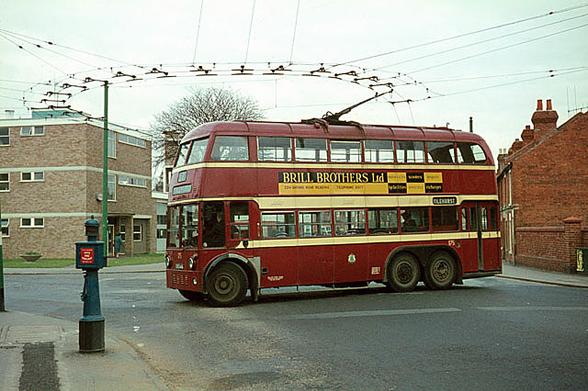
There are trams and 60 years ago there were still WWII era double decker trolley buses in many UK cities.
https://en.wikipedia.org/wiki/File:Reading_Trolleybus_at_Three_Tuns.jpg
Started 1882 and some places still have them.
 llogiq
@david_chisnall there are some experimental electrified roads in Germany (with cables overhead), but just a kilometer. I happen to regularly drive on one near Frankfurt. As far as I know, the whole thing is already switched off though.
 Twotired
@david_chisnall I see that a number of people are helpfully explaining your joke to you.
 D2
D2@david_chisnall decades ago, was flabbergasted to learn my first coding job’s employer (a grain co) usually got $30/ton rates for rail shipping across 5 states. Trucking was 6-8 times that, and the inefficiencies of small-lot (not full rail car) really soar from there.
… tell me we couldn’t engineer a way to let folks hook into this: little bins in boxes in pallets in railcars. Matrushka, and a dollar plops something weighty like a pile of books or preserves or etc anywhere across the country.
@david_chisnall searching, a couple quick estimates are $70/ton, vs 7 times that for trucking. Crates need standardized, automate measuring mass / density, and zoom… then do it again for passengers.
 The Penguin of Evil
@InkomTech @david_chisnall We used to do that in the UK. Our rail companies had parcels services, as did nationalised rail. Then we got a right wing nut job government under Thatcher and they broke it all.
There have been some attempts at doing smaller scale intermodal at stations ("minimodal" the obvious one) but it flopped.
 Reddog
 Phil Thane ✅
@InkomTech @david_chisnall 19th and early 20th century European railways inc UK did stuff like that with chalkboards on each railway wagon detailing what was in the wagon and where it was going. A train would be assembled from all sorts of wagons then would drop some off at a yard someplace and pick up some more to take somewhere else. There were also Mail Trains that did the same sort of thing with letters and parcels. (More)
@InkomTech @david_chisnall They had sorting offices on board and could pick and drop off mail bags without even stopping.
 Tim Ruppert
 ocratato
@david_chisnall
The underlying problem is that rail freight gets to include all the costs associated with the entire rail network; while trucks get to use roads that are paid for out of our taxes.
The underlying problem is that rail freight gets to include all the costs associated with the entire rail network; while trucks get to use roads that are paid for out of our taxes.
 🔏 Matthias Wiesmann
@ocratato @david_chisnall That and they dont pay externalities, pollution, road deaths.
 Jaakko Niemi
@david_chisnall The logistics sector here is adopting electric trucks at accelerating rate. These are 40 to 60 ton vehicles that move the stuff to grocery stores etc. They typically do two driver shifts per day. Interesting thing is that this is all beancounter operations and it's the cheaper option.
@liiwi @david_chisnall Friends I have in trucking tell me the upfront cost is way way higher (but improving) however the operational cost in the UK is something like 25% of the cost of running a diesel truck. Partly that's fuel and partly down time. Trucks do enormous mileage so they spend a surprising amount of time in bits having things replaced due to wear and tear.
 barbra
Two reasons why not:
Road vehicles can't share the same rail track as cars;
Double-tracking to allow trains to go in both directions at once gets really expensive.
@barbra @david_chisnall If you have enough traffic to double track and it pays then the cost is irrelevant, if not you use dynamic loops.
Road vehicles can share tracks with rail btw - we have these things called trams 8)
 mal3aby
@barbra @david_chisnall Good points, but worth noting that (1) trams exist, so road sharing is possible (if not always practical!), and (2) rather than double tracks all the way, you only need to have passing loops at the points where opposing trains cross, which can reduce the cost greatly (in the right situation).
@mal3aby .
Trains slow down regular traffic to the point where it's quicker to walk. CBC did a report on this - people could bike, boat, or not faster than their competitors who took a car, bus, or tram, because teams slowed vehicular traffic.
We put pedestrians on sidewalks for a reason. Same as we have bike lanes and cycling paths. We have express bus lanes that bypass regular traffic, and don't make any stops once they get on their dedicated lane.
Segregation of traffic by type is safer and more efficient.
 Jérôme Petazzoni
The first time i read a shitpost about that, i thought the same thing as you did, "haha that's a funny and brilliant way to remind us that trains exist and are great".
Then i did some research and reading and i suggest you do too; you'll learn that rail freight is already extremely developed pretty much everywhere; cheaper than road freight; and when trucks are used, it's not because some fucker wanted to burn oil for fun but because rail didn't work for that.
So yes, electric trucks are, in fact, not a dumb idea.
Sure it would be even better to engage less in our ultra consumerist society and buy less random garbage so that eventually results in less trucks on the roads - and less trains on tracks, because in the US, one of the reasons why passenger trains suck so much is because the tracks are saturated with freight trains, whose traffic has a higher priority.
You're welcome!
 christian mock
@jpetazzo @david_chisnall but why? Have you ever been to a parcel sorting center? Why, with our current level of software and robotics, is there no system where standardized boxes are automatically routed cross-country, leaving just the first and last mile to trucks?
@cm @david_chisnall you're inches away from reinventing the intermodal shipping container, my friend :)
 Hendrik Weimer
Building roads is a lot cheaper than building railroad tracks.
 Johan Empa
@jpetazzo @david_chisnall You're right. There's a reason railways aren't already reaching all destinations.
That's why electric trucks are a perfect complement to rail freight.
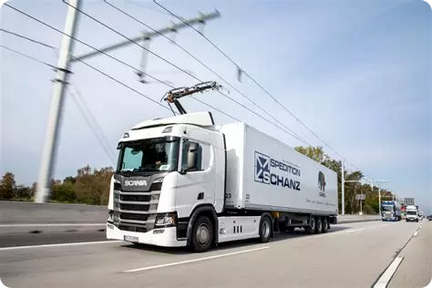
It's even possible to reduce battery size by letting trucks charge with overhead wires.
 Dark Matter Zine
@david_chisnall In Australia they decided it was cheaper to discontinue maintenance for rail and now they’re rethinking that historical blunder. Meanwhile, trucks are ripping up roads and, well, you know the rest.
 Tanek Rune
@david_chisnall
We could even put some of the freight onto a bunch of smaller electric trucks that travel in a known and pre-planned route, picking up and dropping off passengers along the way.
We could even put some of the freight onto a bunch of smaller electric trucks that travel in a known and pre-planned route, picking up and dropping off passengers along the way.
 Epic Null
@david_chisnall M hmm... I see where you are going with this. If I could make a note?
You are providing dedicated paths for these electric vehicles already. Why not include one of the "charge as you go" designs, like an electrified rail or overhead cable to reduce the required battery size?
@Epic_Null @david_chisnall Big clockwork spring under the truck and a giant winder in the road you stop at every so often. No cables, no electrical interference, no lithium needed.
 utzer
utzer@david_chisnall and if this takes off lets figure out how we can charge them during the trip, maybe continously with some kind of line and metal contact that moves along the line. If we could charge them continously we could probably leave out the batteries, reduce the weight and make it all more efficient.
 Dieu
Dieu@david_chisnall I swear some fucker is going to take this 'idea' and turn it into a business plan and get boatloads of funding for it.
@david_chisnall can't fix your railways, all the money's going into proprietary CargoRail now!
 maya_b 🇨🇦
and make it more efficient by running the cargo through underground/elevated tunnels that are in complete vacuum so they can go 500mph
@maya_b @david_chisnall I think that's an actual, real-life brain fart you're recounting here, right?
but if we're making fun of techbros regurgitating ideas it's just a matter of time before it's forgettgn as a dream (just like the old sci-fi stories that dreamt it up previously)
 Mayor of Nerdocrumbesia 🏡
 MacCruiskeen
@david_chisnall In the US at least what you get is a three-mile-long train with one driver on a 16-hour shift who hasn't had a day off in a month.
 Niels Nielsen, geographer
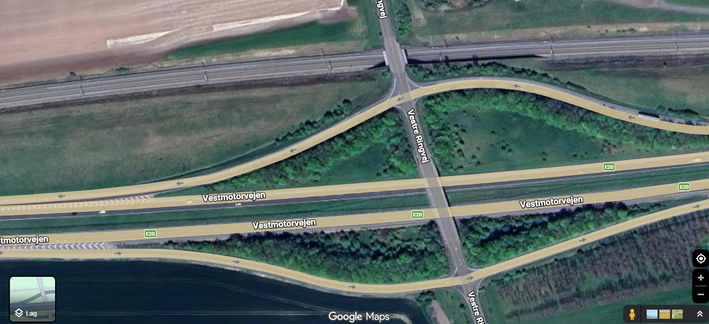
@david_chisnall Something like this, next to an existing motorway (top of image)?
 unattributed 𓂃✍︎
@david_chisnall As someone that worked for a railroad, there are lots of reasons this isn't the solution you think it is.
First, only a single train can be on a given segment of track, unlike trucks which can have dozens.
Second, trains are slower. They are more difficult to control because of the lower friction of steel wheels on steel rails. This also makes it a lot more difficult (read: impossible) for them to travel steep inclines directly. Descending sharp inclines is actually more difficult.
The infrastructure needed for monitoring and controlling trains is a lot more complicated than it is for automobiles / trucks.
The last mile problem: trains are great for moving bulk freight over long distances, but getting that freight to its final destination still requires another mode of transportation.
Trains actually use diesel fuel, they just do it more efficiently by using the fuel to power a generator to produce electricity. Converting them to batteries would have similar issues to electric trucks (IE, the weight required in batteries to power the train). Not to mention a balancing issue: you'd need some way to have the batteries distributed along the length of the train - if you centralize them into the engine or a single car, you create more problems for controlling the train.
There are so many more issues than you've thought of here. I know this was likely meant as a shitpost, but it's not a well considered one.
@unattributed @david_chisnall One train per segment of track - nope that's a solved problem. Trams have done it forever by simple means but for fast trains we have the tech to do it and it's in active use in Europe. Movable blocks are a thing.
Trains are slower. Only in America. Japan has a cargo shinkansen.
Inclines are a solved problem - don't run 5 mile long trains. In fact for high speed rail grades are better than curves.
Rail is not more efficient because it uses a generator
@unattributed @david_chisnall rail is mostly more efficient because the wheels are solid and the track is solid. Tyred vehicles lose loads of energy moving air around tyres - there's a reason they are blazing hot after a drive.
We generally also supply power from wires overhead which is great because your fuel weight is almost zero.
The big issue is the last kilometre problem. Intermodal solves a bunch of it but we really need containers that hop off the train and drive themselves 8)
@etchedpixels @david_chisnall Trains are more efficient because the steel on steel design has a lower contact surface between the rail and the wheel. I was wrong in stating that there is more friction, especially when compared to rubber against concrete, which has a much larger contact surface, and the softer rubber material is more prone to heating from friction.
But, friction is still an issue for long haul freight trains. I can clearly state this from first-hand knowledge that the company I worked for did experiments with lowering the temperature and friction of the wheels / rails. Unfortunately, the experiment they did while I was with the company did not achieve the desired results. I don't know if they were going to work any more on it.
Intermodal does address quite a few issues. Now, if an intermodal tram system could be developed, that might go some distance in addressing the last mile//kilometer problem. (See what I did there?  )
)
@etchedpixels Okay - so I likely mistook @david_chisnall to be posting from an American perspective.
Trams are a local, short distance solution. That won't scale well to long distance freight hauling, especially not for a country the size of America. Japan's cargo shinkansen is very new: it's only been in operation for about the last 3 weeks, and is currently a single train running once a day, over a limited route... Basically it's a test case being done in response to a shortage in trucks.
Now, if we wanted to look at the idea of using trams as a solution to the last mile problem, that would be interesting... But given the politics of this country it would likely not happen. (sigh)
@unattributed @david_chisnall tram in a UK sense is any railway operating in a situation where it is not fenced off from other users. We had some quite long tramways, and we are building a lot more in light rail form. I don't think they solve most cases though.
High speed freight is old here - even before WW2 the LNER ran some very fast freight, and it seems in places even the US is now doing 75mph Intermodal.
Autonomous delivery bots are probably needed to keep the handling costs low
 Bill Zaumen
@unattributed @david_chisnall It was rather odd to read that "Trains actually use diesel fuel" when our local commuter railroad just switched to electric trains with overhead wires, reducing trip time noticeably due to better acceleration after each stop.
Of course, they should have done this decades ago.
@bzdev @david_chisnall There is a huge difference between short distance commuter trains and long haul freight trains. Here's a History of Diesel Engines from Union Pacific.
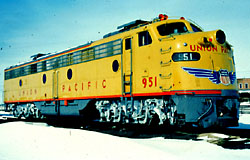
Diesel-Electric Locomotives
Although diesel locomotives first came to American railroads in the 1920s, their use was confined to switch engines, and later to passenger train locomotives. It wasn't until 1940 that the Electro Motive Division of General Motors (EMD) demonstrated that diesels could practically replace steam locomotives in heavy-duty service. A pioneer freight diesel, model "FT," toured the nation's railroads and changed history. Much like its sister passenger locomotives of the day, it was styled with an automobile-like nose and windshield, a design that prevailed until the late 1950s.
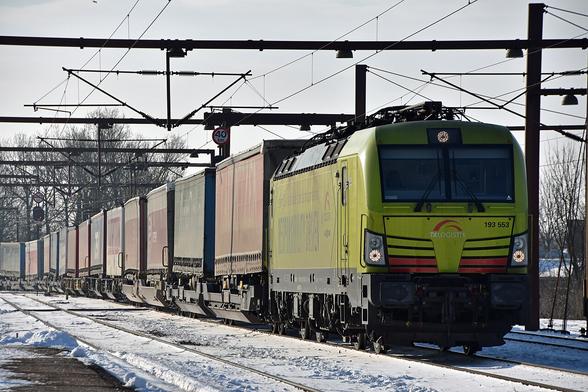
@unattributed @david_chisnall Nice picture, but all it shows is that the U.S. is rather backwards in this regard. Electric trains are used to haul freight in Europe,
and trains running on electricity are not just "short distance commuter trains".
 Jim
Jim@david_chisnall
Bravo! 👏🏻👏🏻👏🏻👏🏻👏🏻
Bravo! 👏🏻👏🏻👏🏻👏🏻👏🏻
@david_chisnall
How about replaceable batteries, changed at fuel stops/services, changeable in whole or part, with a turn around time similar to liquid fueling. It shouldn't be impossible to design a secure vehicle-mounted battery cradle, a secure connector to supply the fitted motor, and a small loading crane or lift truck to automate the transfer. Recharging could be by local renewables at the fuel stop, supplemented by off peak electricity.
How about replaceable batteries, changed at fuel stops/services, changeable in whole or part, with a turn around time similar to liquid fueling. It shouldn't be impossible to design a secure vehicle-mounted battery cradle, a secure connector to supply the fitted motor, and a small loading crane or lift truck to automate the transfer. Recharging could be by local renewables at the fuel stop, supplemented by off peak electricity.
 ohir
ohir Brad Rosenheim
@david_chisnall You, sir, are way ahead of your time!