This is kinda neat: https://www.reddit.com/r/Old_Recipes/comments/1shj9mp/from_the_1939_worlds_fair_cookbook/

I have a few old cookbooks, and one of the amazing things is how much they assume you just know how to do. Like I have a nice recipe for chocolate meringue pie and one of the steps is just "make a meringue."

Clearly home cooks used to have a bit more knowhow about the basics, but the other thing for those of us who cook for our families is details don't matter if you're gonna do the recipe 400 times. You'll adapt it, so specifics aren't useful.

Like people often remark on how really old recipes tend to use vague quantities. But in my experience the best way to cook is to write down a recipe and then adjust it to your kitchen and the tastes of your family. So, numbers beyond a general range aren't that important, other than as a sort of default setting.
@ZachWeinersmith this is especially true for "season to taste" type instructions. I like to think of it as "keep adding garlic until your ancestors tell you to stop".
@ldpm @ZachWeinersmith "If you find yourself communicating with your ancestors, that's too much garlic."
@ZachWeinersmith This is generally true except for the recipes (baking, usually) where the ratios are extremely important. Too little cream of tartar and the texture will be wrong, too much and it leaves a bad taste.
#baking
@samloonie @ZachWeinersmith Yeah, most cooking is just about taste, but baking is chemistry.

@samloonie @ZachWeinersmith

Baking recipes still have to be adjusted for local air pressure, temperature, and humidity. So, for example, when I have baked in California versus New Mexico versus Minnesota; I have to adjust the amount of water by feel.

Which does not change the importance of ratios - see what has happened when manufacturers of boxed cake mix changed the size of the boxes, throwing off all of the derived recipes that were based on "use one box" : https://www.allrecipes.com/adjust-cake-mix-recipes-11868318

@ZachWeinersmith

My great grandmother's Christmas pudding recipe says "enough eggs"!

@ZachWeinersmith

My mother said that her grandmother's recipes called for things like "a ball of butter the size of a wren's egg".

@ZachWeinersmith You wouldn't be so quick so say those numbers don't matter if you made a lot of bread. You'd be using weights instead of volumes to make sure you were more accurate.
@crazyeddie I do! But even then sometimes you have to adjust, especially if you have a new brand of flour or something.
@ZachWeinersmith Yeah, but you can look up how to make a meringue. Like, they also don't tell you how to dice an onion every time you need to dice an onion. There's a nestedness to the instructions on how to do anything (the goblin tools to do list is a masterclass in design for that insight (also my favourite use of an LLM ever)).

@drgroftehauge That really wasn't the case when these cookbooks were originally written. The idea of writing basic skills down is rather new, dating to the Folk Enlightenment movement[1] of late 1700s and 1800s, and we really didn't get properly good at it until, well, the rise of taylorism, which thought that deskilling was important for "efficiency".

[1] Not to be confused with its elite-based prerequisite, the Enlightenment Movement.
@ZachWeinersmith

@ZachWeinersmith See? De-skilling is good for something! It makes for better cookbooks that can be used by de-skilled people!

If English culinary arts had been written down with the modern precision, the death of all the good cooks in the trenches of the War So Great That We'll Surely Never Have Another wouldn't have been quite so effective at making fish-and-chips and vindaloo into the national British dishes.

@ZachWeinersmith There are at least two versions of the Cuban cookbook “Cocina al Minuto” by Nitza Villapol. The blue one is sort of a bootleg version put together by Cuban refugees in the US. It’s apparently based on a 1954 edition which I’ve never seen. There are quirks and the one I remember is recipes that call for a can of something. Big can? Little can? Who knows? See the author’s Wikipedia page for more info.

@ZachWeinersmith I've done this a few times when friends ask me how I made something. I remember it most with a broccoli cheddar soup recipe.

"So you start by making a roux..."
<blank look>
"Uh well, okay, so you take butter and flour"

@ZachWeinersmith Modern recipes employ fake precision, as if using a 1/4-tsp of nutmeg will give perfect results, while a 1/2-tsp will result in inedibility.

It's BS. Taste is subjective. I never trust the quantities in a middle-class white woman's Indian curry, for example.

No writer has tested all the variables. They've just gone with a particular quantity and stuck with it.

Some quantities or proportions may be crucial, but most aren't. Take recipes as a rough guide and improvise.

@ZachWeinersmith already 35 years ago, my then fresh-out-of-college, and newly-wed math teacher complained that she can't use a cookbook because it assumes you know how to make basic stuff.
@ZachWeinersmith
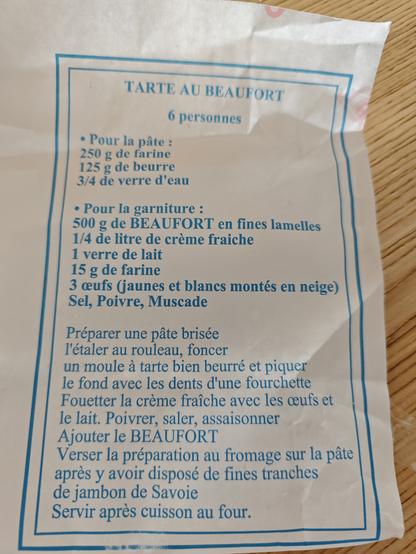
It's not just old recipes. See this recipe for Tarte au Beaufort (Beaufort cheese tarte) from the Cooperative Laitière in Bourg St Maurice from this year that ends with (my translation) "Serve after cooking in the oven".

@ZachWeinersmith Did you look to see if the recipe for meringue is in the book somewhere? Maybe toward the beginning of the section you're in. Joy of Cooking for example does this sometimes.

But yeah, people knew how to cook more. When I was in grade/high school we even had classes on it. I don't know that they do anymore.

@ZachWeinersmith One of my favorite old cookbook finds was a recipe for whole suckling pig.

The first two lines were “Measure your oven. Then MEASURE YOUR PIG.”

I have never made whole suckling pig but I 💯 guarantee if I had, this would have been the step where I messed up.

@ZachWeinersmith if you've made the recipe 400 times, you will have splashed the page in the cookbook at least a few times, so you can't read all of it anyway.