 Andrew Zonenberg
It's... Bigger than i thought it would be.
About time I had one of these. Quite the upgrade from my old clicky thing that doesn't go low enough for small screws on PCBs etc
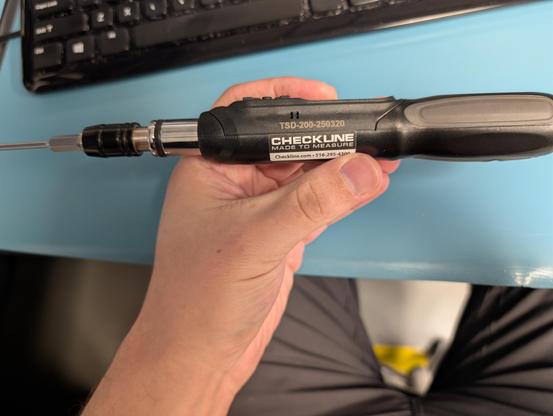
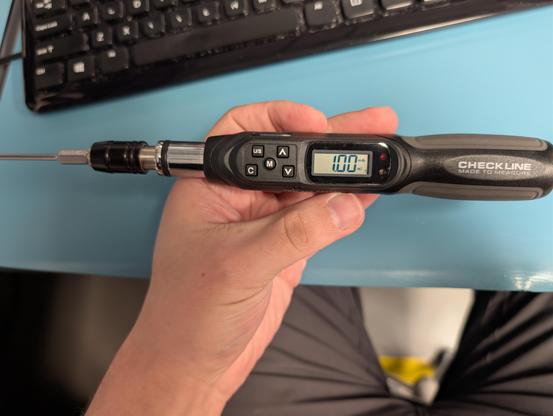
It's... Bigger than i thought it would be.
About time I had one of these. Quite the upgrade from my old clicky thing that doesn't go low enough for small screws on PCBs etc
@xabean This one is specced for 1.7 - 17.7 lbf-in or 2-20 kg-cm torque (it reads lower but isnt calibrated outside that range) and was $369. If you want the NIST traceable or 17025 calibration certificate that's an extra $100 or 200 respectively.
Eventually I want the full set, they have a low range model that does 0.45 - 4.42 lbf-in or 0.5-5 kg-cm, as well as a high range that does 3-35 lbf-in or 4-40 kg-cm.
The low end would be nice to have at some point but I figured this would be a good starter model for "nice torque drivers".
@azonenberg @xabean it never really clicked for me that lbf-feet is measuring "weight" not force until I saw the kg-cm.. poundfeet are something I read sometimes and always ignored so I never thought about that.
@azonenberg @xabean ah, thanks! Now I know what the f stands for.
That means kgf-cm is just Nm, written weirdly.
I can see how this might be more familiar to people growing up with lbf-feet though I would personally optimize for global readability. NB: not a criticism.
@azonenberg @xabean yeah, it seems easy to confuse the two. I saw the "f" and it didn't click.
FWIW, I did the math, kgf-cm are the literal same as Nm, so you can use either
 Richard "mtfnpy" Harman (he/him)
 Richard "RichiH" Hartmann