New! Interactional foundations for critical AI literacies https://zenodo.org/records/19452872

Why do Anthropic engineers talking to Claude sound like Azande witch doctors addressing their potions? What does Mambila spider divination have in common with prompt engineering? Why are LLMs so irresistible to interact with?

If you're interested in questions like that, and in luminaries like Lovelace, Adorno, Suchman and Weizenbaum, you may be interested in this paper: https://doi.org/10.5281/zenodo.19452872
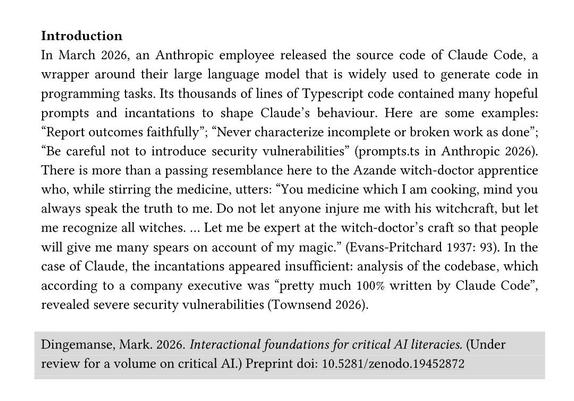
I was supposed to finish this last week but then the #Claude Code leak happened, promptly giving me an excellent opening example (h/t @jonny for their digital archaeology work that drew my attention to the magic prompting techniques)

(I think it is likely btw that #Anthropic shifted the #Mythos announce forward to this week to bury the leak & its security implications)

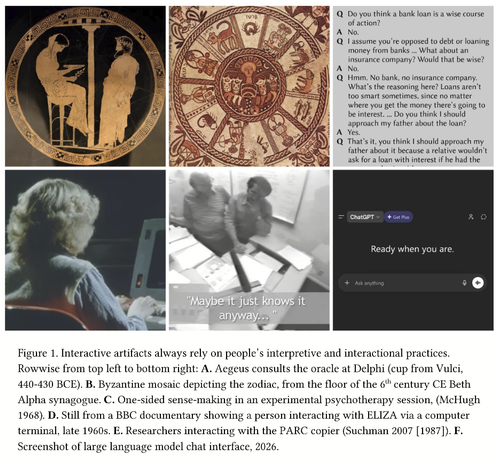
we can consider "AI" at different time depths — deep learning (2010s), cybernetics (1950s), automation (1800s), but in this paper I argue that to understand its *interactive* appeal we must further broaden our outlook

It's not a big jump from divination to deep learning — they are united by the generative use of chance. People have always been eager to ascribe meaning to random processes, and that's where we must start to understand the appeal of present-day LLMs https://doi.org/10.5281/zenodo.19452872

Interactional foundations for critical AI literacies

The ubiquity and ease of use of large language models makes it easy to overlook the interactional and interpretive processes at play. To understand the attraction of this technology we need to trace its sociotechnical roots. From divination and horoscopes and from ELIZA to present-day large language models, I document how people have been thinking with things, outsourcing judgement, and making sense of interactively presented non-sense. Following the lead of Lucy Suchman to “slow down discourses of the ‘smart’ machines”, I consider the interactional foundations of our engagement with technologies of language. I make the case that the fluid output, fine-tuned overconfidence, and interactive design of these computational artefacts conspire to exploit our interpretive processes and interactional infrastructure, rendering them irresistible to lay people and researchers alike. This means that a deep understanding of processes of human interaction and sense-making will be a foundational resource for the growing arsenal of methods in critical AI literacy. Preprint of a chapter for an edited volume: A Research Agenda for Critical AI Studies. Currently under review, likely to be revised. Your comments are welcome!

Zenodo

@dingemansemark

"He deals the cards to find the answer
The sacred geometry of chance
The hidden law of a probable outcome
The numbers lead a dance

I know that the spades are the swords of a soldier
I know that the clubs are weapons of war
I know that diamonds mean money for this art
But that's not the shape of my heart"

@dingemansemark I still have Evans-Pritchard's books. In a box in the attic, admittedly. I loved learning about the different systems of magic, but I mainly recall his prose had become a bit long in the tooth, even in the 1990s. @jonny

@dingemansemark @jonny

I look forward to reading this! (And I promise to set aside my intense dislike of Adorno for it!)

@MichaelTBacon @jonny 😊 can't say I've read a lot of Adorno, but I found his The Stars Down To Earth (1957) pretty amazing as an early example of critical analysis of horoscope columns and their attractions, with wide-ranging implications also for today
@dingemansemark @jonny It’s his writing on jazz that makes me dislike him so much. It’s the epitome of a European leftist essentializing nonwhite phenomena as fundamentally derivative of and only relevant to prior European standards and having no relevance or existence beyond that. It’s so, so bad and colonialist.
@dingemansemark @jonny that’s perhaps unfair to judge someone so harshly for one bit of analysis, but it’s so bad that it makes me suspicious of anything else he wrote. It doesn’t help that he wrote to Walter Benjamin and used the jazz analysis as proof of a bigger point.
@MichaelTBacon oof that doesn't sound great 🫤

@dingemansemark

A lot of people like him. I don't mean to throw you off. But sometimes you get hung up on a thing and it stays with you.

@dingemansemark @jonny

Be careful not to introduce security vulnerabilities 🤣🤣🤣

@dingemansemark @jonny 45 years of sw eng here... after having seen Claude's internals I can say they have dangerously ignorant and young people working on it. shamefully bad. hard to believe nobody there doesnt realise how horrible their Claude impl is.

@dingemansemark @jonny Growing up, I always wanted to be the wizard or the magician, not the princess.

We finally have something that makes it feel like you're a wizard.

But instead of incantations that accurately describe precisely what I want and have a predictable mapping to outcomes ("This incantation reliably creates a bucket of water small enough to carry.") I feel like we're getting "Pretty please with a cherry on top could I maybe have a bucket of water?" and sometimes it's a KFC bucket filled with empty water bottles, and sometimes it's a hose next to a knick-knack shaped like a bucket, and sometimes it's actually a bucket that actually has water in it, but it's upside down or has a hole in the bottom or the water is carbonated and flavored with lemon.

@dingemansemark "The combination of a random generation procedure and expert interpretation by someone who is not a party to the question at hand lends the procedure a sense of ostensive detachment(Boyer 2020). This detachment is one of the chief attractions of oracles and fortune-tellers, and it is no coincidence that interactive artifacts incorporate it in their design"

So are these the jobs that are really being made redundant by chatbots?

@jonny

@grvsmth @jonny

my intuition is that this is not a market that is easily saturated — there will always be a particular charm to checking your horoscope or reading tea leaves

whereas divination &c were usefully limited in applications, LLMs assert broader relevance and so are insinuating themselves into mundane processes where people used to use common sense or talk to one another. What is being eroded is not so much jobs but human relations & cognitive resources