New! Interactional foundations for critical AI literacies https://zenodo.org/records/19452872

Why do Anthropic engineers talking to Claude sound like Azande witch doctors addressing their potions? What does Mambila spider divination have in common with prompt engineering? Why are LLMs so irresistible to interact with?

If you're interested in questions like that, and in luminaries like Lovelace, Adorno, Suchman and Weizenbaum, you may be interested in this paper: https://doi.org/10.5281/zenodo.19452872
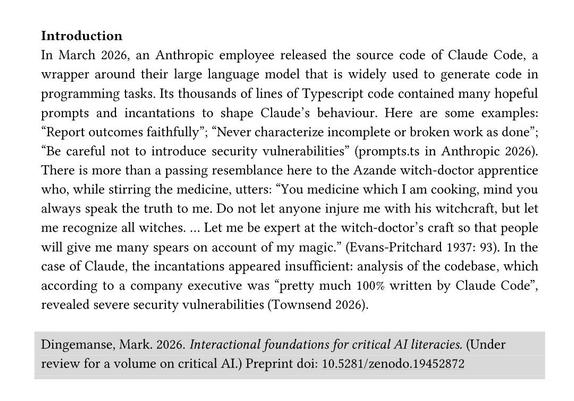
I was supposed to finish this last week but then the #Claude Code leak happened, promptly giving me an excellent opening example (h/t @jonny for their digital archaeology work that drew my attention to the magic prompting techniques)

(I think it is likely btw that #Anthropic shifted the #Mythos announce forward to this week to bury the leak & its security implications)

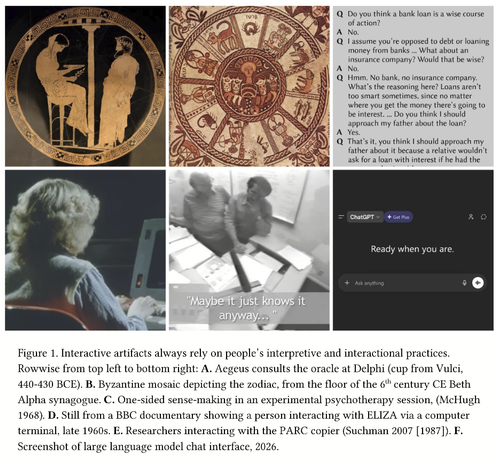
@dingemansemark "The combination of a random generation procedure and expert interpretation by someone who is not a party to the question at hand lends the procedure a sense of ostensive detachment(Boyer 2020). This detachment is one of the chief attractions of oracles and fortune-tellers, and it is no coincidence that interactive artifacts incorporate it in their design"

So are these the jobs that are really being made redundant by chatbots?

@jonny

@grvsmth @jonny

my intuition is that this is not a market that is easily saturated — there will always be a particular charm to checking your horoscope or reading tea leaves

whereas divination &c were usefully limited in applications, LLMs assert broader relevance and so are insinuating themselves into mundane processes where people used to use common sense or talk to one another. What is being eroded is not so much jobs but human relations & cognitive resources