New! Interactional foundations for critical AI literacies https://zenodo.org/records/19452872

Why do Anthropic engineers talking to Claude sound like Azande witch doctors addressing their potions? What does Mambila spider divination have in common with prompt engineering? Why are LLMs so irresistible to interact with?

If you're interested in questions like that, and in luminaries like Lovelace, Adorno, Suchman and Weizenbaum, you may be interested in this paper: https://doi.org/10.5281/zenodo.19452872
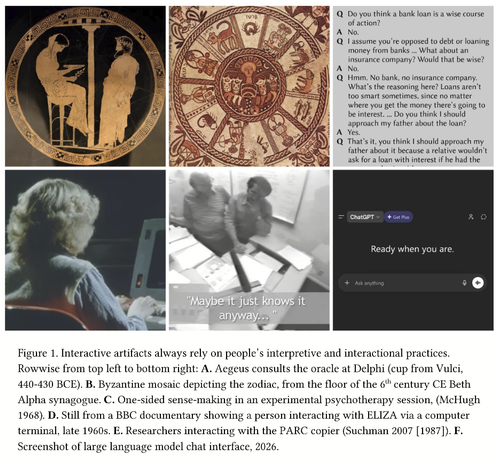
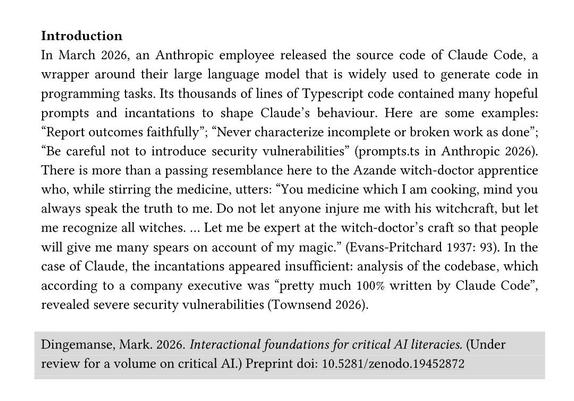
I was supposed to finish this last week but then the #Claude Code leak happened, promptly giving me an excellent opening example (h/t @jonny for their digital archaeology work that drew my attention to the magic prompting techniques)

(I think it is likely btw that #Anthropic shifted the #Mythos announce forward to this week to bury the leak & its security implications)

we can consider "AI" at different time depths — deep learning (2010s), cybernetics (1950s), automation (1800s), but in this paper I argue that to understand its *interactive* appeal we must further broaden our outlook

It's not a big jump from divination to deep learning — they are united by the generative use of chance. People have always been eager to ascribe meaning to random processes, and that's where we must start to understand the appeal of present-day LLMs https://doi.org/10.5281/zenodo.19452872

Interactional foundations for critical AI literacies

The ubiquity and ease of use of large language models makes it easy to overlook the interactional and interpretive processes at play. To understand the attraction of this technology we need to trace its sociotechnical roots. From divination and horoscopes and from ELIZA to present-day large language models, I document how people have been thinking with things, outsourcing judgement, and making sense of interactively presented non-sense. Following the lead of Lucy Suchman to “slow down discourses of the ‘smart’ machines”, I consider the interactional foundations of our engagement with technologies of language. I make the case that the fluid output, fine-tuned overconfidence, and interactive design of these computational artefacts conspire to exploit our interpretive processes and interactional infrastructure, rendering them irresistible to lay people and researchers alike. This means that a deep understanding of processes of human interaction and sense-making will be a foundational resource for the growing arsenal of methods in critical AI literacy. Preprint of a chapter for an edited volume: A Research Agenda for Critical AI Studies. Currently under review, likely to be revised. Your comments are welcome!

Zenodo

@dingemansemark

"He deals the cards to find the answer
The sacred geometry of chance
The hidden law of a probable outcome
The numbers lead a dance

I know that the spades are the swords of a soldier
I know that the clubs are weapons of war
I know that diamonds mean money for this art
But that's not the shape of my heart"