Stumble-bee rescue

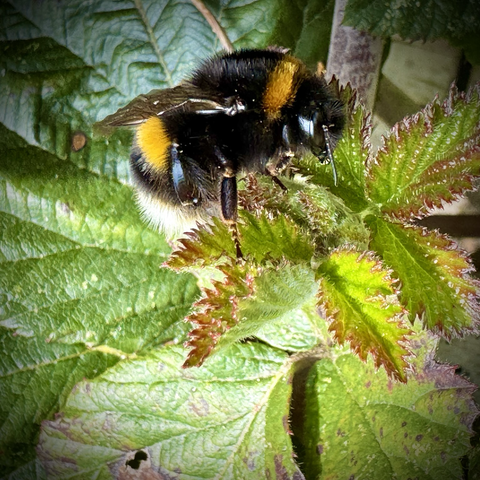
This morning I spotted a bumblebee dropping out of the sky. The night can still be rather cold and the poor thing was only barely awake at all because of it. I let it climb onto my hand and gave it some lukewarm sugar water. After it warmed up, it did some charming calisthenics, and managed to fly off again.
I used to give such bees honey water, but that can be very bad for their little bee family, so I recommend sunshine and sugar water in such cases.💚

#bees #bugs #nature

@HeliaXyana

Possibly a solitary bee? I've seen a few around here in Wales so far, now the weather is s warming up 🙂

@simonzerafa @HeliaXyana Looks like a queen Bombus lucorum to me (i.e. a bumblebee). It has two yellow bands and a bright white bum, which means it’s probably not a Bombus terrestris (2 yellow bands, tawny bum) and definitely not a B. pratensis (2 yellow bands, orange bum) or B. hortorum (white bum, 3 yellow bands). Other common species are B. pascuorum (all brown) and B. lapidarius (black, orange bum). And there are also some less common species. They also have slightly different face shapes.

@nolitimere @simonzerafa

I'm far from an expert on my fuzzy buzzy busy friends. It may be solitary, though there are certainly enough of them having a pollinating party at my flowering cherry trees at the moment. So, not that solitary. 😉

Thanks for the excellent bee facts. I love the idea of having started my day by rescuing teeny tiny fluffy royalty. Ha! 🐝

@HeliaXyana @simonzerafa Yes, she is a queen: she overwintered alone, but she is fertile, and in spring starts a colony on her own (i.e. not solitary), and raises her daughters (sterile females = workers) who help her collect pollen and nectar to raise more broods of workers, until in summer the colony is big enough to produce males and new queens… who mate. During late summer/fall, the new queens forage to get fat enough to hibernate over winter. In spring, the emerge and the cycle starts again
@HeliaXyana @simonzerafa The term “solitary” as applied to bees and wasps means that each female provisions her own nest, on her own. Even if they live very close to other bees of the same species (in an “aggregation”). As opposed to social species, wherein females get help from related females to provision the young, in a “colony”. In honeybees, the colony is perennial: the queen lives up to 4+ years after mating. In bumblebees, the queen lives up to ~1 year, and the colony for up to ~6 months.

@nolitimere @HeliaXyana

Looks like we need to upgrade the A Team to the Bee Team 😄🐝

@simonzerafa @nolitimere

HA! Absolutely. I'd definitely watch that! Actually, am I right now.

@HeliaXyana @simonzerafa @nolitimere

"If you have a bumble, if no one else can help, and if you can find them....maybe you can hire The B-Team."