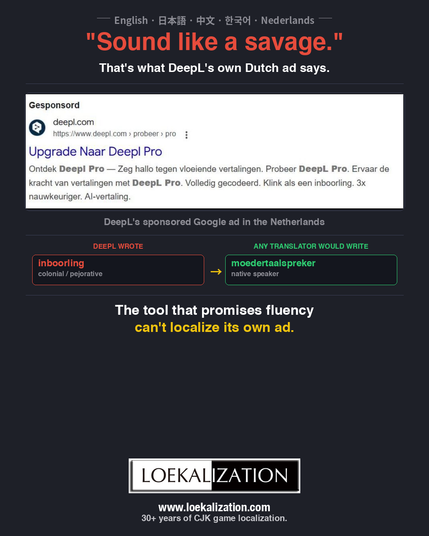
"Sound like a savage."
That's what DeepL's own Dutch Google ad effectively says. Their tagline: "Klink als een inboorling. " They meant "sound like a native speaker. " But "inboorling" sits in the same register as "savage. " It's a word you'd find in a 19th-century colonial ethnography, not in marketing copy. Any Dutch translator would have written "moedertaalspreker" and moved on. This isn't a cherry-picked edge case.
This is a company selling translation, in an ad for their own product, in one of their home markets. And they got it wrong in the most culturally tone-deaf way possible. The irony writes itself: the tool that promises fluency can't localize its own ad without stepping on a cultural landmine. This is what I mean when I talk about the gap between translation and localization. Statistical pattern matching gets you close. Close enough to be dangerous. The words are technically correct.

The cultural signal is all wrong. A translator who knows Dutch culture catches "inboorling" in two seconds and replaces it before anyone has to have an uncomfortable conversation with PR. An AI doesn't flag it, because the grammar is fine and the dictionary definition checks out. That's not a minor nuance. That's your brand, in a market, saying something you never intended.
If you're shipping content into multiple markets, this is the question worth asking: who is reading your copy with cultural eyes, not just linguistic ones? #localization #translation #gamelocalization #brandstrategy