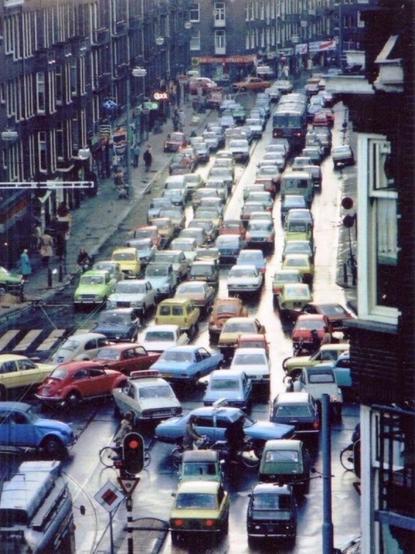
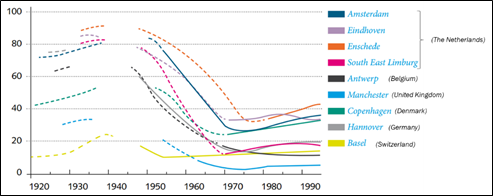
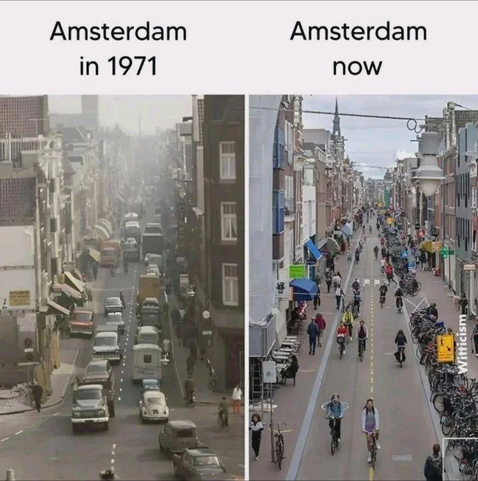
Remember this picture, & others like it, every time you hear someone in your city say "we're not Amsterdam." This was #Amsterdam in the 1970s. Many of the cities we admire made tough choices regarding cars in the past, and are still making better choices today. Better choices instead of excuses.
@brenttoderian.bsky.social I remember Paris and Naples in the 1970s. They also looked like that 👆🏽
@brenttoderian.bsky.social Nice point, but I mostly look at this picture and think "ooh weren't all the cars pretty colours?" I always wonder why modern cars are so very boring!
@janeishly @brenttoderian.bsky.social the short answer is that it's easier to sell stuff when everything is exactly as boring as everything else and there's no distinguishing features that customers might have preferences about ><

@brenttoderian.bsky.social This image keeps going around. Somebody needs to dive deeper into the story. (I am not volunteering, any more than the little I did below.)

Note: I am very much against car-centric city planning. But I am also against blindly repeating claims that might be misleading.

This street is apparently Zeilstraat. It is still used by cars. It seems to have four lanes nowadays, not five. And lots more cycle traffic. I am not claiming it has traffic jams like in the picture very often, I have no idea. But I don't know how common such traffic jams were in the 1970s, either. Anyway, this street still is used by cars.

Was the centre of #Amsterdam in general like this in the 1970s? Hardly. Most streets were as narrow as they are now.

A more useful post would be one showing some other street in the 1970s *and* now, with the current state being more pleasant, with reduced parking, trees planted, etc. And including some statistics about how car traffic has decreased and cycling increased in the centre of Amsterdam, as I assume it has.

@tml Taken from about here, perhaps: https://maps.app.goo.gl/ifgFLyMWLTHPL1J99

Still looks like quite a car-heavy road, and a lot of the issues people raise with bicycle infrastructure are present here too: delivery vans blocking cycle lanes, bikes forced to merge with traffic, etc.

As you say, one needs to look at the wider context.

@brenttoderian.bsky.social

Bevor Sie zu Google Maps weitergehen

@tml @brenttoderian.bsky.social during this time period, like in many other cities, the 'modernization' process involved bulldozing and making way for cars, you can see a sharp decline in bike usage. It has gone up since then and there are plenty of situations where you can get before-after comparisons where the fairly recent improvement is very clear (just on the top of the hat: Plantage Middenlaan, Nieuwezijds Voorburgwal, Sarphatistraat). Not just inside city centers, I think the most overlooked transformation is outside of these. Everybody likes the scenic pictures from Amsterdam and other quaint Dutch cities (and I've lived in Amsterdam and I'm living in one of those other old cities right now!) But I grew up in an 80s suburb at the edge of a smaller city, and even there are fully separate bike paths *everywhere*. I could bike on my own to primary school, no problem. https://international.fhwa.dot.gov/pubs/pl18004/chap02.cfm There's also this nice video comparing 1993 to 2025 in nearby Utrecht: https://www.youtube.com/watch?v=aFPNHm5IUvc
@tml @brenttoderian.bsky.social Good to know is that if you are a cyclist in Amsterdam and use Zeilstraat, you either have a specific goal to be there or are not in the know of the good cycle routes. For example, the main cycle route from the center to Slotervaart is the Theophile de Bockstraat and Vondelpark, and car infected streets (like the S100 center ring) still exists.

@brenttoderian.bsky.social

Their subconscious* means

"We are not like Amsterdam, we don't make tough choices..."

Of course, consciously they are thinking Amsterdam is just lucky, nothing we can do about it here.

* ok probably not. More like their brain IF they allowed it to continue to flourish the way they did when they were a constantly curious kid.

What a classic car parade, some of them are 2cyl less than 1l in displacement, nearly all under 2L 4cyl

Imagine all of them being v8 5L and above idling hot in traffic because they are free and untaxed for being stupid.

Bicycling all through them is very rewarding, even moving slow and grabbing a bus mirror for a free push ..

@brenttoderian.bsky.social

@brenttoderian.bsky.social It's not even necessary to look that far back.
Look at Paris less than 15 years ago: cars, traffic jams everyday and pollution.

Then a Green mayor forced the creation of pedestrian areas, bicycle lanes and the restriction of car use inside Paris.

As a former Parisian I honestly didn't think it would work but I'm really happy to say I was wrong!

https://momentummag.com/new-study-paris-cycling-revolution/

#city #cars #bicycle #pollution #climatechange

New Study Shows How Paris Pedaled Its Way to a Cycling Revolution

Cycling through central Paris meant weaving between buses and scooters—a bold choice reserved for the fearless few.

Momentum Mag

@aSweetGentleman

Socialist Party Mayor of Paris, Anne Hidalgo, did these things, and Paris re-elected the Socialist Party to office.

https://en.wikipedia.org/wiki/Anne_Hidalgo