 lumpenproletariat
crime is a spook
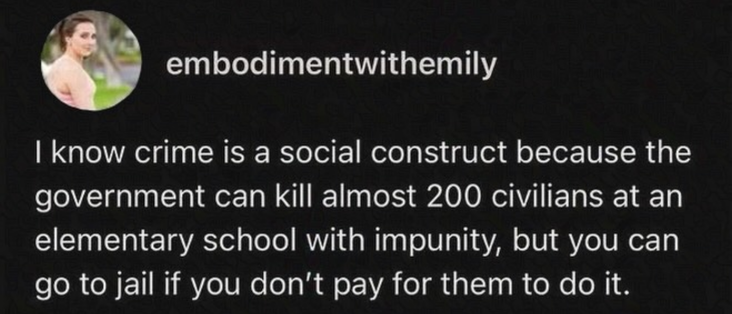
Similarly, a politician can abuse kids with impunity, but you can go to prison for seeing pictures of him doing it (or of others doing the same).
I’m not saying that possession of CSAM shouldn’t be illegal, but if we’re not prosecuting the crimes they depict, then is what they depict the crime or is it the knowledge it’s happening and who’s doing it?
It’s easy to get away with crime, though.
Step 1: have parents who are billionaires
Depends? Morality like “don’t steal” is partially a consequence of game theory. Game theory is math.
Is math a social construct - obviously not.
The biggest fault of Game theory is that it is biased towards instant utility and short-term rewards. It does not model for scenarios where reduced short-term rewards can lead to greater gains in the long-term.
In short, decisions made for singular benefit typically have worse long-term results than decisions accounting for collective benefit.
That’s the point of government: the state has a monopoly on the legitimate use of physical force.
That’s from “Politics as a Vocation” by Max Weber. It’s also why the population needs to beat back if that violence isn’t legitimate (i.e. it’s abusing the population in the first place).
Or dissolve the government and realise offloading societal obligations to use violence to a hierarchical organisation is not the solution.
If there must be violence, let it come from the people for the people.
that’s how speech works. people make up what they say.
when making claims about the natural world, doing that is worse than just keeping your mouth shut.
Weber did mean to legitimize the state but his reasoning can easily be turned from prescriptive to descriptive: we define the state as merely the entity with monopoly on violence over an area. Who decides what is “legitimate” violence? Why, the state, of course: by definition, it has the means to impose its views.
The Weberian idea is there are legitimate non-violent politics that the state offers itself to, which therefore allow the state to use violence against unlegitimate politics that don’t “play by the rules”. However since the state itself decides what is allowable or not, and since any unallowable political group will turn violent or disappear when faced with the violence of the state, we just land back where we started: the state has a monopoly on violence and that is what decides what is “legitimate” politics, and therefore what is legitimate violence.
The current labelling of political opponents as terrorists by the US government is illustrative of that. Some Weberians have you believe that is all legitimate since after all there indeed was an election.
 CerebralHawks
 redsand
 ultrafastsloth
 MinnesotaGoddam
 explodicle
 zenzanzoo
 NostraDavid
 AeonFelis
 MattTheTekie