 rbanffy
In Japan, the robot isn't coming for your job; it's filling the one nobody wants

"No one wants" usually includes an insufficient wage, sometimes also an issue of insufficient investment in training for skilled folks. eg if you need a doctor in 12 years you have to start more or less today.
A quick google suggests ~18% of their working age people do not have jobs, which naturally could be shifted by incentives like money or training.
(Edit, because people are confused, I'm not talking about unemployment rate, i'm talking about labor non-participation rate as a measure of people who could be enticed into the workforce with a living wage)
18% is one of the.lowest rates on the planet. 4th in fact.
This includes early retirees, full time students, home makers and people unable to work for health related reasons.
It's still 10s of millions of people who could be given a job (and some hope and purpose too btw)
Edit: btw I agree there's more to life than work. But when you're unemployed and hoping for work, competing against robots and LLMs is quite crushing.
Why would the retirees want to be put back to work?
Why would the students want to have to do two full-time tasks at once?
Why would the homemakers want to add another full-time task?
Why would the people with cancer want to have to work from their hospital bed?
There's more to life than work. Get a hobby! Hope and purpose doesn't have to come from menial labor.
Money, money, money, and money. We need it to survive. Until people's basic needs are taken care of for them, they need to do what they can to live.
Why not simply pay the homemakers? Why is it so important that everyone produce economic output at the widget factory?
Allow me to translate into a language you can understand: The people who are all “unemployed” are actually performing valuable services like maintaining the future labor pool, learning how to become skilled workers, and so on. These people should not have a second job, they should be paid for the valuable services they’re providing.
Sounds good. You're welcome to pay those people as much as you like. No one is stopping you.
Huh. You used to be concerned with declining birth rates.
IMO, basic income for parents is absolutely a policy that Japan should enact.
And the question of how much the payment should be has a straightforward answer: adjust until the birth rate reaches replacement.
If the payment ends up high enough that some mothers or fathers opt to leave the labor force to focus on raising their kids, then so be it; that's probably healthier for society in the long term.
It would be expensive, yes, but cheaper than the alternatives. And anyway, Japan's stagnant economy would likely benefit from the boost to consumer demand.
You didn't answer the question, you answered a different question: "why would someone want to work, just in general?" The question that was posed was, why would someone who has already chosen to retire, or who is already fully occupied, or who is sick, want to work?
Humans are older than money, so evidently we don't need it to survive, but there is more to existence than mere survival. I agree that people's basic needs to be taken care of, but I think that is an issue that needs to happen because of automation. It needs to happen because it is simply the right thing to do. I would go as fas as saying It shouldn't just be basic needs. Society should be aiming to provide the entire hierarchy of needs for everyone.
I think having employment delivers some of the higher needs to a subset of people, but it is a privileged few. A huge number work just to provide the basic needs. Advocating using the advances in automation to raise everybody up is what we need. Instead we seem to be maintaining a system that gives a few what we want and the rest of us are too busy with the survival part to influence that change.
> Society should be aiming to provide the entire hierarchy of needs for everyone.
I don’t know. Society should provide the framework within which people can achieve their needs (and wants), but not the needs and wants themselves directly.
Otherwise you put an artificial cap on human growth and inefficient allocation of resources.
Japan has one of the lowest unemployments on the planet, 2.5%.
Virtually all that don't work don't want to and don't need to or simply can't.
As the article we're commenting points out Japan has a labor shortage.
But this guy googled it and apparently there are 18% of Japanese people not working, so obviously their entire society pivoting towards automation is wrong.
Yep. In a society with an aging population and a low birth rate, people who would prefer to be full-time parents staying home and raising their kids ought to instead be doing undesirable, monotonous, easily-automatable jobs that robots can do. Or at least two families could agree to pay each other to raise the other's children, so that it counts as employment, rather than raising their own. Yes, maximizing labor force participation... That's how things ought to be.
I don't know what's more crushing, not having a job, or knowing deep-down that there is a machine that can trivially do your job.
If I was made to lamp street lamps 5 years after incandescent street lights were invented, while not working on any way forward, I'd probably fall into a deep existential crisis.
Indeed. My first job was in a factory doing things that we had machines to do, but not enough of them or efficient enough. I spent the whole time dreaming of automating the factory properly.
I agree with aspects of what you mean. But there are exceptions on both sides.
Ofc people dont want to become human fax machines (Morse decoders) nowadays, it would feel absurd.
But also if a role allows someone to feel satisfaction in accomplishment and in being an active member of a society it can be meaningful. For example tidying up streets/yards in low income neighborhoods can make the place look much better and you can feel like you're serving folks who are in need.
I think that nihilistic sentiment arises only when you are materially satisfied, maybe in the 90s and 00s (like office workers in Fight Club or Office Space). Many of us are in survival mode now. We just need money to keep up with inflation. We don't have time to think about the deep meaning of life.
Huge amounts of effort go to feeding our desires, and to feeding our fears, but it actually doesn't take much to meet our needs.
Only 2% of our efforts as a society go to getting food out of the ground.
The reason to have a job, to own property, to earn and spend money, to reproduce and fight in wars, it seems, is to maintain a valid stake in the whole game lest your masters designate you an undesireable.
For said master the more viable the alternatives to humans become, the more all those excess humans start to look like a liability.
Japan's employment rate is hard to compare, in that many of these job just wouldn't be seen as real jobs in any other country ("bullshit job"), and it's compound by half of the population being over 50. A high employment among the elderly could just be masking the harsher truth when that upper half passes away.
> A quick google suggests ~18%
FWIW, this figure looks to be the fraction of 20–69 year olds in the entire population who are unemployed[0]. Referencing the official definitions[1], the standard unemployment figure of 2.6 (as of 2026-02) narrows that denominator to people who are receiving wages or actively looking for work.
> which naturally could be shifted by incentives like money or training.
From the above, 18% seems like the wrong number to look at. Heck, why not quote 38.1%, since it captures everyone who can legally work (including 15 and 90 year olds)?
IMO, the base population we want to look at is people who actually want a job, which is captured by various Labor Underutilization (LU) metrics. These all hover around 2.5–6.0% according to public records[2], and are also defined in the official docs[1].
[0]:https://www.stat.go.jp/data/roudou/sokuhou/tsuki/pdf/gaiyou....
[1]:https://www.stat.go.jp/data/roudou/pdf/hndbk5_2.pdf
[2]:file:///var/folders/96/k0p95wxn7sg5_xjnv5n233bc0000gn/T/gaiyou-1.pdf
I agree with the teachers one. Having one lady in charge of educational instruction for that many kids will be looked back upon as barbarism.
So the solution is to have less ladies in charge? Who's going to wipe snot off the kids' noses, pull legos out of their mouths, and tell them not to hit each other?
> Who's going to wipe snot off the kids' noses, pull legos out of their mouths, and tell them not to hit each other?
The robots? That's what we're discussing in this thread.
The solution is more teachers, smaller class sizes and not underpaying and abusing teachers to function as nanny’s also charged with raising your children.
This isn’t exactly a mystery problem, we’ve understood clearly how to educate humans well for quite a while. It’s just that doing it properly is “eXpEnSiVe” as if the alternative, isn’t quietly orders of magnitude worse, and more costly.
Even if you doubled the number of teachers (which you won't), we're still not getting to anything that resembles individual instruction.
We're still basically warehousing those kids, and we can do better.
I want AI to do my laundry and dishes so that I can do art and writing, not for AI to do my art and writing so that I can do my laundry and dishes.
From: https://x.com/AuthorJMac/status/1773679197631701238
As a species, we need to evaluate our attitudes to work. The quote above resonates at some level, but maybe there are some people who enjoy doing dishes and laundry, who knows.
Most people are just surviving. It is a constant battle between slaving away in jobs (and have healthcare tied to our jobs) we don't like and rest of our lives, including relationships, hobbies, even health. Most people do not have the time or energy to think about anything else other than just getting through the day.

The funny thing is that dishes and laundry are already automated and people are still complaining about them.
Do we need a humaniform robot to move the clothes from the washer to the dryer? Maybe we just need smarter appliances.
The job no one wants?
Grunting out 2.6 babies before you’re 35.
Who’s paying for your nursing home?
Tax the robot’s income?
Will your demographic replacements vote for that?
> Who’s paying for your nursing home
Japanese financial institutions massive capital positions across Asia, the US, and Europe which tend to be public-private ventures.
> Tax the robot’s income
Pretty much, in the sense that corporations and the Japanese government have spent decades working together to build a sovereign wealth model comparable to Singapore and the UAE's.
This is something that really needs to be done in the states imo.
IIRC we don't have a sovereign wealth fund, but we should in order to provide a social safety net for our citizens, especially with all the uncertainties regarding the future right now.
> Grunting out 2.6 babies before you’re 35.
* destroying your body, stripping your bones, getting diabetes and temporarily (or permanently) disabling yourself with issues no healthcare provider will take seriously for decades to come for 2.6 babies in your youth.
–––
Someone called this a "belief."
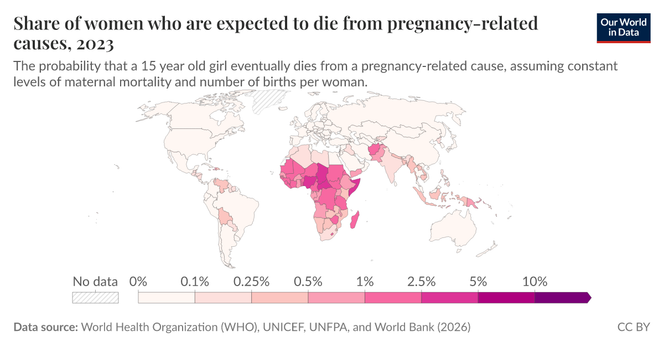
There's a 10% to 4% probability that the average teenage girl will die from childbirth, given the cumulative risk of pregnancies in nations without modern medicine.
That's the default state of the human condition. Maternal mortality is frequent and 1 in 25 to 1 in 10 for women without modern medical interventions.
see: The probability that a 15 year old girl eventually dies from a pregnancy-related cause, assuming constant levels of maternal mortality and number of births per woman. https://ourworldindata.org/grapher/lifetime-risk-of-maternal...
There's a reason why the more women become aware of the risks and downsides of pregnancy – the less likely they are to go through with it. Even when indoctrinated from the start. The only sane solution in an otherwise insane world is technological, external gestation / exowombs.
Indeed. Gotta keep that body in a tip-top shape so that we can pull off all-nighters at some dude's AI startup while eating pizza and pretzels.
Lol my wife is in better shape now after kids than when she was pregnant, and she was in amazing shape before.
For some people having kids crystallizes the importance of health, etc.
This happens, but it's not representative. Interesting belief, it seems like it should be self-extinguishing, the cultures that don't believe this kind of thing will tend to take over over time.
Most of the world is below replacement rate (~2.1 TFR), the rest will get there in a decade or two. Educated, empowered women delay having children, have less children, or no children. Holds across both developed and developing countries.
https://www.pewresearch.org/short-reads/2025/08/15/5-facts-a...
https://www.sas.upenn.edu/~jesusfv/Slides_London.pdf
https://www.visualcapitalist.com/cp/mapped-countries-by-fert...
The world, yes, but specific niches no. Look at the Mormons, or Nigeria, or Somalis in America at 3x the US birthrate.
Latter-day Saints are having fewer children. Church officials are taking note - https://www.npr.org/2025/10/31/nx-s1-5535654/latter-day-sain... - October 31st, 2025
> Dallin H. Oaks, the newly appointed prophet and president of the church, said that while birth rates within the church are higher than national numbers, they've still declined "significantly."
> Catholic University of America demographer Stephen Cranney crunched the numbers on the religion's families. In 2008, about 70% of Latter-day Saint women ages 18-45 had at least one child at home. In 2022, that number was 59%, a rate of decline mirrored in the American population at large.
Any uptick in birth rate in the US from first generation immigrants quickly reverts to the mean for subsequent generations.
The Fertility of Immigrants and Natives in the United States, 2023 - https://cis.org/Report/Fertility-Immigrants-and-Natives-Unit... - May 1st, 2025
Reproductive freedom (or rather, freedom from reproduction, and its costs and burdens) is culturally contagious.
"Latter-day Saints still have more children"
That study has 7 to 12% error ranges for the LDS group. Even with that, the share of LDS women with a child at home is 50% more than non-LDS. Lastly, there's a huge difference in rate of decay when a group is at, above, or below replacement rate. If everyone's declining, but they're declining far slower, that still proves my point that the composition of these communities in 80 years could be far different if current rates hold.
Utah has one of the most expensive housing markets in the country, and average children per women is 1.8 in the state. It’s always hard to predict the future, but I argue the evidence is clear LDS fertility rates will rapidly coalesce with others within the next few years, maybe faster if young followers leave the church faster.
Utah slides to No. 10 for fertility in U.S. - https://www.deseret.com/family/2025/04/07/utah-drop-fertilit... - April 7th, 2025
US Gen Zers and millennials are leaving the LDS church, data confirms - https://religionnews.com/2025/12/10/us-gen-zers-and-millenni... - December 10th, 2025
> In 2007, according to Pew, the LDS church retained 70% of childhood members in the U.S. (n = 581) In 2014, that was 64% (n = 661), and in 2023–24 it had declined still further to 54% (n = 525).
> That 54% current retention rate looks better than the GSS’ 38%, so that’s potentially good news for LDS leaders. But once again, we’re witnessing a clear drop from the fairly recent past. Both major U.S. surveys that track childhood affiliation are saying that more people are leaving than used to.
> What’s more, this is being driven by younger adults. In the general population, younger adults are noticeably more likely to have no religious affiliation than older adults — either because they’ve left religion or they grew up without one. It shouldn’t surprise us that it’s true in Mormonism as well.
So, the cohort leaving the church the fastest are the ones with fertility. What does this do to LDS fertility rate trends? It likely bends them downward.

Right, it looks pretty catastrophic for some areas (eg South Korea) if it doesn’t stabilize.
But I’m also skeptical of anything that extrapolates anything related to human behavior out 75 years.
Once you hit ~1.5 TFR, low fertility trap kicks in.
> Demographers in the early 2000s coined the “low-fertility trap,” hypothesizing that a series of self-reinforcing economic and social mechanisms make it increasingly difficult to raise the fertility rate once it dips below a certain threshold. The academics posited that lower fertility results in increased individual aspirations for personal consumption but at the same time it also results in an aging population and less job creation—and thus greater pessimism about the economic future—which in turn disincentivizes having more children. Moreover, as the average family size grows smaller and smaller generation after generation, the social norm of an ideal family size shrinks, too. These forces together lead to a persistent “downward spiral” for the fertility rate that can be impossible to reverse.
> China’s not the only country in the region or the world facing this kind of demographic crisis. Fertility rates across developed nations globally have almost uniformly dropped over the last few decades. China’s neighbors Japan and South Korea have among the lowest, and policymakers there have invested billions of dollars and pondered uniquely targeted policies, respectively, to try—so far unsuccessfully—to get young people to have more children.
https://time.com/6306151/china-low-fertility-trap-birth-rate...
https://onlinelibrary.wiley.com/doi/10.1111/j.1728-4457.2005...
Most women have watched someone go through a difficult pregnancy in their lives before they hit 20. It's not a "belief" for the people who live through it.
People used to die – frequently – from this "belief." And women still do.
The belief I was talking about was that that was at all representative of the median case, and the implication that it’s not worth the risk to have kids (this was before you added the big chunk about mortality being 4-10% in places without a good medical system). I have first hand experience of some of the potential difficulties, so I know it happens, but I also know that it’s not every pregnancy, most are fine, and that if you do have difficulty, a high quality healthcare system can usually get you through it.
And this belief is interesting, because it seems like one of the most evolutionarily unfit ideas possible, at least on the individual level. But maybe it’s good for the survival of the group if it decreases resource contention.
off topic. all risks you mention are in developing countries without good medicine. that's not Japan.
I went to a chain Family Restaurant recently here in Japan. The food is brought by a robot for a while now. Recently you get your seat selected at a touchscreen. You can pay at your table's tablet using PayPay. There is still some waiter staff, but it being reduced to the past. The only part that did not change much yet is the kitchen.
I said to myself to stop going, if there is no human staff left. On the other hand, small shops with good atmosphere are thriving.
I think that many signs are indicating that Japan will re-emerge as a major technology powerhouse in the coming decades. And being confronted early to demographic transformation will end-up being an advantage. On the opposite side I think that immigration is a temporary band-aid that doesn’t solve any of the structural issues.
Can you share some other signs you think may indicate it rising as a powerhouse? Living in Japan, I am interested what others see.
Regarding immigration, Japan is actually making it a lot stricter now. Not sure how that will play out.
Miti is basically a second government with real power, finance and expertise, and they appear to bet on the correct things, it should have happened earlier but from what I have seen they are moving faster than EU on the semiconductor and robotics fronts.