 rbanffy
In Japan, the robot isn't coming for your job; it's filling the one nobody wants

The job no one wants?
Grunting out 2.6 babies before you’re 35.
Who’s paying for your nursing home?
Tax the robot’s income?
Will your demographic replacements vote for that?
> Grunting out 2.6 babies before you’re 35.
* destroying your body, stripping your bones, getting diabetes and temporarily (or permanently) disabling yourself with issues no healthcare provider will take seriously for decades to come for 2.6 babies in your youth.
–––
Someone called this a "belief."
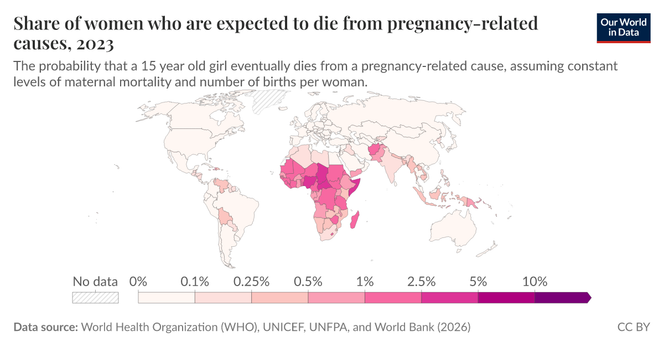
There's a 10% to 4% probability that the average teenage girl will die from childbirth, given the cumulative risk of pregnancies in nations without modern medicine.
That's the default state of the human condition. Maternal mortality is frequent and 1 in 25 to 1 in 10 for women without modern medical interventions.
see: The probability that a 15 year old girl eventually dies from a pregnancy-related cause, assuming constant levels of maternal mortality and number of births per woman. https://ourworldindata.org/grapher/lifetime-risk-of-maternal...
There's a reason why the more women become aware of the risks and downsides of pregnancy – the less likely they are to go through with it. Even when indoctrinated from the start. The only sane solution in an otherwise insane world is technological, external gestation / exowombs.
This happens, but it's not representative. Interesting belief, it seems like it should be self-extinguishing, the cultures that don't believe this kind of thing will tend to take over over time.
Most of the world is below replacement rate (~2.1 TFR), the rest will get there in a decade or two. Educated, empowered women delay having children, have less children, or no children. Holds across both developed and developing countries.
https://www.pewresearch.org/short-reads/2025/08/15/5-facts-a...
https://www.sas.upenn.edu/~jesusfv/Slides_London.pdf
https://www.visualcapitalist.com/cp/mapped-countries-by-fert...

Right, it looks pretty catastrophic for some areas (eg South Korea) if it doesn’t stabilize.
But I’m also skeptical of anything that extrapolates anything related to human behavior out 75 years.
Once you hit ~1.5 TFR, low fertility trap kicks in.
> Demographers in the early 2000s coined the “low-fertility trap,” hypothesizing that a series of self-reinforcing economic and social mechanisms make it increasingly difficult to raise the fertility rate once it dips below a certain threshold. The academics posited that lower fertility results in increased individual aspirations for personal consumption but at the same time it also results in an aging population and less job creation—and thus greater pessimism about the economic future—which in turn disincentivizes having more children. Moreover, as the average family size grows smaller and smaller generation after generation, the social norm of an ideal family size shrinks, too. These forces together lead to a persistent “downward spiral” for the fertility rate that can be impossible to reverse.
> China’s not the only country in the region or the world facing this kind of demographic crisis. Fertility rates across developed nations globally have almost uniformly dropped over the last few decades. China’s neighbors Japan and South Korea have among the lowest, and policymakers there have invested billions of dollars and pondered uniquely targeted policies, respectively, to try—so far unsuccessfully—to get young people to have more children.
https://time.com/6306151/china-low-fertility-trap-birth-rate...
https://onlinelibrary.wiley.com/doi/10.1111/j.1728-4457.2005...