rbanffy
In Japan, the robot isn't coming for your job; it's filling the one nobody wants

The job no one wants?
Grunting out 2.6 babies before you’re 35.
Who’s paying for your nursing home?
Tax the robot’s income?
Will your demographic replacements vote for that?
> Grunting out 2.6 babies before you’re 35.
* destroying your body, stripping your bones, getting diabetes and temporarily (or permanently) disabling yourself with issues no healthcare provider will take seriously for decades to come for 2.6 babies in your youth.
–––
Someone called this a "belief."
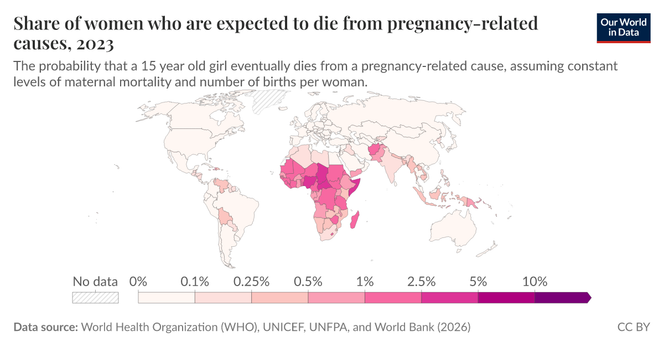
There's a 10% to 4% probability that the average teenage girl will die from childbirth, given the cumulative risk of pregnancies in nations without modern medicine.
That's the default state of the human condition. Maternal mortality is frequent and 1 in 25 to 1 in 10 for women without modern medical interventions.
see: The probability that a 15 year old girl eventually dies from a pregnancy-related cause, assuming constant levels of maternal mortality and number of births per woman. https://ourworldindata.org/grapher/lifetime-risk-of-maternal...
There's a reason why the more women become aware of the risks and downsides of pregnancy – the less likely they are to go through with it. Even when indoctrinated from the start. The only sane solution in an otherwise insane world is technological, external gestation / exowombs.
This happens, but it's not representative. Interesting belief, it seems like it should be self-extinguishing, the cultures that don't believe this kind of thing will tend to take over over time.
Most of the world is below replacement rate (~2.1 TFR), the rest will get there in a decade or two. Educated, empowered women delay having children, have less children, or no children. Holds across both developed and developing countries.
https://www.pewresearch.org/short-reads/2025/08/15/5-facts-a...
https://www.sas.upenn.edu/~jesusfv/Slides_London.pdf
https://www.visualcapitalist.com/cp/mapped-countries-by-fert...
The world, yes, but specific niches no. Look at the Mormons, or Nigeria, or Somalis in America at 3x the US birthrate.
Latter-day Saints are having fewer children. Church officials are taking note - https://www.npr.org/2025/10/31/nx-s1-5535654/latter-day-sain... - October 31st, 2025
> Dallin H. Oaks, the newly appointed prophet and president of the church, said that while birth rates within the church are higher than national numbers, they've still declined "significantly."
> Catholic University of America demographer Stephen Cranney crunched the numbers on the religion's families. In 2008, about 70% of Latter-day Saint women ages 18-45 had at least one child at home. In 2022, that number was 59%, a rate of decline mirrored in the American population at large.
Any uptick in birth rate in the US from first generation immigrants quickly reverts to the mean for subsequent generations.
The Fertility of Immigrants and Natives in the United States, 2023 - https://cis.org/Report/Fertility-Immigrants-and-Natives-Unit... - May 1st, 2025
Reproductive freedom (or rather, freedom from reproduction, and its costs and burdens) is culturally contagious.
"Latter-day Saints still have more children"
That study has 7 to 12% error ranges for the LDS group. Even with that, the share of LDS women with a child at home is 50% more than non-LDS. Lastly, there's a huge difference in rate of decay when a group is at, above, or below replacement rate. If everyone's declining, but they're declining far slower, that still proves my point that the composition of these communities in 80 years could be far different if current rates hold.
Utah has one of the most expensive housing markets in the country, and average children per women is 1.8 in the state. It’s always hard to predict the future, but I argue the evidence is clear LDS fertility rates will rapidly coalesce with others within the next few years, maybe faster if young followers leave the church faster.
Utah slides to No. 10 for fertility in U.S. - https://www.deseret.com/family/2025/04/07/utah-drop-fertilit... - April 7th, 2025
US Gen Zers and millennials are leaving the LDS church, data confirms - https://religionnews.com/2025/12/10/us-gen-zers-and-millenni... - December 10th, 2025
> In 2007, according to Pew, the LDS church retained 70% of childhood members in the U.S. (n = 581) In 2014, that was 64% (n = 661), and in 2023–24 it had declined still further to 54% (n = 525).
> That 54% current retention rate looks better than the GSS’ 38%, so that’s potentially good news for LDS leaders. But once again, we’re witnessing a clear drop from the fairly recent past. Both major U.S. surveys that track childhood affiliation are saying that more people are leaving than used to.
> What’s more, this is being driven by younger adults. In the general population, younger adults are noticeably more likely to have no religious affiliation than older adults — either because they’ve left religion or they grew up without one. It shouldn’t surprise us that it’s true in Mormonism as well.
So, the cohort leaving the church the fastest are the ones with fertility. What does this do to LDS fertility rate trends? It likely bends them downward.