I'm a big fan of this explanation/rant from Andrew Murphy.

Taken as a whole, there are many bottlenecks in a corporate software development process. The "load-bearing" calendar is a great example!

Speeding up code creation just increases pressure on the bottleneck, which decreases throughput.

https://andrewmurphy.io/blog/if-you-thought-the-speed-of-writing-code-was-your-problem-you-have-bigger-problems

If you thought the speed of writing code was your problem - you have bigger problems | Debugging Leadership

AI coding tools are optimising the wrong thing and nobody wants to hear it. Writing code was already fast. The bottleneck is everything else: unclear requirements, review queues, terrified deploy cultures, and an org chart that needs six meetings to decide what colour the button should be.

Debugging Leadership

So why are we still trying to optimize code creation?

For decades, people with power - executives and product people - have been shifting the blame for strategy failures and poor market insight onto development "productivity."

This AI moment should be incredibly clarifying. Like, it should be the reductio ad absurdum of a productivity-centric approach.

The fact that we are *not* seeing wildly improving software all around us tells us everything we need to know.

There is no flourishing of value delivery, new product categories, more needs being satisfied better. It’s the opposite.

All we are seeing is decreases in quality, because 👏 code 👏 creation 👏 is not 👏 the problem.

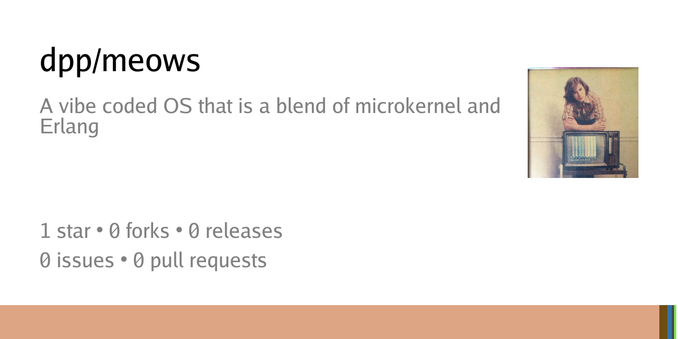
@elizayer @hbons give me some time. I’ve only been using LLMs to code for a few months… so far I’ve only managed to write an operating system https://codeberg.org/dpp/meows
A new scripting language https://codeberg.org/dpp/meowscript
An eBPF to FPGA converter https://codeberg.org/dpp/lycaon
And some misc utils
But this is weekend work
meows

A vibe coded OS that is a blend of microkernel and Erlang

Codeberg.org
@dpp @elizayer @hbons maybe llm will bring high achievers closer together so they can develop a really new innovative computing baseline

@dpp @elizayer @hbons Who’s using it, and what for?

So you created some things quickly. Now they exist. If that’s all they ever do, you spent (likely) thousands of dollars on agent time to create something for no reason.

So what?

@dpp and somehow, all these boatloads of incredible new projects (not picking specifically at yours) managed to have approximatively 0 impact. (I’m talking about positive impact of course, the negative ones are well documented).
But as long as you have fun helping destroying society, you do you! Otherwise, maybe pick up playing ukulele or something?

@elizayer @hbons

@ced @elizayer @hbons we are posting via a tool that was developed by an imperial government to ensure communications could survive after a nuclear war.

We are using a toxic form of communication (oh… yeah… mastodon is toxic light) that has destroyed the trust in institutions and is the proximate cause of the rise of authoritarian regimes

Yes, I use tools that have negative externalities.

I use these tools to explore and create.

You don’t like it, ignore me.

@dpp

“The world is bad already, so let’s make it worse” 👏
Have fun !

@elizayer @hbons

@ced @dpp @elizayer I don't think AI use is productive or in our (the working class) interest. but let's be nice and people who do decide to use it for whatever reason are not bad people.

@hbons true, and not implying people are bad, just maybe not thinking about the consequences, or not caring about them (in which case I see no reason to interact with them anymore)

@dpp @elizayer

@dpp @ced @elizayer @hbons it somehow fits that someone likes bad quality of the source code doesn't care about the quality of his source. No, this was not developed for surviving after a nuclear war. This all started with Californian hippies at Californian Universities who wanted connect with each other. They were just clever enough to get money for it with using your argument.

So already your first claim is wrong...

@stevE @dpp @ced @elizayer you’re not going to convince anyone by personally directing facepalm emoji at them. it’s just mean.
@hbons @dpp @ced @elizayer i don't think i would or even could convince him ...
... and i never considered a face palm emoji mean but more of an expression of desperate resignation. Looks like an intercultural misunderstanding i was not aware of. So thank you for pointing it out.

@dpp @elizayer @hbons

after a few minutes with that codebase:
cool test case bro (it should check the const and not a hardcoded value) https://codeberg.org/dpp/meows/src/commit/73bb89ecc559b5bd023e2d179b1b0cef177a61e5/plugins/devmgr/src/probe.rs#L205

I found another bug typical for slop (discrepancy between an explaining comment and what the code actually does - comment is correct but code is wrong) and an architecture mistake, sadly you'll have to discover those yourself or pay me 🙃

meows/plugins/devmgr/src/probe.rs at 73bb89ecc559b5bd023e2d179b1b0cef177a61e5

meows - A vibe coded OS that is a blend of microkernel and Erlang

Codeberg.org

@dngrs @elizayer @hbons I appreciate that you’ve reviewed the code (I say this with honesty and no sarcasm)

There is plenty wrong with it. It’s about exploring, not a final shippable OS

The OP asked where the innovation is. This is an example of an OS (it boots on real hardware) that explores MACH style message passing and Elang style supervisor hierarchies

It’s part of broader exploration into local first and end to end encrypted systems

@dpp @elizayer @hbons can you quantify by how much llm made your work faster? Or would you have simply not been capable of doing the work without an LLM?
@dpp @elizayer @hbons I looked at your eBPF to FPGA project. (I'm an FPGA guy by day.) I think it is pretty clear _what_ you want it to do, but I think I'm struggling to understand the motivation. Maybe you just haven't got to writing a README.md where you would record such motivation, but I would love to understand why you wrote this or what end application you have in mind.
@poleguy @elizayer @hbons much of eBPF is used for managing network traffic. Many high end NICs have onboard fpgas. Being able to unify the code (eBPF in low end, fpga in high end) seemed interesting.

@dpp @elizayer @hbons Thanks for the responses. It's not clear to me that general purpose eBPF translation into FPGA code is a valuable route. It seems to be optimizing for ease of development while at the same time trying to hit high performance (or else, why the FPGA?).

I understand you to be mostly exploring here, correct?

It doesn't seem you actually got to synthesis or performance measurement.

The only need for eBPF in the first place would be to run user code in the kernal, right?

@poleguy @elizayer @hbons you’re right. I don’t know enough about fpgas to go beyond “it blinks pretty lights” to “its production ready”

Part of the meta exploration has been “beyond assembling a common app (a web site) how much domain knowledge does the human need to get a good result?”

The answer seems to be I need deep domain knowledge… thus the fpga exploration… I don’t have the domain skills to make this a production reality

@poleguy @elizayer @hbons otoh, going from “eBPF which is guaranteed to halt” to “let’s make a circuit out of code that’s guaranteed to halt” has a nice feel to it even if the circuit is absurdly slow

@poleguy @elizayer @hbons I’ve been working on meowscript on and off for 15 years. I originally presented it as Visi at the emerging languages summit 2011 where I shared the stage with Rust and Julia (maybe it was 2012)

In a few months I was able to iterate on the prototype multiple times (eg integrating unit types).

The ability to throw away bad ideas quickly rather than sunk costing suboptimal designs has been liberating

@poleguy @elizayer @hbons I wouldn’t have started on MeowOS but for having a tool that could rapidly iterate on machine crashes and remediate the issues.

Once again the freedom to explore and the ability to say “try these three approaches and show me the performance differences” while I looked at the code complexity differences.