Something I have trouble explaining about space travel. Like, if you've read my book, you know I think human space faring is probably not economically valuable. It's not a good use of science dollars compared to other areas. I'm even skeptical of the case for inspiration (it doesn't seem to causally related to more aerospace degrees).

But it's also just really cool. Why don't I feel this way about Antarctica or Seabed exploration?

@ZachWeinersmith Antarctic exploration *was* sexy 100-150 years ago, though! We kind of remember Captain Scott's ill-fated South polar expedition, but less so the ferocious international rivalry that drove it (or Norwegian explorer Roald Amundsen who got there first and survived).

In contrast, now we have Antarctic bases, familiarity breeds … boredom?

@cstross @ZachWeinersmith
Amundsen–Scott Was the original “Heated Rivalry” on ice.
@cstross @ZachWeinersmith Off topic, but a podcast on the Scott expedition was how I found out just how bad scurvy was and what *specifically* it did. I still have occasional trauma flashbacks to “and then the scar from when he was sixteen opened up”….
@cstross @ZachWeinersmith Exactly. Similar for undersea exploration in the 1940s to 1960s (roughly). What makes space special is its enduring and outsize role in popular culture. "Antarctic opera" or "Undersea opera" don't have the same draw as their space equivalent.

@cstross @ZachWeinersmith I feel compelled to mention the number of 1900s and 1910s science fiction boys novels about arctic or antarctic exploration.

I just finished "through the air to the north pole" a not especially noteworthy entrant in the genre.

This kind of thing was absolutely the stuff of dreams and ambition prior to the age of commercial flight.

@cstross @ZachWeinersmith Perhaps unsurprisingly, here in Denmark we *do* remember Roald Amundsen. There are streets named after him and the like.

(But we have little if any cultural memory of Scott.)

@datarama @cstross @ZachWeinersmith

TBF, Scott didn't make it.

@lemgandi @datarama @ZachWeinersmith Scott *did* make it to the South Pole! But he got there weeks after Amundsen then his entire team died before they got back to base. (Killed by spectacularly bad weather, even by Antarctic standards.)

@cstross @datarama @ZachWeinersmith

Ah, you right and I am wrong.

Not makin' it back is a pretty big deal tho.

@lemgandi Yeah, it was Shackleton who didn’t make it there. But he did make it back without losing a man, which makes him a way bigger hero than Scott, if you ask me.
@pdcawley @lemgandi
👍
Agreed. Rescuing his stranded crew was an odyssey on part with the classics.
@cstross @lemgandi @datarama @ZachWeinersmith nope. Killed by arrogant imperial incompetence and cutting things too fine.

@alanpaxton @cstross @lemgandi @datarama @ZachWeinersmith I would not call it “arrogant imperial incompetence.” First a rendezvous failed as the rest of Scott’s team simply failed to show up as expected, and then after prolonged bad weather, Scott and his last companions got stuck another 10 days in a blizzard just 20 km (12 mi) short of the final depot / meeting place.

All these arctic/antarctic explorers had to have some level of hubris to try so hard to be first. Given the competition, nobody was going to be first without significant risks.

The real shocker with Antarctic exploration is that there weren’t MORE deaths. These expeditions were all inherently risky. There were too many unknowns, & safety margins were not high enough to protect against all risks.

@alanpaxton @cstross @lemgandi @datarama @ZachWeinersmith Special shout-out to Shackleton: hard to believe he didn’t lose anyone from Endurance. (Though three of his “Lost Men” laying supply caches did die, as is oft forgotten.)

@tphinney @alanpaxton @cstross @lemgandi @datarama @ZachWeinersmith a TV company re-enacted some of the expedition with like-for-like materials and food. The Scandinavian team ate like kings and actually gained weight, but the Brits all lost weight and were suffering malnutrition so the programme had to be stopped before they suffered long term effects.

Scott gambled and in most years would have made it back alive, but Amundsen had the better materials and food however you look at it.

@drajt @tphinney @alanpaxton @cstross @lemgandi @ZachWeinersmith I read a while ago that a lot of the decisions Amundsen made while preparing the expedition (including diet, clothing, transportation) were based on things he'd learned while staying with Inuit for a winter. They taught him their own Arctic survival skills, which he concluded worked a lot better than modern European approaches. Hence the heavy furs, the dog sleds rather than motorized vehicles, etc.
@datarama @drajt @tphinney @cstross @lemgandi @ZachWeinersmith The Huntford dual biography discusses this. Amundsen spent 3 years in the Arctic as the first to sail the Northwest Passage. In that telling he basically set out to learn all he could from the Inuit.
@tphinney @cstross @lemgandi @datarama @ZachWeinersmith oh they were definitely taking significant risks all the time. But Huntford is prettty damning of Scott’s leadership failings causing most of his own problems, making it terribly unclear who would be in a position to rescue him if indeed he needed rescued. Did for Cherry-Garrard’s mental health agonising over whether he could have done something different to save them.
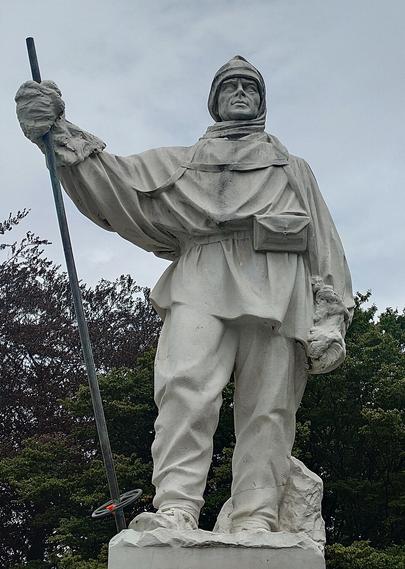
Statue of Robert Falcon Scott, Christchurch - Wikipedia

@bigblen @cstross @ZachWeinersmith As far as I know there aren't any Amundsen statues in Denmark, but there are some in Norway. In Oslo, there's actually a monument with five statues, one of each of Amundsen's expedition members who reached the South Pole (including himself, of course).

I used to live just a couple of streets away from one of those streets named after him. When I was a kid and we learned about the history of polar exploration, we got a long story of Amundsen's expedition - and Scott got only a brief mention.

@bigblen In fairness, we also have a big bronze bust of Amundsen. He has a very shiny nose, because it is considered lucky to touch it when you visit the museum.

A journalist looked into this a few years ago, and it turns out that this tradition dates back to the 1960s, when a tour guide found himself with time to fill. He made up a local legend about Amundsen's nose having aphrodisiac qualities and the tourists all queued up to touch it.

https://ehive.com/collections/3003/objects/50/bust-of-roald-amundsen

@datarama @cstross @ZachWeinersmith

@isaacfreeman @bigblen @datarama @cstross @ZachWeinersmith
There was an #Antarctic expedition museum in #Christchurch NZ before the earthquake, which I visited briefly and hurriedly.

@Photo55 That's the one: the Antarctic gallery in Canterbury Museum.

The whole museum is currently closed for a five-year rebuild, so a generation of children is missing out on seeing the giant moa and blue whale skeletons, the meteorite you're allowed to touch, the mummy Tash Pen Khonsu, the reproduction Victorian street, the racist 1980s dioramas of early Māori (not coming back), the gallery of later Māori culture that did a better job, and Amundsen's nose.

https://www.canterburymuseum.com

@bigblen @datarama @cstross @ZachWeinersmith

Canterbury Museum Official Website | A must visit in Christchurch New…

Visit the Canterbury Museum Pop-Up at 66 Gloucester Street for collection highlights and temporary exhibitions while our main building is redeveloped.

Canterbury Museum
@datarama @ZachWeinersmith @cstross San Francisco remembers, too. https://www.foundsf.org/index.php?title=Roald_Amundsen_and_Gjoa_memorial. When I was in Norway earlier this year, I went to the Fram museum; it was amazing.
Roald Amundsen and Gjoa memorial - FoundSF