TOPIC> Face On

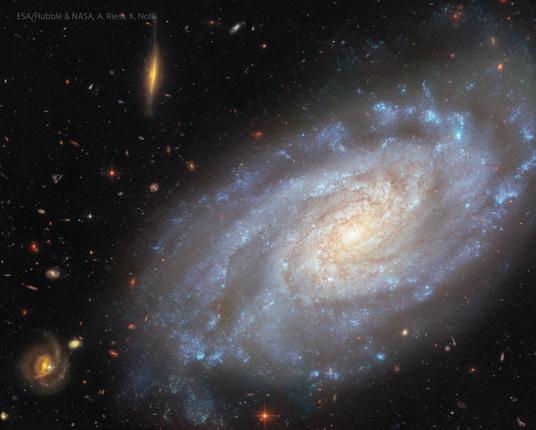
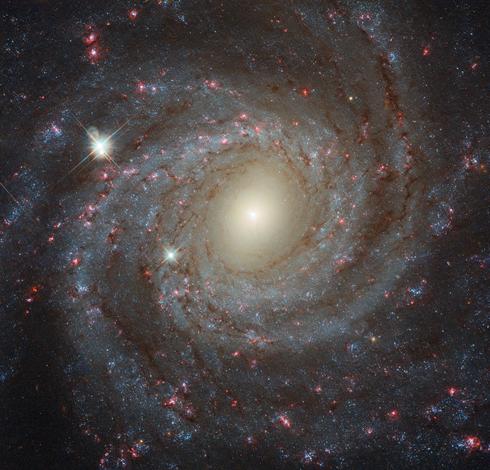
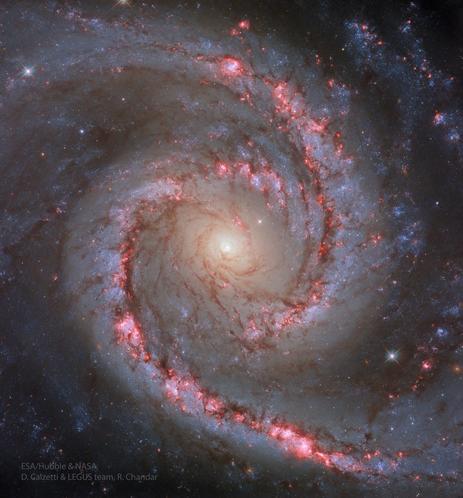
Facing NGC 3344
* Image Credit: ESA/Hubble & NASA
http://www.esa.int/
https://www.spacetelescope.org/
httpshttps://apod.nasa.gov/apod/ap250624.html://www.nasa.gov/

Explanation:
From our vantage point in the Milky Way Galaxy, we see NGC 3344 face-on. Nearly 40,000 light-years across, the big, beautiful spiral galaxy is located just 20 million light-years away in the constellation of Leo Minor. This multi-color Hubble Space Telescope close-up of NGC 3344 includes remarkable details from near infrared to ultraviolet wavelengths. The frame extends some 15,000 light-years across the spiral's central regions. From the core outward, the galaxy's colors change from the yellowish light of old stars in the center to young blue star clusters and reddish star forming regions along the loose, fragmented spiral arms. Of course, the bright stars with a spiky appearance are in front of NGC 3344 and lie well within our own Milky Way.
https://esahubble.org/images/heic1803a/
https://apod.nasa.gov/apod/ap250513.html
https://science.nasa.gov/mission/hubble/overview/hubbles-35th-anniversary/

https://esahubble.org/images/heic1803a/

#space #galaxy #astrophotography #photography #science #nature #NASA
2025 June 24

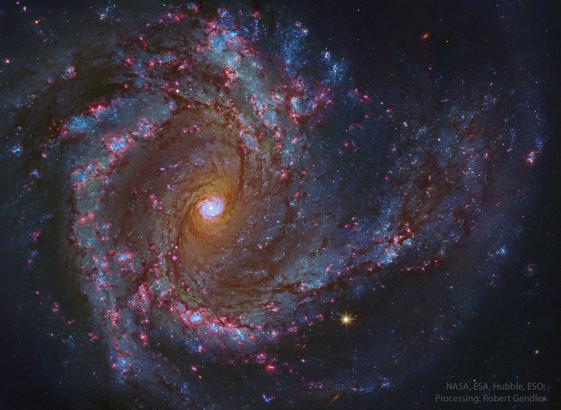
In the Center of Spiral Galaxy M61
* Image Credit: NASA, ESA, Hubble, ESO
https://www.eso.org/public/about-eso/
https://science.nasa.gov/mission/hubble/overview/about-hubble/
https://www.esa.int/
https://www.nasa.gov/;
* Processing & Copyright: Robert Gendler
http://www.robgendlerastropics.com/Biography2.html

Explanation:
Is there a spiral galaxy in the center of this spiral galaxy? Sort of. Image data from the Hubble Space Telescope, the European Southern Observatory, and smaller telescopes on planet Earth are combined in this detailed portrait of face-on spiral galaxy Messier 61 (M61) and its bright center. A mere 55 million light-years away in the Virgo Cluster of Galaxies, M61 is also known as NGC 4303. It's considered to be an example of a barred spiral galaxy similar to our own Milky Way. Like other spiral galaxies, M61 also features sweeping spiral arms, cosmic dust lanes, pinkish star forming regions, and young blue star clusters. Its core houses an active supermassive black hole surrounded by a bright nuclear spiral -- infalling star-forming gas that itself looks like a separate spiral galaxy.
https://esahubble.org/images/potw1324a/
http://www.robgendlerastropics.com/M61-HST-ESO-New.html
https://en.wikipedia.org/wiki/Messier_61

https://apod.nasa.gov/apod/ap100529.html
https://ui.adsabs.harvard.edu/abs/2000ApJ...528..677E/abstract

https://apod.nasa.gov/apod/ap250624.html

#space #galaxy #astrophotography #photography #science #astronomy #nature #NASA

2025 June 27

Messier 109
* Image Credit & Copyright: Robert Eder
https://app.astrobin.com/u/Robsi#gallery

Explanation:
Big beautiful barred spiral galaxy Messier 109 is the 109th entry in Charles Messier's famous catalog of bright Nebulae and Star Clusters. You can find it just below the Big Dipper's bowl in the northern constellation Ursa Major. In fact, bright dipper star Phecda, Gamma Ursa Majoris, produces the glare at the upper right corner of this telescopic frame. M109's prominent central bar gives the galaxy the appearance of the Greek letter "theta", θ, a common mathematical symbol representing an angle. M109 spans a very small angle in planet Earth's sky though, about 7 arcminutes or 0.12 degrees. But that small angle corresponds to an enormous 120,000 light-year diameter at the galaxy's estimated 60 million light-year distance. The brightest member of the now recognized Ursa Major galaxy cluster, M109 (aka NGC 3992) is joined by spiky foreground stars. Three small, fuzzy bluish galaxies also on the scene, identified (top to bottom) as UGC 6969, UGC 6940 and UGC 6923, are possibly satellite galaxies of the larger barred spiral galaxy Messier 109.
https://app.astrobin.com/u/Robsi?i=albk8c#gallery
https://science.nasa.gov/mission/hubble/science/explore-the-night-sky/hubble-messier-catalog/messier-109/

https://apod.nasa.gov/apod/ap110624.html
https://apod.nasa.gov/apod/ap121013.html

http://www.messier.seds.org/xtra/history/m-cat.html

https://chandra.harvard.edu/photo/scale_distance.html
https://chandra.harvard.edu/photo/scale.html
https://arxiv.org/abs/astro-ph/9608124

https://apod.nasa.gov/apod/ap250627.html

#space #galaxy #astrophotography #photography #science #nature #NASA
2025 June 30

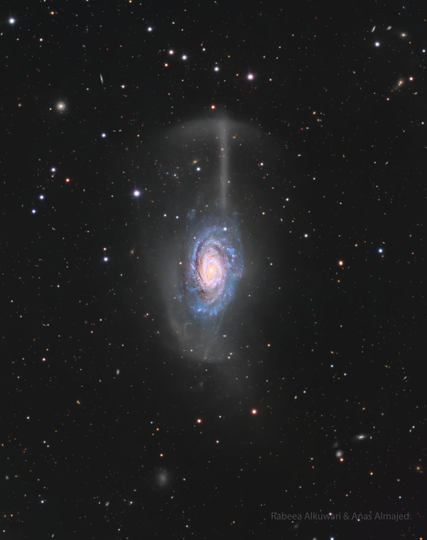
NGC 4651: The Umbrella Galaxy
* Image Credit: Rabeea Alkuwari & Anas Almajed
https://www.instagram.com/bolahdan/
https://www.instagram.com/anas_almajed/

Explanation:
It's raining stars. What appears to be a giant cosmic umbrella is now known to be a tidal stream of stars stripped from a small satellite galaxy. The main galaxy, spiral galaxy NGC 4651, is about the size of our Milky Way, while its stellar parasol appears to extend some 100 thousand light-years above this galaxy's bright disk. A small galaxy was likely torn apart by repeated encounters as it swept back and forth on eccentric orbits through NGC 4651. The remaining stars will surely fall back and become part of a combined larger galaxy over the next few million years. The featured deep image was captured in long exposures from Saudi Arabia. The Umbrella Galaxy lies about 50 million light-years distant toward the well-groomed northern constellation of Berenice's Hair (Coma Berenices).
https://www.instagram.com/anas_almajed/https://www.instagram.com/anas_almajed/
https://en.wikipedia.org/wiki/NGC_4651

https://en.wikipedia.org/wiki/Satellite_galaxy
https://en.wikipedia.org/wiki/Orbital_eccentricity#/media/File:Animation_of_Orbital_eccentricity.gif

https://apod.nasa.gov/apod/ap130514.html
https://apod.nasa.gov/apod/ap120604.html

https://apod.nasa.gov/apod/ap250630.html

#space #galaxy #astrophotography #photography #science #astronomy #nature #NASA

Short "Offtopic" Explanation

2013 May 14
Galaxy Collisions: Simulation vs Observations

* Images Credit: NASA, ESA
http://www.esa.int/
http://www.nasa.gov/;
* Visualization: Frank Summers (STScI)
http://www.stsci.edu/;
* Simulation: Chris Mihos (CWRU) & Lars Hernquist (Harvard)
https://astronomy.case.edu/ .

Explanation:
What happens when two galaxies collide? Although it may take over a billion years, such titanic clashes are quite common. Since galaxies are mostly empty space, no internal stars are likely to themselves collide. Rather the gravitation of each galaxy will distort or destroy the other galaxy, and the galaxies may eventually merge to form a single larger galaxy. Expansive gas and dust clouds collide and trigger waves of star formation that complete even during the interaction process. Pictured above is a computer simulation of two large spiral galaxies colliding, interspersed with real still images taken by the Hubble Space Telescope. Our own Milky Way Galaxy has absorbed several smaller galaxies during its existence and is even projected to merge with the larger neighboring Andromeda galaxy in a few billion years.

https://apod.nasa.gov/apod/ap130514.html

#space #galaxy #astrophotography #photography #science #astronomy #nature #NASA

2025 July 4

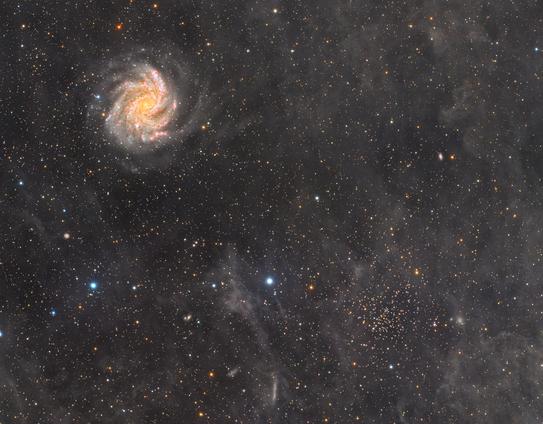
NGC 6946 and NGC 6939
* Image Credit & Copyright: Alberto Pisabarro
https://www.loscoloresinvisibles.com/

Explanation:
Face-on spiral galaxy NGC 6946 and open star cluster NGC 6939 share this cosmic snapshot, composed with over 68 hours of image data captured with a small telescope on planet Earth. The field of view spans spans about 1 degree or 2 full moons on the sky toward the northern constellation Cepheus. Seen through faint interstellar dust couds near the plane of our Milky Way galaxy, the stars of open cluster NGC 6939 are 5,600 light-years in the distance, near bottom right in the frame. Face-on spiral galaxy NGC 6946 is at top left, but lies some 22 million light-years away. In the last 100 years, 10 supernovae have been discovered in NGC 6946, the latest one seen in 2017. By comparison, the average rate of supernovae in our Milky Way is about 1 every 100 years or so. Of course, NGC 6946 is also known as The Fireworks Galaxy.
https://www.loscoloresinvisibles.com/null
https://ui.adsabs.harvard.edu/abs/2022AJ....163..191K/abstract

Location:
http://www.hawastsoc.org/deepsky/cep/

Super Novae of NGC 6946:
https://rochesterastronomy.org/sn2017/sn2017eaw.html
https://skyandtelescope.org/astronomy-news/observing-news/possible-bright-supernova-discovered-in-fireworks-galaxy-ngc-6946/

nasa.gov/apod/ap250704.html

#space #galaxy #astrophotography #photography #science #nature #NASA

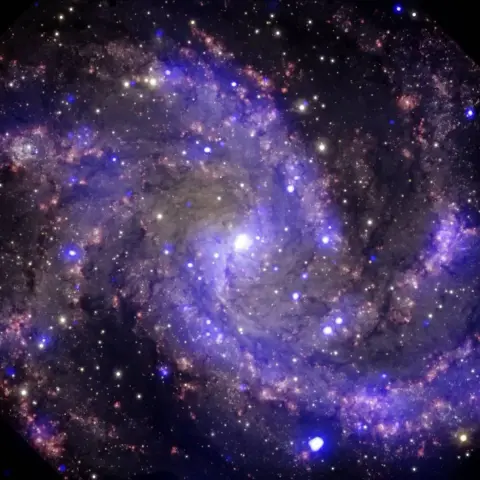
NGC 6946: The ‘Fireworks Galaxy’

NGC 6946 is a medium-sized, face-on spiral galaxy about 22 million light years away from Earth. In the past century, eight supernovas have been observed to explode in the arms of this galaxy. Chandra observations (purple) have, in fact, revealed three of the oldest supernovas ever detected in X-rays, giving more credence to its nickname of the “Fireworks Galaxy.” This composite image also includes optical data from the Gemini Observatory in red, yellow, and cyan.

Image credit: X-ray: NASA/CXC/MSSL/R.Soria et al, Optical: AURA/Gemini OBs

#space #galaxy #astrophotography #photography #science #nature #NASA
A Mysterious Rash of Star Birth

"A Mysterious Rash of Star Birth In this crisp Gemini North image, pink bubbles of glowing hydrogen gas spread across the arms of the face-on spiral galaxy NGC 6946 like a rash. This amazing infusion of color is fueled by the ubiquitous birth of massive stars throughout NGC 6946; these hot young stars blast copious amounts of ultraviolet radiation into their natal shrouds of hydrogen gas, causing the clouds to glow red. For reasons unknown, NGC 6946 has a much higher rate of star formation than all of the other large galaxies in our local neighborhood. The prodigious output of stellar nurseries in this extragalactic neighbor — which lies about 20 million light years away in the direction of the constellation of Cepheus — eventually leads to accelerated numbers of supernovae explosions. NGC 6946’s supernovae have occurred in rapid-fire fashion for tens of millions of years. Over the past century, eight supernovae are known to have exploded in the arms of this stellar metropolis. NGC 6946 is, in fact, the most prolific known galaxy for supernovae during the past 100 years. These events have led to its popular nickname, the “Fireworks Galaxy.” If we could compress just a million years of NGC 6946’s history into a time-lapse movie, lasting but a few seconds, we would bear witness to a stream of nearly constant outbursts of light as new stars flare into view, while old ones expire in spectacular explosions." Technical Details: Acquisition Date(s): August 12, 2004 Telescope: Gemini North, Mauna Kea Hawai'i Instrument: GMOS (Gemini Multi-Object Spectrograph) Field of View: 5.80 x 5.58 arcminutes Orientation: Image is rotated CCW by 184 degrees from North = up, East = left
https://www.gemini.edu/news/press-releases/gemini0501

* Credits:
International Gemini Observatory/AURA/Manuel Paredes

https://www.gemini.edu/gallery/images/gemini0501a/

#space #galaxy #astrophotography #photography #science #nature #NASA
2025 April 26

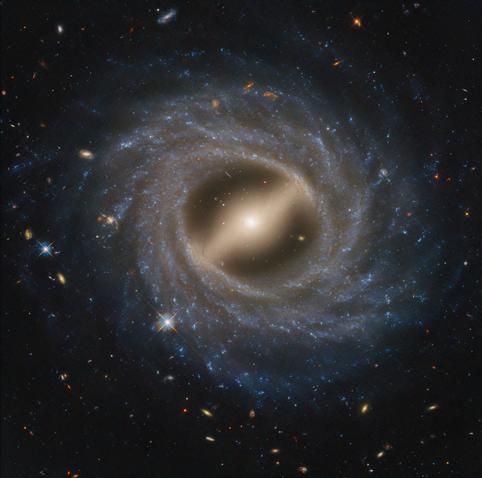
Barred Spiral Galaxy NGC 5335
* Image Credit: NASA, ESA, STScI
https://www.nasa.gov/
https://www.stsci.edu/home
https://esahubble.org/

Explanation:
This stunning portrait of NGC 5335 was captured by the Hubble Space Telescope. Some 170,000 light-years across and over 200 million light-years away toward the constellation Virgo, the magnificent spiral galaxy is seen face-on in Hubble's view. Within the galactic disk, loose streamers of star forming regions lie along the galaxy's flocculent spiral arms. But the most striking feature of NGC 5335 is its prominent central bar. Seen in about 30 percent of galaxies, including our Milky Way, bar structures are understood to channel material inward toward the galactic center, fueling star formation. Of course, distant background galaxies are easy to spot, scattered around the sharp Hubble image. Launched in 1990, Hubble is now celebrating its 35th year exploring the cosmos from orbit around planet Earth.
https://science.nasa.gov/asset/hubble/ngc-5335/

https://apod.nasa.gov/apod/ap250426.html

#space #galaxy #astrophotography #photography #science #astronomy #nature #NASA

January 10, 2005

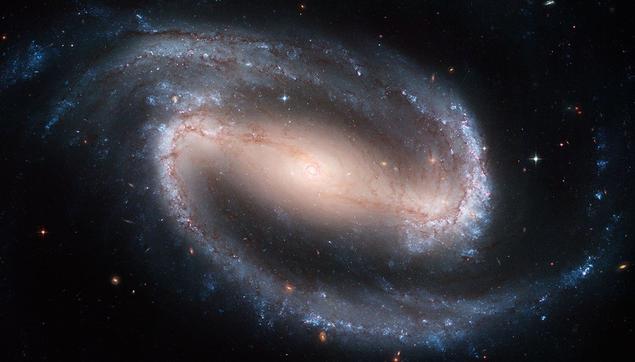
Barred Spiral Galaxy NGC 1300 - NASA Science

One of the largest Hubble Space Telescope images ever made of a complete galaxy is being unveiled today at the American Astronomical Society meeting in San Diego, Calif.

The Hubble telescope captured a display of starlight, glowing gas, and silhouetted dark clouds of interstellar dust in this 4-foot-by-8-foot image of the barred spiral galaxy NGC 1300. NGC 1300 is considered to be prototypical of barred spiral galaxies. Barred spirals differ from normal spiral galaxies in that the arms of the galaxy do not spiral all the way into the center, but are connected to the two ends of a straight bar of stars containing the nucleus at its center.

At Hubble's resolution, a myriad of fine details, some of which have never before been seen, is seen throughout the galaxy's arms, disk, bulge, and nucleus. Blue and red supergiant stars, star clusters, and star-forming regions are well resolved across the spiral arms, and dust lanes trace out fine structures in the disk and bar. Numerous more distant galaxies are visible in the background, and are seen even through the densest regions of NGC 1300.

In the core of the larger spiral structure of NGC 1300, the nucleus shows its own extraordinary and distinct "grand-design" spiral structure that is about 3,300 light-years (1 kiloparsec) long. Only galaxies with large-scale bars appear to have these grand-design inner disks - a spiral within a spiral. Models suggest that the gas in a bar can be funneled inwards, and then spiral into the center through the grand-design disk, where it can potentially fuel a central black hole. NGC 1300 is not known to have an active nucleus, however, indicating either that there is no black hole, or that it is not accreting matter.

https://science.nasa.gov/asset/hubble/barred-spiral-galaxy-ngc-1300/

#space #galaxy #astrophotography #photography #science #astronomy #nature #NASA

A zoom into the center of NGC 1300 that reveals the fine details captured by Hubble's Advanced Camera for Surveys across the spiral arms, and dust lanes in the disk and bar.

Credit:
NASA, ESA, and G. Bacon (STScI); Acknowledgment: NASA, ESA, A. Fujii, Digitized Sky Survey (DSS), STScI/AURA, Palomar/Caltech, and UKSTU/AAO, and the Hubble Heritage Team (STScI/AURA)

#space #galaxy #astrophotography #photography #science #astronomy #nature #NASA

Messier 63

This flocculent galaxy is a type of spiral without well defined spiral arms.

Star formation is one of the most important processes in shaping the universe. In addition to birthing new stars, it gives rise to planetary systems and plays a pivotal role in the evolution of galaxies. Yet there is still much that astronomers do not understand about this fundamental process. The driving force behind star formation is particularly unclear for a type of galaxy called a flocculent spiral. Unlike grand-design spiral galaxies, flocculent spiral galaxies do not have well defined spiral arms. Instead, they appear to have many discontinuous arms.

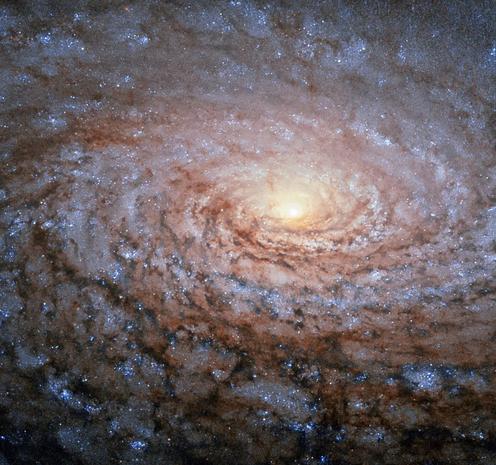
M63, also known as the Sunflower galaxy, is one such flocculent spiral galaxy. Although it only has two arms, many appear to be winding around its yellow core in this image captured by Hubble. The arms shine with the radiation from recently formed blue stars and can be more clearly seen in infrared observations. By imaging flocculent spiral galaxies like M63, astronomers hope to gain a better understanding of how stars form in such systems.

The Sunflower galaxy was discovered in 1779 by the French astronomer Pierre Méchain and was the first of 24 objects that Méchain would contribute to Charles Messier’s catalog. The galaxy is located roughly 27 million light-years from Earth in the constellation Canes Venatici. It has an apparent magnitude of 9.3 and appears as a faint patch of light in small telescopes. The best time to observe M63 is during May.

Credit:
ESA/Hubble & NASA

#space #galaxy #astrophotography #photography #science #astronomy #nature #NASA #ESA

Messier 64

This dusty galaxy is also known as the "Black Eye" or "Evil Eye" galaxy.

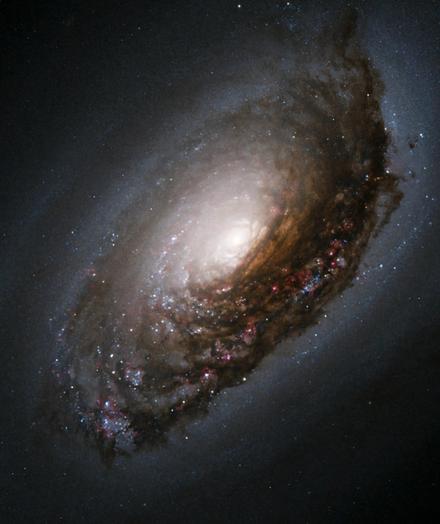
Easily identified by the spectacular band of dark dust that partially obscures its bright core, Messier 64, or the Black Eye Galaxy, is characterized by its bizarre internal motion. The gas in the outer regions of this spiral galaxy is rotating in the opposite direction from the gas and stars in its inner regions. This strange behavior may be the result of a merger between M64 and a satellite galaxy over a billion years ago.

New stars are forming in the region where the oppositely rotating gases collide, are compressed, and then contract. Particularly noticeable in this stunning Hubble image of the galaxy’s core are recently formed hot, blue stars and pink clouds of glowing hydrogen gas that fluoresce when exposed to ultraviolet light from the newly-formed stars.

English astronomer Edward Pigott first spotted M64 in March of 1719, just 12 days before German astronomer Johann Elert Bode, and roughly a year before Charles Messier independently rediscovered it in March of 1780. The galaxy is located 17 million light-years from Earth in the constellation Coma Berenices. The best time of year to look for the Black Eye Galaxy is May. Its apparent magnitude of 9.8 requires a moderately sized telescope and dark sky site.
This dusty galaxy is also known as the "Black Eye" or "Evil Eye" galaxy.

Credit:
NASA and the Hubble Heritage Team (AURA/STScI); Acknowledgment: S. Smartt (Institute of Astronomy) and D. Richstone (U. Michigan)

#space #galaxy #astrophotography #photography #science #astronomy #nature #NASA #ESA
M74M74

Phantom Galaxy across the spectrum

The Phantom Galaxy is around 32 million light-years away from Earth in the constellation Pisces, and lies almost face-on to Earth. This, coupled with its well-defined spiral arms, makes it a favourite target for astronomers studying the origin and structure of galactic spirals.

M74 is a particular class of spiral galaxy known as a ‘grand design spiral’, meaning that its spiral arms are prominent and well-defined, unlike the patchy and ragged structure seen in some spiral galaxies.

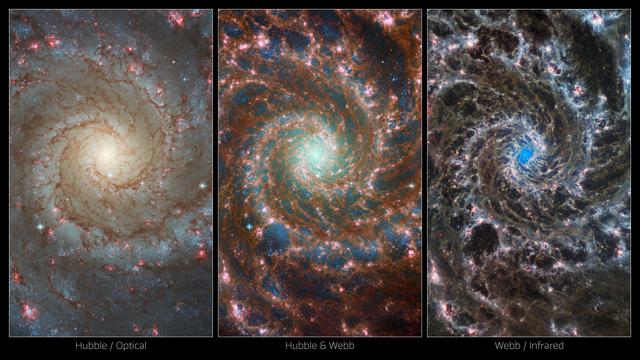
With Hubble’s venerable Advanced Camera for Surveys (ACS) and Webb’s powerful Mid-InfraRed Instrument (MIRI) capturing a range of wavelengths, this new image has remarkable depth. The red colours mark dust threaded through the arms of the galaxy, lighter oranges being areas of hotter dust. The young stars throughout the arms and the nuclear core are picked out in blue. Heavier, older stars towards the galaxy’s centre are shown in cyan and green, projecting a spooky glow from the core of the Phantom Galaxy. Bubbles of star formation are also visible in pink across the arms. Such a variety of galactic features is rare to see in a single image.

Scientists combine data from telescopes operating across the electromagnetic spectrum to truly understand astronomical objects. In this way, data from Hubble and Webb compliment each other to provide a comprehensive view of the spectacular M74 galaxy.

CREDIT
ESA/Webb, NASA & CSA, J. Lee and the PHANGS-JWST Team; ESA/Hubble & NASA, R. Chandar Acknowledgement: J. Schmidt

#space #galaxy #astrophotography #photography #science #astronomy #nature #NASA #ESA
Multi-observatory views of M74

New images of the Phantom Galaxy, M74, showcase the power of space observatories working together in multiple wavelengths.
* see ALT-Text for more

Webb’s sharp vision has revealed delicate filaments of gas and dust in the grandiose spiral arms of M74, which wind outwards from the centre of the image. A lack of gas in the nuclear region also provides an unobscured view of the nuclear star cluster at the galaxy's centre.

Webb gazed into M74 with its Mid-InfraRed Instrument (MIRI) in order to learn more about the earliest phases of star formation in the local Universe. These observations are part of a larger effort to chart 19 nearby star-forming galaxies in the infrared by the international PHANGS collaboration. Those galaxies have already been observed using the NASA/ESA Hubble Space Telescope and ground-based observatories.

The addition of crystal-clear Webb observations at longer wavelengths will allow astronomers to pinpoint star-forming regions in the galaxies, accurately measure the masses and ages of star clusters, and gain insights into the nature of the small grains of dust drifting in interstellar space.


Hubble observations of M74 have revealed particularly bright areas of star formation known as HII regions. Hubble’s sharp vision at ultraviolet and visible wavelengths complements Webb’s unparalleled sensitivity at infrared wavelengths, as do observations from ground-based radio telescopes such as the Atacama Large Millimeter/submillimeter Array, ALMA.

By combining data from telescopes operating across the electromagnetic spectrum, scientists can gain greater insight into astronomical objects than by using a single observatory – even one as powerful as Webb!

CREDIT
ESA/Webb, NASA & CSA, J. Lee and the PHANGS-JWST Team; ESA/Hubble & NASA, R. Chandar Acknowledgement: J. Schmidt

#space #galaxy #astrophotography #photography #science #astronomy #nature #NASA #ESA
07/11/2023
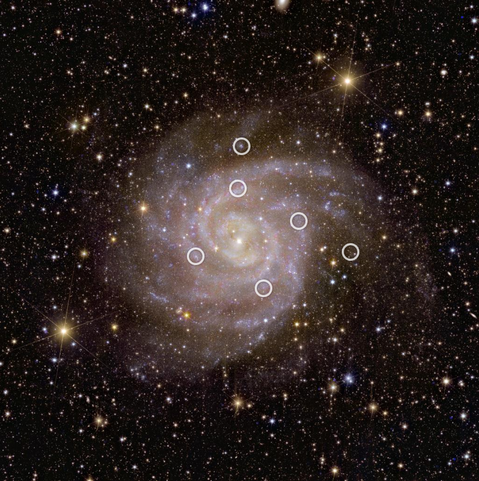
Euclid’s view of spiral galaxy IC 342

Over its lifetime, our dark Universe detective will image billions of galaxies, revealing the hidden influence that dark matter and dark energy have on them.

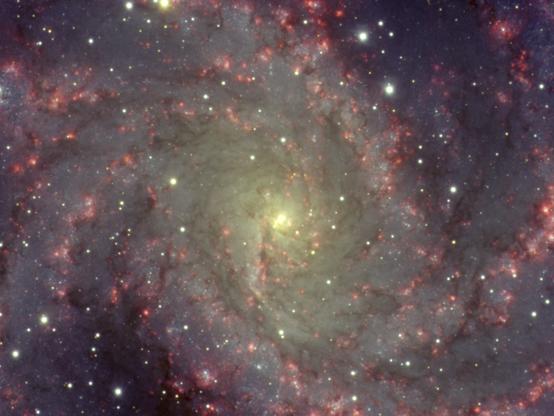
That’s why it’s fitting that one of the first galaxies that Euclid observed is nicknamed the ‘Hidden Galaxy’. This galaxy, also known as IC 342 or Caldwell 5, is difficult to observe because it lies behind the busy disc of our Milky Way, and so dust, gas and stars obscure our view.

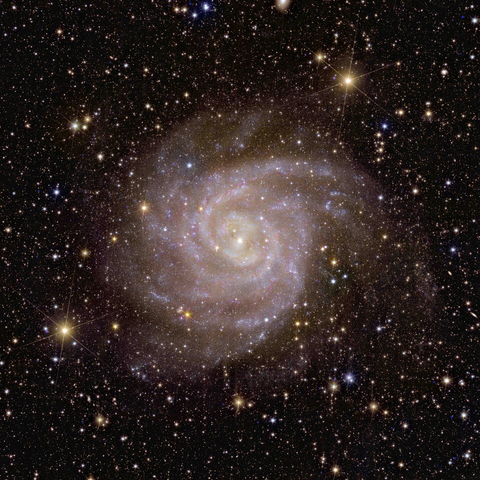
Euclid could take this beautiful and sharp image thanks to its incredible sensitivity and superb optics. Most important here is that Euclid used its near-infrared instrument to peer through the dust and measure the light from the many cool and low-mass stars that dominate the galaxy's mass.

“That’s what is so brilliant about Euclid images. In one shot, it can see the whole galaxy in all its beautiful detail,” explains Euclid Consortium scientist Leslie Hunt of the National Institute for Astrophysics in Italy, on behalf of a broader team working on showcasing galaxies imaged by Euclid.

“This image might look normal, as if every telescope can make such an image, but that is not true. What’s so special here is that we have a wide view covering the entire galaxy, but we can also zoom in to distinguish single stars and star clusters. This makes it possible to trace the history of star formation and better understand how stars formed and evolved over the lifetime of the galaxy.”

CREDIT
ESA/Euclid/Euclid Consortium/NASA, image processing by J.-C. Cuillandre (CEA Paris-Saclay), G. Anselmi

#space #galaxy #astrophotography #photography #science #astronomy #nature #NASA #ESA

IC 342
is located around 11 million light-years from Earth, very nearby our own galaxy (in astronomical distances). It is as large as the full Moon on the sky. And as a spiral galaxy, it is considered a look-alike of the Milky Way. “It is difficult to study our own galaxy as we are within it and can only see it edge on. So, by studying galaxies like IC 342, we can learn a lot about galaxies like our own,” adds Leslie.

Euclid is not the first to observe the Hidden Galaxy. The NASA/ESA Hubble Space Telescope has previously imaged its core. But until now it has been impossible to study the star-formation history of the entire galaxy. Additionally, scientists have already spotted many globular clusters in this image, some of which have not been previously identified.

Euclid will observe billions of similar but more distant galaxies, all distributed along a ‘cosmic web’ of dark matter filaments. In this way, it will provide a 3D view of the dark matter distribution in our Universe. The map of the distribution of galaxies over cosmic time will also teach us about dark energy, which accelerates the expansion of the Universe.

CREDIT
ESA/Euclid/Euclid Consortium/NASA, image processing by J.-C. Cuillandre (CEA Paris-Saclay), G. Anselmi

#space #galaxy #astrophotography #photography #science #astronomy #nature #NASA #ESA

Finding globular clusters in Euclid’s view of spiral galaxy IC342

In Euclid’s image of spiral galaxy IC342, the locations of several globular clusters are shown. Globular clusters are compact collections of hundreds of thousands of stars held together by gravity. Globular clusters tend to be old, with red colors, while star clusters may be less compact and blue. In spiral galaxies, like our Milky Way, these globular clusters are mostly found in the galactic halo.

from arxiv:

"We examine the star cluster populations in the three nearby galaxies IC 342, NGC 2403, and Holmberg II, observed as part of the Euclid Early Release Observations programme. Our main focus is on old globular clusters (GCs), for which the wide field-of-view and excellent image quality of Euclid offer substantial advantages over previous work. For IC 342 this is the first study of stellar clusters other than its nuclear cluster. After selection based on size and magnitude criteria, followed by visual inspection, we identify 111 old (> 1 Gyr) GC candidates in IC 342, 50 in NGC 2403 (of which 15 were previously known), [...] "
https://arxiv.org/abs/2503.16637
https://arxiv.org/pdf/2503.16637

* note by grobi: "Could these mass-holding clusters be useful for gravitational lensing? The Euclid team is talking about 7000 possible candidates by the end of 2026 and 100000 candidates by the end of the mission. Which would mean that very soon we will be able to look much further into the depths of space-time than we can even imagine today.
Exciting times from an astronomical point of view, right? Feel free to check out the following post from the TOPIC> Gravitational Lensing
https://defcon.social/@grobi/114682791891969004 Enjoy!"

#space #galaxy #astrophotography #photography #science #astronomy #nature #NASA #ESA

2022 May 17

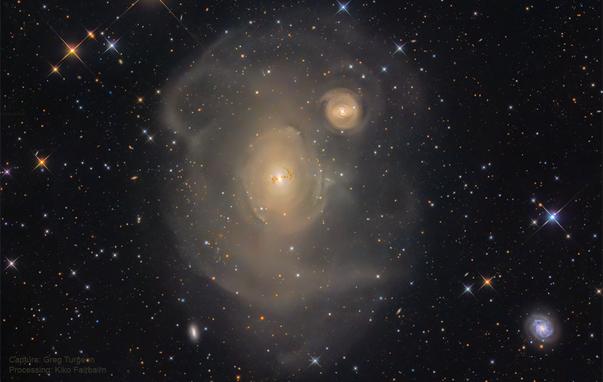
NGC 1316: After Galaxies Collide
* Image Credit & Copyright:
** Capture: Greg Turgeon;
** Processing: Kiko Fairbairn
https://www.instagram.com/gregturgeon_astro/
https://www.instagram.com/kikofairbairn/

Explanation:
Astronomers turn detectives when trying to figure out the cause of startling sights like NGC 1316. Investigations indicate that NGC 1316 is an enormous elliptical galaxy that started, about 100 million years ago, to devour a smaller spiral galaxy neighbor,
NGC 1317,
just on the upper right. Supporting evidence includes the dark dust lanes characteristic of a spiral galaxy, and faint swirls and shells of stars and gas visible in this wide and deep image. One thing that >remains unexplained is the unusually small globular star clusters, seen as faint dots on the image. Most elliptical galaxies have more and brighter globular clusters than NGC 1316. Yet the observed globulars are too old to have been created by the recent spiral collision. One hypothesis is that these globulars survive from an even earlier galaxy that was subsumed into NGC 1316. Another surprising attribute of NGC 1316, also known as Fornax A, is its giant lobes of gas that glow brightly in radio waves.

https://en.wikipedia.org/wiki/NGC_1317

https://apod.nasa.gov/apod/ap220517.html

#space #galaxy #astrophotography #photography #science #astronomy #nature #NASA #ESA

2022 September 22

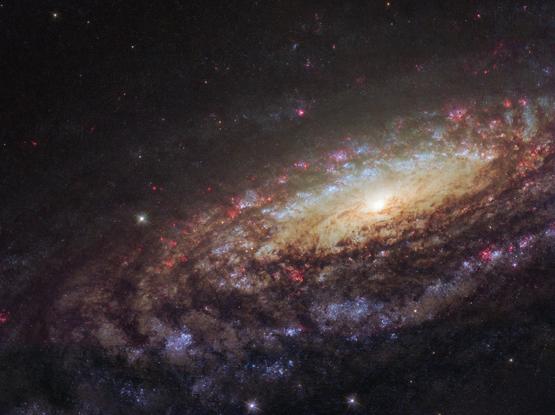
NGC 7331 Close Up
* Image Credit & License: ESA/Hubble & NASA/D. Milisavljevic (Purdue University)

Explanation:
Big, beautiful spiral galaxy NGC 7331 is often touted as an analog to our own Milky Way. About 50 million light-years distant in the northern constellation Pegasus, NGC 7331 was recognized early on as a spiral nebula and is actually one of the brighter galaxies not included in Charles Messier's famous 18th century catalog. Since the galaxy's disk is inclined to our line-of-sight, long telescopic exposures often result in an image that evokes a strong sense of depth. This Hubble Space Telescope close-up spans some 40,000 light-years. The galaxy's magnificent spiral arms feature dark obscuring dust lanes, bright bluish clusters of massive young stars, and the telltale reddish glow of active star forming regions. The bright yellowish central regions harbor populations of older, cooler stars. Like the Milky Way, a supermassive black hole lies at the core of spiral galaxy NGC 7331.

https://apod.nasa.gov/apod/ap220922.html

#space #galaxy #astrophotography #photography #science #astronomy #nature #NASA #ESA

2025 August 18

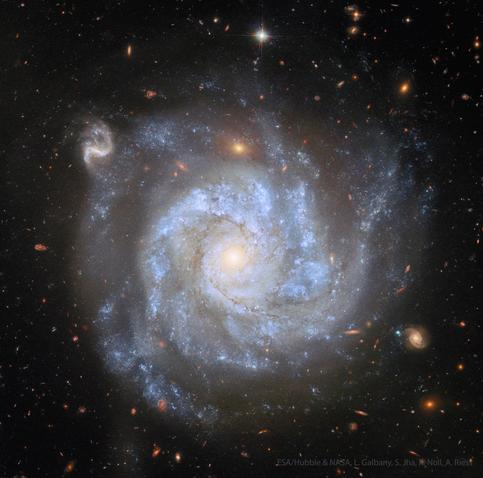
NGC 1309: A Useful Spiral Galaxy
* Image Credit: NASA, ESA, Hubble
https://www.nasa.gov/
https://www.esa.int/
https://science.nasa.gov/mission/hubble/overview/about-hubble/
* Processing: L. Galbany, S. Jha, K. Noll, A. Riess
https://lgalbany.github.io/

Explanation:
This galaxy is not only pretty -- it's useful. A gorgeous spiral some 100 million light-years distant, NGC 1309 lies on the banks of the constellation of the River (Eridanus). NGC 1309 spans about 30,000 light-years, making it about one third the size of our larger Milky Way galaxy. Bluish clusters of young stars and dust lanes are seen to trace out NGC 1309's spiral arms as they wind around an older yellowish star population at its core. Not just another pretty face-on spiral galaxy, observations of NGC 1309's two recent supernovas and multiple Cepheid variable stars contribute to the calibration of the expansion of the Universe. Still, after you get over this beautiful galaxy's grand design, check out the array of more distant background galaxies also recorded in this sharp image from the Hubble Space Telescope.
https://esahubble.org/images/potw2530a/
https://en.wikipedia.org/wiki/NGC_1309
zoom in >> https://esahubble.org/images/potw2530a/zoomable/

https://lco.global/spacebook/distance/cepheid-variable-stars-supernovae-and-distance-measurement/
http://www.hawastsoc.org/deepsky/eri/index.html

https://apod.nasa.gov/apod/ap250818.html

#space #galaxy #astrophotography #photography #science #astronomy #nature #NASA #ESA

2025 November 5

Spiral Galaxy NGC 3370 from Hubble
* Image Credit: ESA/Hubble & NASA, A. Riess, K. Noll
https://esahubble.org/
https://www.nasa.gov/
https://physics-astronomy.jhu.edu/directory/adam-riess/
https://science.gsfc.nasa.gov/sci/bio/keith.s.noll

Explanation:
Is this what our own Milky Way Galaxy looks like from far away? Similar in size and grand design to our home Galaxy (although without the central bar), spiral galaxy NGC 3370 lies about 100 million light-years away toward the constellation of the Lion (Leo). Recorded here in exquisite detail by the Hubble Space Telescope, the big, beautiful face-on spiral is not only photogenic, but has proven sharp enough to study individual stars known as Cepheids. These pulsating stars have been used to accurately determine NGC 3370's distance. NGC 3370 was chosen for this study because in 1994 the spiral galaxy was also home to a well studied stellar explosion -- a Type Ia supernova. Combining the known distance to this standard candle supernova, based on the Cepheid measurements, with observations of supernovas at even greater distances has helped to reveal the size and expansion rate of the entire Universe itself.
https://esahubble.org/images/potw2542a/
https://en.wikipedia.org/wiki/NGC_3370
https://esahubble.org/videos/potw2542a/
https://cas.sdss.org/dr6/en/proj/basic/galaxies/spirals.asp
https://en.wikipedia.org/wiki/Cepheid_variable
http://www.ianridpath.com/startales/leo.html
https://www.pbs.org/wgbh/nova/universe/supernova1a_nf_01.html
https://www.starstryder.com/2007/10/03/type-1a-supernoave-a-non-standard-candle/
https://apod.nasa.gov/debate/debate96.html

https://apod.nasa.gov/apod/ap251105.html

#space #galaxy #astrophotography #photography #science #astronomy #nature #NASA #ESA #apod

Pan: NGC 3370
Release date: 22 October 2025, 15:55

Today’s ESA/Hubble Picture of the Week features a galaxy that Hubble has captured multiple times over more than 20 years. The galaxy is called NGC 3370, and it is a spiral galaxy located nearly 90 million light-years away in the constellation Leo (The Lion).

What is it about this galaxy that makes it a popular target for researchers? NGC 3370 is home to two kinds of objects that astronomers prize for their usefulness in determining distances to faraway galaxies: Cepheid variable stars and Type Ia supernovae.

Cepheid variable stars change in both size and temperature as they pulsate. As a result, the luminosity of these stars varies over a period of days to months. It does so in a way that reveals something important: the more luminous a Cepheid variable star is, the more slowly it pulsates. By measuring how long a Cepheid variable’s brightness takes to complete one cycle, astronomers can determine how bright the star actually is. Paired with how bright the star appears from Earth, this information gives the distance to the star and its home galaxy.

Type Ia supernovae provide a way to measure distances in a single explosive burst rather than through regular brightness variations. Type Ia supernovae happen when the dead core of a star ignites in a sudden flare of nuclear fusion. These explosions peak at very similar luminosities, and much like for a Cepheid variable star, knowing the intrinsic brightness of a supernova explosion allows for its distance to be measured. Observations of Cepheid variable stars and Type Ia supernovae are both critical for precisely measuring how fast our Universe is expanding.
[...]
https://esahubble.org/videos/potw2542a/

Credit:
ESA/Hubble & NASA, A. Riess, K. Noll, N. Bartmann (ESA/Hubble)
Music: Stellardrone - Ascent

#space #galaxy #astrophotography #photography #science #astronomy #nature #NASA #ESA #apod

2025 November 6

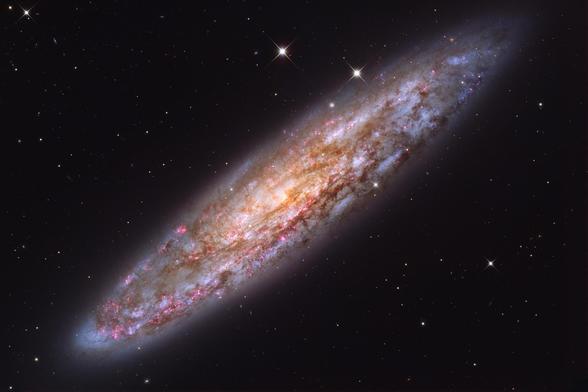
NGC 253: Dusty Island Universe
* Image Credit & Copyright: Adam Block
https://www.adamblockphotos.com/

Explanation:
Shiny NGC 253 is one of the brightest spiral galaxies visible, and also one of the dustiest. Some call it the Silver Coin Galaxy for its appearance in small telescopes, or just the Sculptor Galaxy for its location within the boundaries of the southern constellation Sculptor. Discovered in 1783 by mathematician and astronomer Caroline Herschel, the dusty island universe lies a mere 10 million light-years away. About 70 thousand light-years across, NGC 253 is the largest member of the Sculptor Group of Galaxies, the nearest to our own Local Group of Galaxies. In addition to its spiral dust lanes, tendrils of dust seem to be rising from its galactic disk laced with young star clusters and star forming regions in this colorful galaxy portrait. The high dust content accompanies frantic star formation, earning NGC 253 the designation of a starburst galaxy. NGC 253 is also known to be a strong source of high-energy x-rays and gamma rays, likely due to black holes near the galaxy's center.
https://www.adamblockphotos.com/ngc-253.html
https://science.nasa.gov/asset/hubble/spiral-galaxy-ngc-253-left-and-its-core-full-of-star-formation/
https://www.arxiv.org/abs/astro-ph/0509430
https://chandra.harvard.edu/photo/2001/0012/index.html

https://www.nasa.gov/universe/nasa-missions-unmask-magnetar-eruptions-in-nearby-galaxies/

http://www.messier.seds.org/more/local.html
http://www.messier.seds.org/xtra/ngc/sclgr.html
http://www.messier.seds.org/xtra/ngc/n0253.html
https://www.rmg.co.uk/stories/space-astronomy/caroline-herschel-first-paid-female-astronomer

https://apod.nasa.gov/apod/fap/ap251106.html

#space #galaxy #astrophotography #photography #science #astronomy #nature #NASA #ESA #apod

2025 November 15

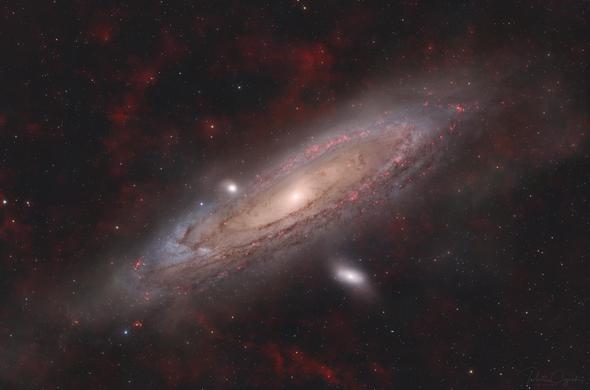
Andromeda and Friends
* Image Credit & Copyright: Piotr Czerski
https://app.astrobin.com/u/PiotrC#gallery

Explanation:
This magnificent extragalactic skyscape looks toward the Andromeda Galaxy, the closest large spiral galaxy to the Milky Way. It also accomplishes a Messier catalog trifecta by including Andromeda, cataloged as Messier 31 (M31), along with Messier 32 (M32), and Messier 110 (M110) in the same telescopic field of view. In this frame, M32 is just left of the Andromeda Galaxy's bright core with M110 below and to the right. M32 and M110 are both elliptical galaxies themselves and satellites of the larger spiral Andromeda. By combining 60 hours of broadband and narrowband image data, the deep telescopic view also reveals tantalizing details of dust lanes, young star clusters, and star-forming regions along Andromeda's spiral arms, and faint, foreground clouds of glowing hydrogen gas. For now, Andromeda and friends are some 2.5 million light-years from our own large spiral Milky Way.
https://app.astrobin.com/u/PiotrC?i=1y6644#gallery
https://science.nasa.gov/mission/hubble/science/explore-the-night-sky/hubble-messier-catalog/messier-31/
https://science.nasa.gov/mission/hubble/science/explore-the-night-sky/hubble-messier-catalog/messier-32/
https://science.nasa.gov/mission/hubble/science/explore-the-night-sky/hubble-messier-catalog/messier-110/

https://apod.nasa.gov/apod/fap/ap251115.html

#space #galaxy #astrophotography #photography #science #astronomy #nature #NASA #ESA #apod

2025 December 2

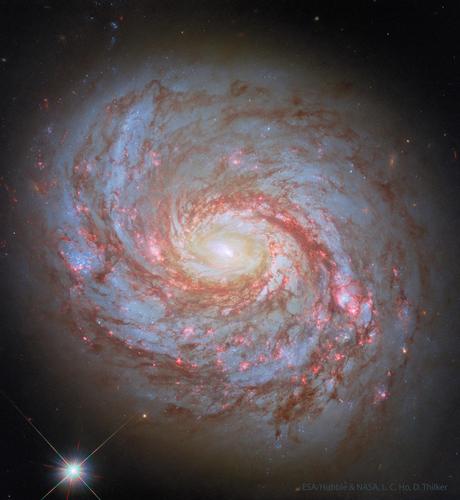
M77: Spiral Galaxy with an Active Center
* Image Credit: Hubble, NASA, ESA, L. C. Ho, D. Thilker
https://hla.stsci.edu/
https://www.nasa.gov/
https://www.esa.int/
http://kavli.pku.edu.cn/people/luis-c-ho
https://physics-astronomy.jhu.edu/directory/david-thilker/

Explanation:
What's happening in the center of nearby spiral galaxy M77? The face-on galaxy lies a mere 47 million light-years away toward the constellation of the Sea Monster (Cetus). At that estimated distance, this gorgeous island universe is about 100 thousand light-years across. Also known as NGC 1068, its compact and very bright core is well studied by astronomers exploring the mysteries of supermassive black holes in active Seyfert galaxies. M77's active core glows bright at x-ray, ultraviolet, visible, infrared, and radio wavelengths. The featured sharp image of M77 was taken by the Hubble Space Telescope. The image shows details of the spiral's winding spiral arms as traced by obscuring red dust clouds and blue star clusters, all circling the galaxy's bright white luminous center.
https://en.wikipedia.org/wiki/Messier_77
https://esahubble.org/images/potw2515a/
https://en.wikipedia.org/wiki/Active_galactic_nucleus
https://en.wikipedia.org/wiki/Seyfert_galaxy
https://apod.nasa.gov/apod/ap250504.html
https://en.wikipedia.org/wiki/Cetus_(constellation)
https://chandra.harvard.edu/photo/cosmic_distance.html
https://ned.ipac.caltech.edu/level5/March02/Gordon/Gordon2.html
https://science.nasa.gov/mission/hubble/science/universe-uncovered/hubble-star-clusters/

https://science.nasa.gov/mission/hubble/overview/about-hubble/
https://science.nasa.gov/ems/11_xrays/
https://science.nasa.gov/ems/10_ultravioletwaves/
https://science.nasa.gov/ems/07_infraredwaves/
https://science.nasa.gov/ems/09_visiblelight/
https://science.nasa.gov/ems/07_infraredwaves/
https://science.nasa.gov/ems/05_radiowaves/
https://chandra.harvard.edu/photo/cosmic_distance.html

https://apod.nasa.gov/apod/ap130831.html
https://apod.nasa.gov/apod/ap161109.html

https://apod.nasa.gov/apod/ap251202.html

#space #galaxy #astrophotography #photography #science #astronomy #nature #NASA #ESA #apod

2026 January 8

IC 342: Hidden Galaxy in Camelopardalis
* Image Credit & Copyright: Gaetan Maxant
https://app.astrobin.com/u/Gmaxt

Explanation:
Similar in size to large, bright spiral galaxies in our neighborhood, IC 342 is a mere 10 million light-years distant toward the long-necked, northern constellation Camelopardalis. A sprawling island universe, IC 342 would otherwise be a prominent galaxy in our night sky, but it is hidden from clear view and only glimpsed through the veil of stars, gas and dust clouds along the plane of our own Milky Way galaxy. Even though IC 342's light is dimmed and reddened by intervening cosmic clouds, this sharp telescopic image traces the galaxy's own obscuring dust, young star clusters, and glowing star forming regions along spiral arms that wind far from the galaxy's core. IC 342 has undergone a recent burst of star formation activity and is close enough to have influenced the evolution of the local group of galaxies and the Milky Way.
https://theskylive.com/sky/deepsky/ic342-object
https://ui.adsabs.harvard.edu/abs/2002AJ....124..839S/abstract
https://noirlab.edu/public/education/constellations/camelopardalis/
https://history.aip.org/exhibits/cosmology/ideas/island.htm
https://apod.nasa.gov/apod/ap110520.html
http://www-ssg.sr.unh.edu/ism/what1.html
https://app.astrobin.com/u/Gmaxt?i=zk43hn#gallery
https://ui.adsabs.harvard.edu/abs/2016MNRAS.459.2237B/abstract
https://www.messier.seds.org/xtra/ngc/maffei1g.html

https://apod.nasa.gov/apod/ap260108.html

#space #galaxy #astrophotography #photography #science #astronomy #nature #NASA #ESA #apod

2026 January 14

M51: The Whirlpool Galaxy
* Image Credit & Copyright: Michael Sleeman
https://astro.sleeman.at/about

Explanation:
The Whirlpool Galaxy is a classic spiral galaxy. At only 30 million light years distant and fully 60 thousand light years across, M51, also known as NGC 5194, is one of the brightest and most picturesque galaxies on the sky. The featured deep image is a digital combination of images taken in different colors over 58 hours with a telescope from Lijiang, China. Anyone with a good pair of binoculars, however, can see this Whirlpool toward the constellation of the Hunting Dogs (Canes Venatici). M51 is a spiral galaxy of type Sc and is the dominant member of a whole group of galaxies. Astronomers speculate that M51's spiral structure is primarily due to its gravitational interaction with the smaller galaxy just above it.
https://en.wikipedia.org/wiki/Whirlpool_Galaxy
https://en.wikipedia.org/wiki/New_General_Catalogue
https://www.google.com/search?q=M51+site%3Aapod.nasa.gov

https://apod.nasa.gov/apod/ap260114.html

#space #galaxy #astrophotography #photography #science #astronomy #nature #NASA #ESA #apod

2026 January 21

Barred Spiral Galaxy NGC 1365 from Webb
* Image Credit: NASA, ESA, CSA, Janice Lee (NOIRLab)
https://www.nasa.gov/
https://www.esa.int/
https://www.asc-csa.gc.ca/eng/
https://noirlab.edu/public/
* Processing: Alyssa Pagan (STScI)
https://www.stsci.edu/

Explanation:
A mere 56 million light-years distant toward the southern constellation Fornax, NGC 1365 is an enormous barred spiral galaxy about 200,000 light-years in diameter. That's twice the size of our own barred spiral Milky Way. This sharp image from the James Webb Space Telescope's Mid-Infrared Instrument (MIRI) reveals stunning details of this magnificent spiral in infrared light. Webb's field of view stretches about 60,000 light-years across NGC 1365, exploring the galaxy's core and bright newborn star clusters. The intricate network of dusty filaments and bubbles is created by young stars along spiral arms winding from the galaxy's central bar. Astronomers suspect the gravitational field of NGC 1365's bar plays a crucial role in the galaxy's evolution, funneling gas and dust into a star-forming maelstrom and ultimately feeding material into the active galaxy's central, supermassive black hole.
https://apod.nasa.gov/apod/ap221222.html
https://ned.ipac.caltech.edu/level5/Lindblad/Lind_contents.html
https://webbtelescope.org/contents/media/images/2023/104/01GS812G7AGRG6D1WCXPS3EYZ5
https://webbtelescope.org/home
https://noirlab.edu/public/blog/stellar-nurseries-nearby-galaxies/
https://webbtelescope.org/webb-science/the-observatory/infrared-astronomy
https://webbtelescope.org/contents/media/images/2023/104/01GS81DRATN70PTZKK42BS2JXG
https://arxiv.org/abs/0907.2602
https://www.nasa.gov/image-feature/goddard/2020/hubble-sees-swirls-of-forming-stars
https://apod.nasa.gov/apod/fap/ap250504.html

https://apod.nasa.gov/apod/fap/ap260121.html

#space #galaxy #astrophotography #photography #science #astronomy #nature #NASA #ESA #apod

2026 January 29

NGC 2442: Galaxy in Volans
* Image Credit & Copyright: Mike Selby
https://throughlightandtime.com/about/

Explanation:
Distorted galaxy NGC 2442 can be found in the southern constellation of the flying fish, (Piscis) Volans. Located about 50 million light-years away, the galaxy's two spiral arms extending from a pronounced central bar give it a hook-shaped appearance in this deep and colorful image, with foreground stars scattered across the telescopic field of view. The image also reveals the distant galaxy's obscuring dust lanes, young blue star clusters and reddish star forming regions surrounding a core of yellowish light from an older population of stars. But the star forming regions seem more concentrated along the drawn-out (upper right) spiral arm. The distorted structure is likely the result of an ancient close encounter with a smaller galaxy that lies off top left of the frame. This telescopic field of view spans over 200,000 light-years at the estimated distance of NGC 2442.
https://esahubble.org/news/heic1108/
https://en.wikipedia.org/wiki/Volans
https://apod.nasa.gov/apod/ap061123.html
http://cass.ucsd.edu/public/tutorial/Galaxies.html
http://arxiv.org/abs/astro-ph/9701015
https://throughlightandtime.com/ngc-2442-lrgb-ha-rev-1-crop-cdk-1000-18-jan-2026/

https://apod.nasa.gov/apod/fap/ap260129.html

#space #galaxy #astrophotography #photography #science #astronomy #nature #NASA #ESA #apod

2026 February 4

Spiral Galaxy NGC 1512: Wide Field
* Image Credit & Copyright: Daniel Stern
https://www.instagram.com/messierchaser/

Explanation:
Most galaxies don't have any rings -- why does this galaxy have three? To begin, a ring that's near NGC 1512's center -- and so hard to see here -- is the nuclear ring which glows brightly with recently formed stars. Next out is a ring of stars and dust appearing both red and blue, called, counter-intuitively, the inner ring. This inner ring connects ends of a diffuse central bar of stars that runs horizontally across the galaxy. Farthest out in this wide field image is a ragged structure that might be considered an outer ring. This outer ring appears spiral-like and is dotted with clusters of bright blue stars. All these ring structures are thought to be affected by NGC 1512's own gravitational asymmetries in a drawn-out process called secular evolution. The featured image was captured last month from a telescope at Deep Sky Chile in Chile.
https://en.wikipedia.org/wiki/NGC_1512
https://apod.nasa.gov/apod/fap/ap170710.html
https://astronomy.swin.edu.au/cosmos/d/Dust+Grain
https://ru.fishki.net/picsw/112007/29/ugol/ugol_012.jpg
https://apod.nasa.gov/apod/ap220508.html
https://apod.nasa.gov/apod/ap221016.html
https://en.wikipedia.org/wiki/Open_cluster
https://esawebb.org/images/weic2403i/
https://astronomy.swin.edu.au/cosmos/s/Secular+Evolution
https://ui.adsabs.harvard.edu/abs/2004ARA%26A..42..603K/abstract
https://youtu.be/i-qdANr8z3Y
https://en.wikipedia.org/wiki/Chile

https://apod.nasa.gov/apod/ap260204.html

#space #galaxy #astrophotography #photography #science #astronomy #nature #NASA #ESA #apod

2026 February 26

Webb and Hubble: IC 5332
* Image Credit: ESA/Webb, NASA, CSA, J. Lee and the PHANGS-JWST and PHANGS-HST Teams
https://esawebb.org/
https://www.nasa.gov/
https://www.asc-csa.gc.ca/eng/
https://phangs.stsci.edu/
* Text: Cecilia Chirenti (NASA GSFC, UMCP, CRESST II)
https://science.gsfc.nasa.gov/sci/bio/cecilia.bertonimarthahadlerchirenti

Explanation:
What does the universe look like through infrared goggles? Our eyes can only see visible light, but astronomers want to see more. Today’s APOD shows spiral galaxy IC 5332 as seen by two NASA telescopes: Webb (left image) in mid-infrared and Hubble (right image) in ultraviolet and visible light. The Hubble image highlights the spiral arms of the galaxy separated by dark regions, whereas the Webb image reveals a finer, more tangled structure. Interstellar dust scatters and absorbs light from the stars in the galaxy, causing the dark dust lanes in the Hubble image, and then emits heat in infrared light, so dust glows in this Webb image. The Mid-InfraRed Instrument on Webb needs to operate at a chilling temperature of -266ºC (or - 447ºF), otherwise it would detect infrared radiation from the telescope itself. Combining these observations, astronomers connect the “small scale” of gas and stars to the truly large scale of galactic structure and evolution.
https://www.wikihow.com/Build-Near-Infrared-Goggles
https://science.nasa.gov/ems/09_visiblelight/
https://science.nasa.gov/universe/galaxies/types/
https://www.nasa.gov/
https://science.nasa.gov/mission/webb/
https://science.nasa.gov/ems/07_infraredwaves/
https://science.nasa.gov/mission/hubble/
https://apod.nasa.gov/apod/image/2602/IC5332hubble2209b_1024.jpg
https://en.wikipedia.org/wiki/Spiral_arm

https://apod.nasa.gov/apod/ap260226.html

#space #galaxy #astrophotography #photography #science #astronomy #nature #NASA #ESA #apod

2026 March 16

NGC 1566: The Spanish Dancer Galaxy
* Image Credit: ESA/Hubble & NASA, D. Calzetti & the LEGUS Team, R. Chandar
https://esahubble.org/
https://www.nasa.gov/
https://www.umass.edu/astronomy/about/directory/daniela-calzetti
https://legus.stsci.edu/legus_survey.html
https://www.utoledo.edu/nsm/physast/people/rupali-chandar.html

Explanation:
If not perfect, then this spiral galaxy is at least one of the most photogenic. An island universe containing billions of stars and situated about 40 million light-years away toward the constellation of the Dolphinfish (Dorado), NGC 1566 presents a gorgeous face-on view. Classified as a grand design spiral, NGC 1566 shows two prominent and graceful spiral arms that are traced by bright blue star clusters, red emission nebulas, and dark cosmic dust lanes. Numerous Hubble Space Telescope images of NGC 1566 have been taken to study star formation, supernovas, and the spiral's unusually active center. NGC 1566's flaring center makes the spiral one of the closest and brightest Seyfert galaxies, likely housing a central supermassive black hole wreaking havoc on surrounding stars and gas.
https://en.wikipedia.org/wiki/Spiral_galaxy
http://ned.ipac.caltech.edu/level5/March02/Gordon/Gordon2.html
https://en.wikipedia.org/wiki/Dorado
https://en.wikipedia.org/wiki/NGC_1566
https://apod.nasa.gov/apod/ap010427.html
http://burro.cwru.edu/Academics/Astr222/Galaxies/Spiral/spiral.html
https://apod.nasa.gov/apod/ap200909.html
https://apod.nasa.gov/apod/ap250917.html
https://apod.nasa.gov/apod/ap151119.html
https://science.nasa.gov/mission/hubble/
https://esahubble.org/images/potw2344a/
https://science.nasa.gov/universe/stars/
https://www.youtube.com/watch?v=8en5uDqw0aM
https://ui.adsabs.harvard.edu/abs/2019MNRAS.483L..88P/abstract
https://en.wikipedia.org/wiki/Seyfert_galaxy
https://apod.nasa.gov/apod/ap181203.html
https://apod.nasa.gov/apod/ap190427.html

https://apod.nasa.gov/apod/fap/ap260316.html

#space #galaxy #astrophotography #photography #science #astronomy #nature #NASA #ESA #apod

2026 March 21

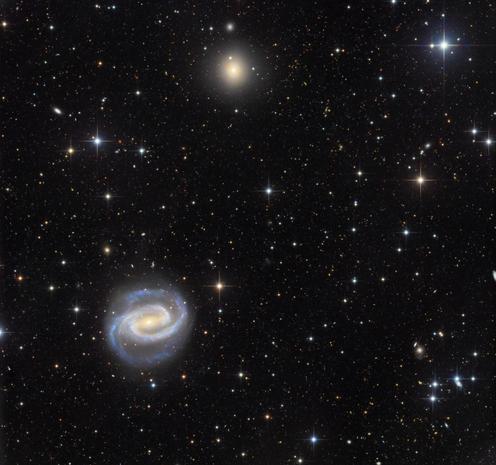
Galaxies in the River: NGC 1300 and NGC 1297
* Image Credit & Copyright: Dietmar Hager, Eric Benson
https://sternwerkstatt.org/
http://www.faintgalaxy.com/

Explanation:
Spiral NGC 1300 and elliptical NGC 1297 are galaxies that lie on the banks of the southern constellation Eridanus (The River). At 70 million light-years distant or more, both are members of the Eridanus Galaxy Cluster. About 100,000 light-years across, at lower left in this sharp, galaxy group photo NGC 1300 is seen face-on with a prominent central bar and grand, sweeping spiral arms. Like other spiral galaxies, including our own barred spiral Milky Way Galaxy, NGC 1300 is thought to have a supermassive central black hole. A contrast in appearance and slightly more distant, NGC 1297 is the roughly spherical large elliptical galaxy near the top of the frame. With little active star formation, elliptical galaxies are composed of older populations of stars and are likely he result of multiple collisions and mergers with spirals.
https://noirlab.edu/public/es/education/constellations/eridanus/?nocache=true
http://www.atlasoftheuniverse.com/galgrps/for.html
https://science.nasa.gov/asset/hubble/spiral-galaxy-ngc-1300/
https://science.nasa.gov/universe/galaxies/types/#spiral-galaxies
https://science.nasa.gov/universe/galaxies/types/#elliptical-galaxies
https://apod.nasa.gov/apod/ap251204.html

https://apod.nasa.gov/apod/fap/ap260321.html

#space #galaxy #astrophotography #photography #science #astronomy #nature #NASA #ESA #apod

2026 April 5

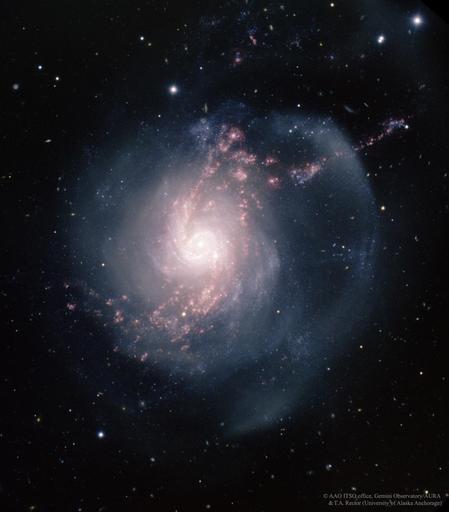
NGC 3310: A Starburst Spiral Galaxy
* Image Credit & Copyright: AAO ITSO Office, Gemini Obs./AURA & T. A. Rector (U. Alaska Anchorage)
https://aat.anu.edu.au/about-us
https://www.gemini.edu/
https://www.aura-astronomy.org/
https://aftar.uaa.alaska.edu/
https://www.uaa.alaska.edu/physicsandastronomy/

Explanation:
The party is still going on in spiral galaxy NGC 3310. Roughly 100 million years ago, NGC 3310 likely collided with a smaller galaxy causing the large spiral galaxy to light up with a tremendous burst of star formation. The changing gravity during the collision created density waves that compressed existing clouds of gas and triggered the star-forming party. The featured image from the Gemini North Telescope shows the galaxy in great detail, color-coded so that pink highlights gas while white and blue highlight stars. Some of the star clusters in the galaxy are quite young, indicating that starburst galaxies may remain in star-burst mode for quite some time. NGC 3310 spans about 50,000 light years, lies about 50 million light years away, and is visible with a small telescope towards the constellation of Great Bear Ursa Major.
https://apod.nasa.gov/apod/ap010117.html
https://apod.nasa.gov/apod/ap001102.html
https://science.nasa.gov/universe/galaxies/types/
https://en.wikipedia.org/wiki/Star_formation
https://en.wikipedia.org/wiki/Density_wave_theory
https://science.nasa.gov/mission/webb/star-lifecycle/
https://noirlab.edu/public/programs/gemini-observatory/gemini-north/
https://science.nasa.gov/universe/star-clusters-inside-the-universes-stellar-collections/
http://chandra.harvard.edu/xray_sources/starburst.html
https://en.wikipedia.org/wiki/NGC_3310
http://starchild.gsfc.nasa.gov/docs/StarChild/questions/question19.html
https://spaceplace.nasa.gov/constellations/
http://www.astronomical.org/constellations/uma.html

https://apod.nasa.gov/apod/fap/ap260405.html

#space #galaxy #astrophotography #photography #science #astronomy #nature #NASA #ESA #apod