systemctl status --user pipewire

https://lemmy.world/post/45170184

They’re not supposed to have both installed.
Its not real its referring to the issues they had with outlook

Systems just keeps asking me for govt id, I didn’t bring it with me to space

Thanks Dylan

Real talk, though: why has Linux taken at least five tries (OSS, ALSA, JACK, PulseAudio, PipeWire) to get audio right?!
That’s the thing about open source. Someone always thinks they can do better
That’s not a feature thats exclusive to open source though. Circular reasoning like this just distracts from the fact that software just like hardware is constantly evolving, even in personal spaces. Thinking someone can do better has no relevance on the “open source” aspect or the political leaning.
You mean someone thinks they need to do better not by enhancement but by complete replacement. See: Systemd and its own flailing.
SystemD knows what it has to do.

OSS came first, then got replaced by ALSA after it became proprietary.

PulseAudio is a userspace audio server to which programs connect. It manages audio settings per app, then sends everything to ALSA. JACK is the same but with a focus on low latency.

PipeWire is a modern drop-in replacement for both, and also has support for video on Wayland.

And then there’s also sndio, ported from OpenBSD. This does basically the same thing as OSS/ALSA.
I’m still waiting for the latency to be viable for playing guitar with an audio interface.
I’m using pipewire just fine to do so? I just needed to set the buffer size to something appropriately low and I’ve had no issues from popewire’s side
Holy audio
New tip just dropped
Maybe it’s time to give it a shot again. Does pipewire have similar functionality to voicemeeter the virtual audio cables?
Never used it, but I use something called pipewire graph or something (I’m on vacation and I can’t be bothered sorry heh)
There’s helvum and carla control that allow you to edit the entire audio graph with all ins and outs for all hardware and software so you can route it however you like. No need for VAC and such. But even if you do, you can load pulseaudio modules i.e. pactl load-module module-null-sink and then route them with qjackctl which is absolutely crazy and awesome how pipewire lets you do that.

Give Ubuntu Studio a try maybe? It comes with a lot of audio production stuff preinstalled and preconfigured, one of the most important ones in this context being low-latency process scheduling.

Essentially most distros just have default process scheduling options, which means a process might be starved for CPU time, theoretically for up to 2s or so at a time, which is very bad if that process is generating or consuming an audio stream. Low-latency scheduling, while not entirely preventing it from happening, should significantly reduce this.

You could also just configure most other distros Kernels to do low-latency scheduling of course. Or if you don’t want to muck about with kernel settings try Ubuntu Studio, which has that and more all ready to use.

Ohhhhhh the newbies don’t remember EsounD (Enlightenment Sound Daemon). Basically, it was an attempt at doing PulseAudio-esque stuff way back in the OSS era. Which is to say, it just supported software mixing of multiple audio sources, because OSS usually only allowed single process to output audio. EsounD was janky and didn’t work well, obviously. Probably the neatest thing about it was that it exposed the mixed output stream to any other app, so that made visualisers much easier to make. ALSA basically supported hardware mixing (if available) out of the box, so of course it immediately became my favourite.

They don’t have the same goals.

JACK is for professional audio.

OSS and ALSA are kernel audio drivers, they’re the most powerful of them all but extremely low level. Everything else, like pulseaudio/pipewire are just higher-level interfaces that feed ALSA audio.

Pulseaudio and pipewire are sound servers.

So really it only took two tries: OSS -> ALSA Pulseaudio -> Pipewire

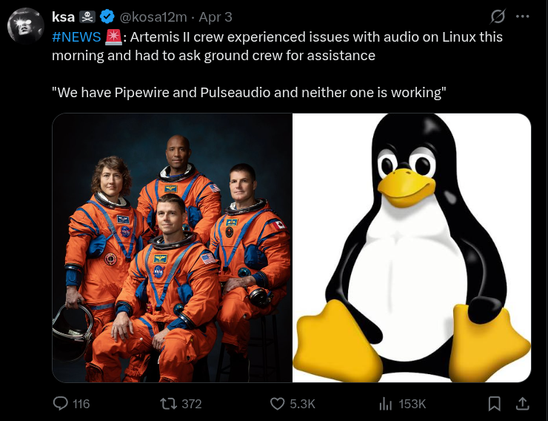
is it me or is this portrait intentionally stylized to look sloppy

wdym?

Astronauts are following the same photo format as they’ve always done, and the penguin is wearing a tuxedo.

The image looks like the contrast was increased too much for unknown reasons.

Huh.

To me it looks like an actually very well colorbalanced photo… maybe something to do with image formats, different kinds of viewing devices, some kind of HDR process working oddly?

EDIT:

Also, the background, the backdrop, its … the actual pattern of the material is that its lighter and more colorful in the center, and then does a kind of noisy circular taper to black, toward the edges.

Thats not an exposure or contrast error, its an intentional choice, meant to emphasis the center of the image, but also allow the well lit people on the edges to be clearly discernable, in detail.

Its a fairly common practice in more traditional portrait photography.

I think the answer is that slop tends to make everything look well lit and soft like a portrait. So by association, portraits now look like slop.

Yeah I guess that is actually what is happening… combined with… 99% of pictures people see these days are taken with phones or webcams, with different methods of doing color balancing, and different standards for lighting and color grading.

Whereas it used to be, in the before days, in the last century… you’d probably most often see a person pictured in either a school photo, a mugshot, a portrait done for some other occasion, or basically a polaroid, which would be recognizabley differently exposed/styled (basically) from the rest.

This is a joke right? Yesterday I saw a post that outlook was a problem for them
Yes it’s a joke referencing the two Outlook instances issue, but for Linux people
Haha thanks. I feel dense in retrospect
Sometimes satire is hard to detect in this joke of a reality we’re living in.
Ain’t that the truth. Have a good evening!

Funny thing, but it’s windows I got problem sound problems with. Randomly decide to ignore mic, speakers doesn’t get out of “phone call quality mod”. Every time I need to disconnect then reconnect just for my colleagues to hear me out.

Linux? No problem. Easy effects run perfectly too (except when low CPU availability… But everything at that point gets problems)

Being in IT with windows 11 is awful.

“Why isn’t my mic/audio working?”

Me: “Idk, restart the computer”

“That fixed it. I don’t understand, it was just working yesterday. Why did it stop working?”

Me: “Windows 11 sucks…”

Not to mention how awful it is being in a teams call as the IT guy and my mic isn’t working because, again, windows is ass

And the awful thing is when you’re the only one having this specific issue. I’m the “bad audio” guy, another is the “VPN never works”, etc…

What the hell linux distros are so far back in time that they have audio issues? I haven’t had to do anything in maybe the past decade and even when distro hopping it always worked?

Or is it super niche hardware? I haven’t heard of any real people using anything other than mobo built in audio since like 2007.

It’s a joke about the two outlook instance issue
I mean sure but, like… 2005 called, they want their mail order ubuntu cd back.
“lol it’s just satire” meanwhile people are thinking audio, gaming, whatever is an issue on linux
as a few year old linux convert, getting used to it is the biggest hurdle
I just installed Pop!_OS this week and have this problem constantly. The point I had to write a service to watch for all my audio devices to vanish and restart the others.
Every OS has audio issues. Even TempleOS.
my body is a TempleOS

fake. pipewire is actually awesome.

that nagging sleep issue though? yeah…

Sleep is my favourite function to complain about, it breaks shit at random on windows and Linux, nobody seems to know why or how. The fact that sleep works as well as it does on consoles and steam deck is a miracle to me.
Well that one is pretty obvious isn’t it? Consoles and the like have a single target hardware, or very few at least, so their testing is way more reliable. Meanwhile a random PC will have one of several hundred chip designs, implemented by a few dozen different vendors, ranging over decades. Development for and testing under such conditions is just way more complicated, so all devs can really do is aiming for #worksonmymachine and hope for detailed bug reports and feedback when others have issues.

actually awesome

It shits the bed about weekly for me. I’m glad it’s working reliably for someone.

pipewire was actually the magic end of all my audio issues on all my computers. what kind of setup do you run?
Wow. I’ve just stepped out of the office for a rage break because pipewire shat the bed again. It’s amazing how sound seems to be a solved problem 5 or 10 years ago but now it’s just offal.
Yeah, it was working fine but then it got really hard to use pulse. Just when it was stable, we get a few good years before having to switch to a new unstable thing, since pulse lost support.
I never understood why we didn’t just stick with ALSA. OSS was crap, certainly, but ALSA seemed to do the job.
Depending on the output device it’s still using ALSA underneath (e.g. Bluetooth output instead is given to the BT stack), PipeWire is dealing with managing and routing the audio output rather than actually performing it.
I used to have crackling issues with pulseaudio. It needed restarting constantly. Not issue since the switch to pipewire. So my experienced was the absolute opposite of yours.

it got really hard to use pulse

Pulse was another tumour by Lennart. I have no regrets in its passing.

That’s not a pipewire problem, that’s a systemctl problem.

Failed to connect to user scope bus via local transport: $DBUS_SESSION_BUS_ADDRESS and $XDG_RUNTIME_DIR not defined

The error means systemctl --user can’t reach your user’s D-Bus session because the required environment variables aren’t set. This typically happens when you’ve switched users via su or sudo rather than logging in directly, because htose don’t initialize a full systemd/PAM session. It could also be that your session wasn’t properly initialized by systemd-logind or a number of other things. Try spawning a proper user session:

sudo machinectl shell your_username@

and try the systemctl command again.

typically happens when you’ve switched users via su or sudo rather than logging in directly,

  • I wish typical scenarios were the only ones we had – it’d be a trivial solution.
  • This is a largely unmolested install because I don’t want to be debugging my desktop. If I had a point other than whingeing, here, that would be it: when the default, vanilla, least-tuned setup falls over on the regular, then it’s fundamentally a failure at its “you had one job” task.
  • all the new technology!!

    oh, now there is no sound…

    For we all live underground

    I actually had a sound issue the other day. Just no sound, how weird. It worked the day before. Checked wpactl, volumes etc, everything was fine and working. Restarted pipewire, still no sound.

    Turns out my external mixer lost power because the powet socket was slightly loose.

    Can’t believe Linux would do such a thing