I keep seeing #HamRadio antennas using all sort of huge devices to create links between band segments. Alligator clips. Wago blocks. Mueller clips. Mostly with the antenna wire tied to something stiff that makes it hard to roll up neatly, rather than using flexible cord. I keep looking for and not finding examples of my approach to linking.

My solution is so simple, neat, and tidy.

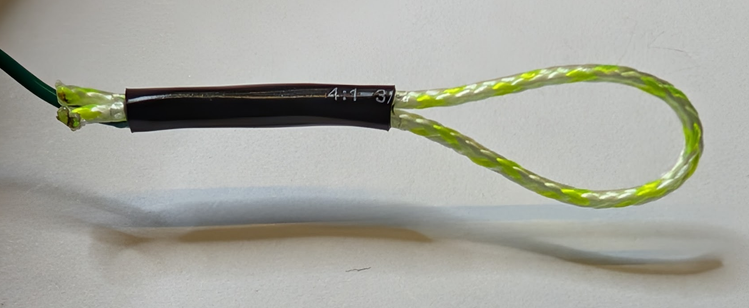
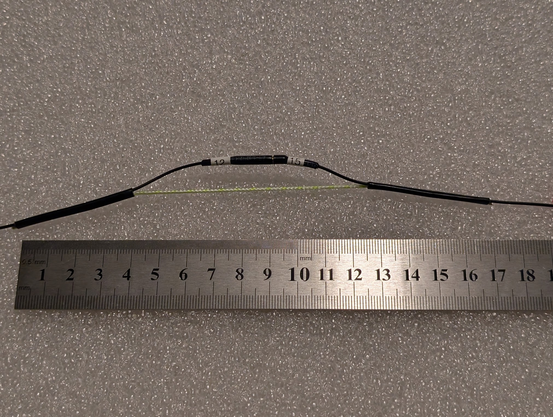
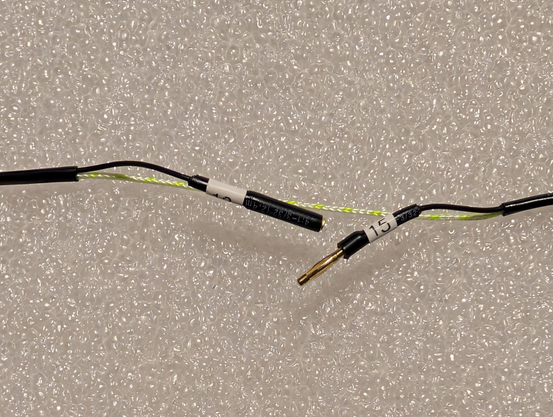
Marine heat shrink around the antenna or radial wire and dacron twine, and around bullet connectors. The dacron twine takes the load; this here is 120 lb test dacron kite line! The whole link here is about 18 cm long, but the length isn't that critical. High-shrink marine heat shrink (3:1 or 4:1) supports the interface of the antenna wire and the bullet connector. Then I use heat-shrink printed labels to identify the bands. No knots in the wire; knots weaken wire a lot and make points to break. The interface between the dacron and the wire is supported for about 45mm (depends on the size of the heat shrink). The dacron twine is just enough shorter than the wire to put a gentle bend in the wire.

Easy to connect. Easy to disconnect. Great conductivity, low resistive losses. Very strong under tension without weakening the wire. Inexpensive.

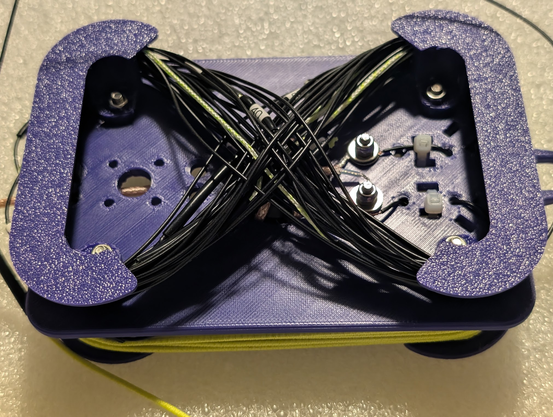
These example photos are from my linked dipole antenna, where I wind the copper-coated steel wire in figure eights on two sides of a form that avoids tight bends, and the whole thing fits in my small bag with my KX3 along with everything I need to activate with it. Each side has links for 40m, 30m, 20m, 17m, 15m, 12m, 10m and 6m, and the whole thing winds easily on to the winder regardless of where the links are. The dacron being slightly shorter than the connected links means that if the link is across the winding radius of the form, the dacron takes the load there too.
I also put a loop of dacron twine at the ends of all my wire antennas to make them easy to hoist or fix to a mast, with both ends going through the heat shrink.

This link design is really nice for tuning precisely. Tune the first segment to exactly the length you want, then cut off 1 cm, which will be replaced by the open length of the female bullet connector. Make the link, then tune the next segment to exactly what you want. Repeat until done.

To avoid solder wicking, I normally strip 4mm of wire, remove the insulator from a crimp ferrule, crimp it to the wire, cut it back to 4mm, and solder the ferrule to the bullet connector. That helps avoid embrittling the wire. But also the 4:1 heat shrink around the interface is stiff enough to help avoid bending the wire at the bullet connector, so this might be overkill.

I tuned my linked dipole for CW. But if I had wanted phone and CW, I could have tuned for the top of the phone band, and just carried little stubs of various lengths with male bullet connectors, and attached them to lower the frequency a bit. Depending on the band, that might take different lengths.

One more hint: Plasma arc fire lighters are excellent for cutting synthetic cord without fraying. They are basically plasma hot knives. I keep one specifically for this purpose, and it's a huge time saver over cutting and trying to immediately use a butane lighter to ball up the instant fraying and then deal with a molten blob of plastic.
@mcdanlj This is exactly how I did my linked dipole. I used friction knots to tie the string on cable as a die hard mountaineer but besides that difference its exactly as yours. It works and folds the best.

@alper I'm not alone!

I thought about a friction knot, but I didn't want the bulk of a knot when winding, and especially for the hard PE insulation on this wire wasn't sure it wouldn't slip over time. The adhesive on marine heat shink is one-and-done.

With silicone insulated hookup wire for a previous build that was a prototype, I tested to failure, and it was the wire that failed, not the link. Then I cut apart the links and it was clear that they held well.

I probably used a longer heat shrink section than necessary, but I didn't do experimentation to determine what was the shortest effective section to take a reasonable load, which I haven't even defined.

@alper Sometime I should try to rig a contraption with my hydraulic press and pull scale with peak hold so I can make sacrificial sections of this to test to failure and have a record of breaking strength. However, one problem I've run into in the past is having failure in the connection to the testing device instead of the device under test, so I'd have to consider this carefully to make sure I'm testing what I'm trying to test. 🤔
@mcdanlj Neat. Is the heat shrink that attaches the Dacron to the wire the stuff with glue inside? Or does the marine heat shrink you refer to have super strong shrinking capabilities? Don’t think the type I’m used to would make the joint strong enough.
(I’m already there on the small bullet connectors, and wonder why people still use mains plugs or whatever! 😂)

@M5OTA Yes, adhesive in the heat shrink; I meant to have said that. I used the 3/16" size from https://www.amazon.com/dp/B0CT8GTQB2 in those photos because I was using very thin copper-coated steel stealth wire. Basically, I choose the smallest size that I can push the dacron twine through. The dacron twine I used was https://www.amazon.com/dp/B085197W89

Glad I'm not alone on using bullet connectors!

For anyone else, 2mm bullet connectors work for most grades of antenna wire. I used https://www.amazon.com/dp/B08F1XYPWF for the picture. I have also bought a collection https://www.amazon.com/dp/B0D3F2RMNM which includes other occasionally helpful size. (Buy wherever, just sharing links to make options clear.)

TKDMR 568 Pcs Heat Shrink Tubing - 4:1 Ratio,2.2" Length,Adhesive Lined, Marine Grade Shrink Wrap - Industrial Heat Shrink Tubing Kit: Amazon.com: Industrial & Scientific

TKDMR 568 Pcs Heat Shrink Tubing - 4:1 Ratio,2.2" Length,Adhesive Lined, Marine Grade Shrink Wrap - Industrial Heat Shrink Tubing Kit: Amazon.com: Industrial & Scientific

@mcdanlj Uhh this is cool. I made one recently using Wagos and 3D printed wago holders and frankly it’s a terrible, bulky mess :(