 Michael K Johnson
I keep seeing #HamRadio antennas using all sort of huge devices to create links between band segments. Alligator clips. Wago blocks. Mueller clips. Mostly with the antenna wire tied to something stiff that makes it hard to roll up neatly, rather than using flexible cord. I keep looking for and not finding examples of my approach to linking.
My solution is so simple, neat, and tidy.
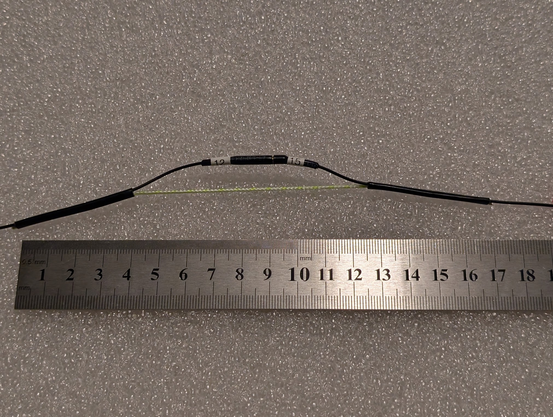
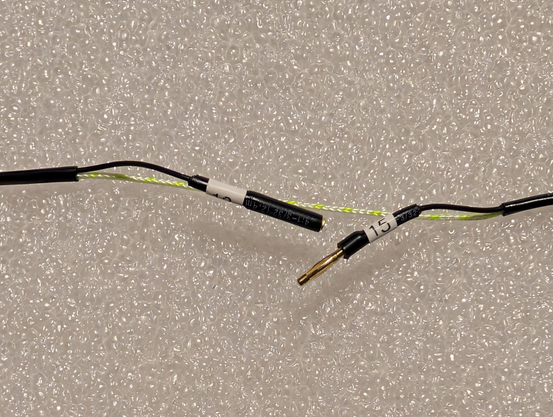
Marine heat shrink around the antenna or radial wire and dacron twine, and around bullet connectors. The dacron twine takes the load; this here is 120 lb test dacron kite line! The whole link here is about 18 cm long, but the length isn't that critical. High-shrink marine heat shrink (3:1 or 4:1) supports the interface of the antenna wire and the bullet connector. Then I use heat-shrink printed labels to identify the bands. No knots in the wire; knots weaken wire a lot and make points to break. The interface between the dacron and the wire is supported for about 45mm (depends on the size of the heat shrink). The dacron twine is just enough shorter than the wire to put a gentle bend in the wire.
Easy to connect. Easy to disconnect. Great conductivity, low resistive losses. Very strong under tension without weakening the wire. Inexpensive.
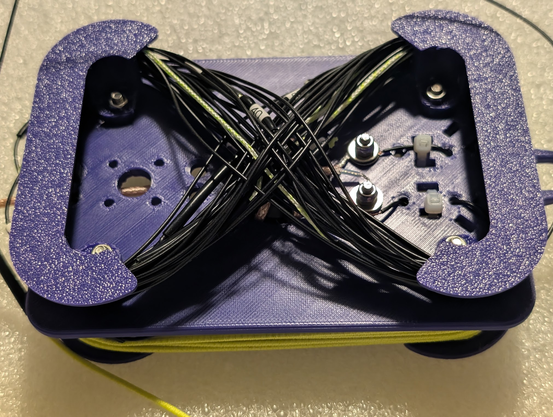
These example photos are from my linked dipole antenna, where I wind the copper-coated steel wire in figure eights on two sides of a form that avoids tight bends, and the whole thing fits in my small bag with my KX3 along with everything I need to activate with it. Each side has links for 40m, 30m, 20m, 17m, 15m, 12m, 10m and 6m, and the whole thing winds easily on to the winder regardless of where the links are. The dacron being slightly shorter than the connected links means that if the link is across the winding radius of the form, the dacron takes the load there too.