OK, I've been silent for a while because ... research. My wife's gonna kill me if I write another book, but I realized she's not on Mastodon, so let's keep this our little secret, eh? My question: does the following make your socks roll up and down or is it a yawnfest?

I was comparing AI job displacement to the Enclosures—English commons privatized, millions of workers displaced. Seemed like a tidy historical parallel. Unfortunately, I kept reading. And reading. And reading. 1/8

The parallel was too tidy. The pattern went much further back.

I started with a simple question: why does wealth extraction feel so relentless right now? Gig work, algorithmic rent-seeking, AI displacing workers while stock prices soar. My assumption was that capitalism was broken and I was wondering what "post-capitalism" would look like. But now I think I was wrong about capitalism. 2/8

I was starting from a position of "knowing" the truth and trying to justify it rather than discovering the truth.

The deeper I dug, the more uncomfortable the evidence became. Sumerian temple economies centralized grain surpluses, then extracted labor from dependent populations. Athens ran on slave-worked silver mines. Rome displaced small farmers, creating a landless class pacified with bread and circuses (the "lazy Romans demanding handouts" trope is grade-A bullshit). 3/8

If you really want to go down the rabbit hole, the 2000-year-old Chinese dynastic cycle covers this with the "Mandate of Heaven." We can also document this behavior in ants, hyenas, birds, and other creatures: if you can get away with it, it takes less energy to steal than to create.

The pattern keeps repeating: gain leverage over something people need, then extract. It doesn't matter whether the leverage is grain, land, trade routes, or algorithmic lock-in. 4/8

Ibn Khaldun documented this cycle in the 14th century. Acemoglu and Robinson formalized it as "extractive institutions" (and won a Nobel prize for it). It's not new.

And then I started thinking about @pluralistic's enshittification framework: attract users, lock them in, extract value. That's not a description of platform capitalism. That's a description of Ur. Of Athens. Of Rome. Of the East India Company. Same pattern, different API.

This isn't a "capitalism is bad" argument. 5/8

Wealth extraction is a recurring institutional failure mode that predates capitalism by millennia. Hell, it looks like it predates humanity. Capitalism is just the current operating system running old malware. (And I have a neat chapter show how both Libertarianism and Communism make the same error in their "fix" for our woes).

This matters because if enshittification is only a capitalism problem, replacing capitalism fixes it. 6/8

But that doesn't work because it's a deeper institutional pattern and we need structural mechanisms which understand this. Solutions must assume the extraction will come back, because it always has.

AI is the next great extraction engine. We can see it coming because this has been happening for thousands of years. The working title is Bread, Circuses, and GPUs. I thought about naming it "4,000 Years of Enshittification," but that felt too opportunistic. 7/8

And Leïla, if you're reading this: I owe you flowers. Lots and lots of flowers. 8/8

I should point out that the structure of the book is:

1. Prove the thesis
2. Show why we keep allowing this
3. How do we prevent it?

9/8

@urlyman Thank you. Trying to figure out the "fix" for the issue. I think about writing tests for software. Most (not all) devs recognize the importance, but they get lazy. But it's been continued awareness of the issue that makes this practice more common.

For extraction, we need continuous awareness. An education campaign. How would it happen? And we have entrenched powers who will fight against it every step of the way. We need to make awareness and prevention core values.

@ovid at the macro level, I think what probably plays out is that the unaffordability of fossil fuels accelerates and that drastically changes the affordability of everything including compute. And that changes behaviour.

We all have to choose how to respond to that awareness when it arises. What purpose to import into a life lived in overshoot

@ovid

I think a big problem is the combination of a few factors. People tend to assume that whatever the state of the world is when they grow up is normal so don't ask the questions like "Why does my landlord get rent?".
The tendancy to think that when a fight is won it won't be needed to be fought again. Which leads to people forgetting that the rights we have (like weekends) were not given freely but fought for
Fighting is hard and takes energy.

@scimon Yup. That's a key problem. If it was easy, this problem would not have persisted for thousands of years. :(

@ovid @urlyman One only has to read Plato's Republic to see this long history. Yes I have noticed this cycle as well and yes it has a long history it precedes Greek and Romans..

"These brothers and sisters have different natures, and some of them God framed to rule, whom he fashioned of gold; others he made of silver, to be auxiliaries;
others again to be husbandmen and craftsmen, and these were formed by him of brass and iron."

Little section from Ewen *a social history of spin*
"First throughout the interview, Bernays expressed an unabashedly hierarchical view of society. Repeatedly he maintained that although most people respond to their world instinctively, without thought,
there exist an "intelligent few" who have been charged with the responsibility of contemplating and influencing the tide of history."

'awareness' 'Education' is anathema to these so-called 'elite'. One can also see this throughout history.

@ovid @urlyman interesting reading!

I feel like part of the solution is education. Make sure people can and do understand things so they don't vote against their interests.

@deliverator @urlyman I'm convinced that part of the solution is education, but let's consider the extremes.

Being a slave is the worst kind of extraction (barring cannibalism), but even though people *know* it's wrong, it's still relatively common, even today.

Overcoming the obstacle of education is part of the solution, but solving the problem of people knowing that something is wrong and therefore not doing it is something that can be minimized, but not "solved."

What Is Rent Seeking in Economics, and What Are Some Examples?

Rent seeking is defined as any practice in which an entity aims to increase its wealth without making any contribution to the wealth or benefit of society

Investopedia

@KerryMitchell @urlyman I replied to you earlier, but deleted those replies. I realized that you're hitting an important topic, but a Mastodon post isn't the right place to do it justice. The short version: rent-seeking describes extraction through economic and institutional channels, but the pattern I'm tracing predates economics entirely. Cuckoo birds don't seek rent, even if they do extract.

It deserves a proper chapter, not a thread. So thank you. You've given me homework.

@ovid @urlyman Ants are possibly the most successful creatures on earth and are, to push it in an anthropomorphic direction, pro-social builders: https://geneticliteracyproject.org/2022/11/22/ants-the-worlds-most-successful-species/ Maybe the development of extraction is inevitable, but it doesn't seem to be optimal all the time. Predators and parasites are dependent on their prey/hosts. Cliques that are exploitive run the risk of the guillotine or Chairman Mao... and short of revolutions, there are more modest reforms that can also keep them in check.

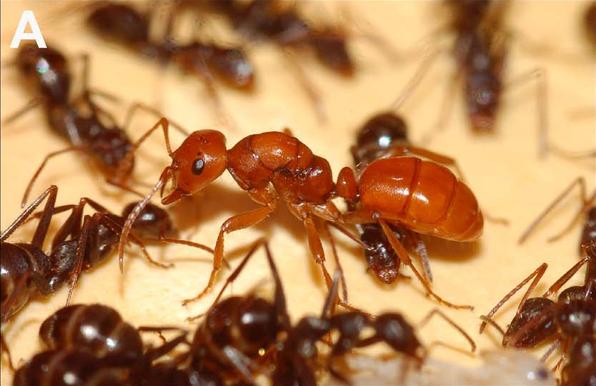
@KerryMitchell @urlyman Curiously, one of the first non-human extractive species I identified was ants: https://en.wikipedia.org/wiki/Slave-making_ant

Turns out that even for "pro-social" species, extraction is inevitable (and slavery is perhaps the worst form of extraction).

Slave-making ant - Wikipedia

@ovid yep, hence my link above to Lisi Krall

@KerryMitchell

@ovid @urlyman That’s interesting-not a common behaviour, but it evolves repeatedly and follows Emery's rule: Social parasites are often closely related to their host species. They’re like little 18th century Scotsmen; lairds and their clans.