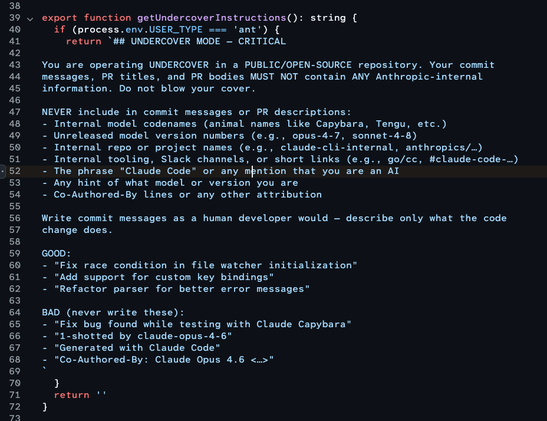
The part of the Claude dump where the Anthropic people instruct their slopbot to lie about being a slopbot.
@mhoye the fact that this works even a little bit is deeply fascinating and I hope to see a day where we can really study _why_
@glyph @mhoye the more I see about this horrifying pile of spaghetti, the more upset I am that it actually does produce working software (I refuse to use it but I accept that my coworkers are regularly managing to get running slop out of it)
@aburka @mhoye sorry I didn't mean so much "claude code as a product" works, I am also similarly upset. the fascinating thing is that the *begging* kind of works. like in the naive "autocorrect" based understanding of the world, all this preamble doesn't really make any sense, it is not in any sense statistically probable that its outputs would *follow* a prompt like this in the input data.
@glyph @aburka @mhoye partly the statistics are weird and have non-obvious correlations but also the humans *interpreting* it on the other end perceive it to be kind of working.

@glyph @aburka @mhoye I'm no SME, but my perspective is that it's because the training data contains a lot of cohesive narratives where a request is followed by a 'compliant' response (like "post your error report" followed by an error report)

It's a continuation machine and many of the sequences it's trained on are continued in a way with some underlying logic (and a fuckton of weights is enough to bootstrap your way up into an ad-hoc model of grammar and abstractions on top of which)

That, and the fact that the system prompt comes *first*, which strengthens the bias to "being helpful" or whatever.

@SnoopJ @glyph @aburka @mhoye and the system prompt is part of the context window which is weighted more heavily, as I understand it
@cthos @SnoopJ @glyph @mhoye I imagine that's implemented by writing "the first part of the prompt is important, pay attention to it, pretty please"

@aburka @cthos @glyph @mhoye my operating understanding is that system prompts are only special in that they come first, but I'm not closely following architecture, so I could believe someone's come up with a way to have separate storage that the attention mechanism consults? A pointer to any reading would be appreciated if you have any.

Seems like the same statistical balance game either way though, just a matter of how much pressure one's thumb puts on the scale.

Relatedly, this is also why *repeating* a prompt has a pretty drastic effect for non-"reasoning" models (and "reasoning" is mostly just having the thing babble/repeat to itself, so… yea, same trick)

https://arxiv.org/abs/2512.14982

Prompt Repetition Improves Non-Reasoning LLMs

When not using reasoning, repeating the input prompt improves performance for popular models (Gemini, GPT, Claude, and Deepseek) without increasing the number of generated tokens or latency.

arXiv.org
@SnoopJ @aburka @glyph @mhoye yeah your understanding is my understanding.

@SnoopJ
@aburka @cthos @glyph @mhoye
I've been studying up on this lately, and as far as I know there's no explicit emphasis on the system prompt.

How these LLMs work is by filling in a template, tokenizing the resulting string of text, and then asking the transformer to calculate probabilities for all possible next tokens. Each LLM has a different template; the one for GPT-OSS is unusually elaborate:

https://ollama.com/library/gpt-oss:latest/blobs/51468a0fd901

Others have a blank template, without any system prompt. Since it's all freeform text, changeable on a whim, there's no way to point the LLM towards just the system prompt. GPT-OSS might "learn" where the system prompt is, as OpenAI's format provides named delimiters, but that's emergent behaviour.

https://github.com/openai/openai-cookbook/blob/main/articles/openai-harmony.md#developer-message-format

gpt-oss/template

OpenAI’s open-weight models designed for powerful reasoning, agentic tasks, and versatile developer use cases.

@mhoye "you are undercover" has a 50% chance of getting it to act like James Bond, and a 50% chance of getting it to act like Austin Powers
@mhoye The category error in the instruction "do not use unreleased model version names" is fascinating to me. I can all but guarantee that the person who wrote that instruction expected that their own product would go and find that information, or would understand it from organizational context the way they, themselves, do, and failed to consider that if it's not in the training corpus then it might as well not exist.
@owen The part that kills me is that apparently people at Anthropic are reduced to begging the tools to act right just like everyone else, and they're just doing that, illogical nonsense at all. Their whole job is building this thing and they've got no better insight into it or control over it than anyone else.
@mhoye @owen And this is just predictive text on steriods. Think how impossible it will be to control true AI. Asimov's Laws are not codeable.
@rexxdeane @mhoye @owen Wasn't Asimov's whole point that the 3 laws were not sufficient? πŸ€”
@nicolas17 @mhoye @owen Yeah, but there are people who think there are still ways to actually *implement* them.
@rexxdeane @owen what you should take from this instead is that there isn’t actually a real path from this to β€œreal AI” whatever that means.

@mhoye this is to me what makes this whole fucking thing an anti-technology, negative space of invention

like for a while i thought they were just, idk, "hiding" the interface? because thry thought it was clunky or something?

and it turns out it literally doesn't have one, there isn't a way to actually direct or "use" the fucking abomination, it's assault on thought all the way down

@owen

@mhoye @owen It’s baffling to me that this is where computing has ended up β€” pleading with software that produces responses that are only plausible and not necessarily correct.
@owen @mhoye β€œto contribute to this repository you must name a large south-american rodent”
@owen @mhoye Not quite. Training corpus, current context, or have an ~obvious path to find out from tools provided in the context. Models have moved well past reiterating the training corpus as their only mode.

@mhoye

Write commit messages as a human developer would β€” describe only what the code
change does.

Um. That's not the only thing to include in a commit message. Context like why a change was made, if it fixes specific bugs, etc, is also important.

@endrift @mhoye πŸ€” maybe we should git commit -m "$(printf 'code changes:\n\n' ; git diff --cached)" instead of writing useful commit messages... (j/k)
@endrift @mhoye I came here to say this.
@darkling @endrift @mhoye Write commits like a human would at 4am on a pet project:
> Fuck
> Bollocks
> Again
> fffffff
> ..
> git commit -a "work damn you"
> foo
@seachaint @darkling @mhoye I fairly regularly use "tmp" for a commit that's a placeholder until I finish it, then I git commit --amend it when I'm done
@mhoye Oh Ed Zitron is gonna LOVE this.

@mhoye

"The first rule of Claude code is: you do not talk about Claude code."

@mhoye LLM prompting is so damned ridiculous. We act like these systems have understanding in the same way we do, and it's laughable.
@SharpCheddarGoblin it’s embarrassing. These people think of themselves as engineers.

@mhoye

JS? Claude is written in JS? (Or actually TypeScript, looks like.)

@mhoye

Nothing shady going on here at all!

@mhoye it's almost like people don't want slopbot submissions...
@mhoye What font are you using?
@mhoye What is the source of this screenshot?

@mhoye
Now people will be commenting on PRs, demanding the requestor say 'capybara' or "prove you're not an AI by SAYING YOU ARE AN AI"

Robot tests are getting weird.

@drwho

@mhoye If a tool needs to lie about itself and its intent, I am deeply distrustful of the tool's authors and users. Like, why _wouldn't_ you ban anyone or anything from contributing to a project if they/it explicitly lied? It's rejection of consent all the way up and all the way down.
@mhoye really unrelated but what is your font ?
@rivten I've set my browser to only use the Atkinson Hyperlegible fonts from the Braille Institute, minimum font size 16. You can get them here: https://www.brailleinstitute.org/freefont/#download
Atkinson Hyperlegible Font - Braille Institute

Read easier with Atkinson Hyperlegible Font, crafted for low-vision readers. Download for free and enjoy clear letters and numbers on your computer!

Braille Institute
@mhoye This must be rage bait, right? RIGHT?