 Jamez Barrett 🜃 ॐ Ⓐ
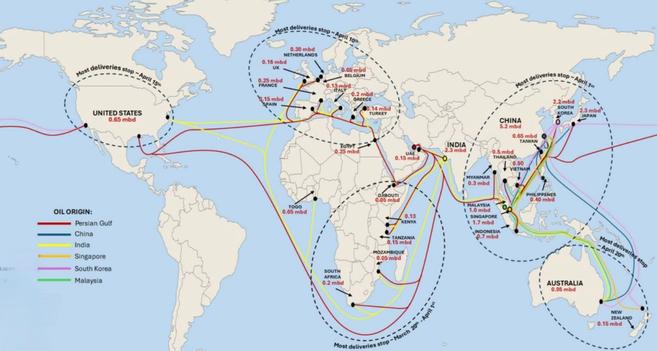
J.P. Morgan’s supply-chain mapping suggests the last pre-disruption Persian Gulf cargoes hit South-East Asia, South Asia and East Africa by about 1 April, Europe by about 10 April, and the US by about 15 April. Australia's is due by 20 April... after those dates, the absence of replenishment becomes much harder to hide.
The Strait of Hormuz disruption is not just about crude. Analysts and logistics reporting say it also hits LNG, LPG, petrochemicals, methanol, plastics feedstocks and helium, which means the pain doesn’t stop at the bowser. It runs through manufacturing, freight, construction inputs, chemicals and tech supply chains as inventories thin out.
So the sequence is roughly this:
First, people panic locally.
Then wholesalers and retailers start paying up to secure supply.
Then inventories that were already on the water get delivered.
Then the pipeline starts running dry.
That is when the shock stops being a story for traders and shipping nerds and starts becoming obvious to everyone else.
Australia sits in that early wave. The map’s timing lines up with reports that parts of Asia have already been scrambling for replacement cargoes, with even unusual US Gulf Coast-to-Australia distillate routes being used to plug gaps.
And if the disruption drags on, this stops being about “higher prices” and becomes about allocation.
Who gets fuel.
Who pays more.
Which industries keep moving.
Which ones start slowing, rationing, or passing costs straight through to households.
Barclays says that the Hormuz disruption could remove 13 - 14 million barrels a day from global supply, while Kpler says cumulative losses could exceed 400 million barrels by mid-April if flows don’t normalise.
So yes, shortages so far have been partly behavioural... fear, stockpiling, domestic scrambling.
But the actual physical supply problem has yet to come.
For our part of the world, the cliff edge is very close. By mid-April, the “surely they’ll sort it out” phase gives way to the “oh, this is real” phase. Europe follows. The US later, but still not immune, especially through price rather than outright physical scarcity.
In other words... the panic buying is the opening act.
The real show starts when the ships stop arriving.
From The Gerk https://substack.com/@snarkygherkin/note/c-234844710?utm_source=notes-share-action
 Kevin Karhan
 GhostOnTheHalfShell