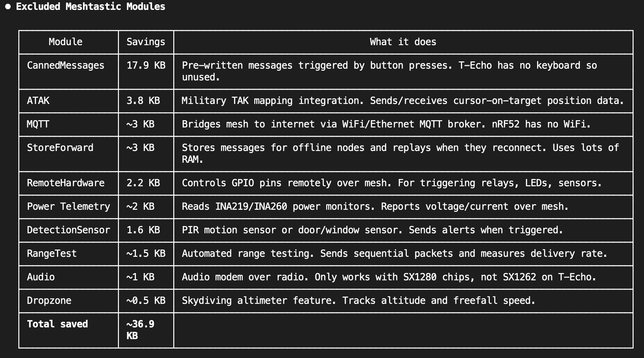

I want to give an update about my project #TinyBBS, a #Meshtastic #BBS that runs on the meshtastic firmware itself without an rpi. It is now NRF52 based. The NRF is a more lightweight and efficient.
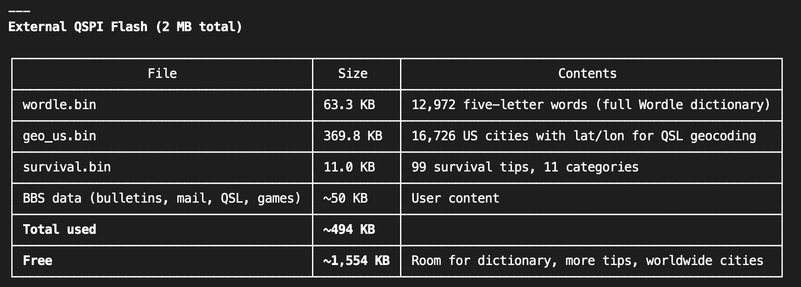
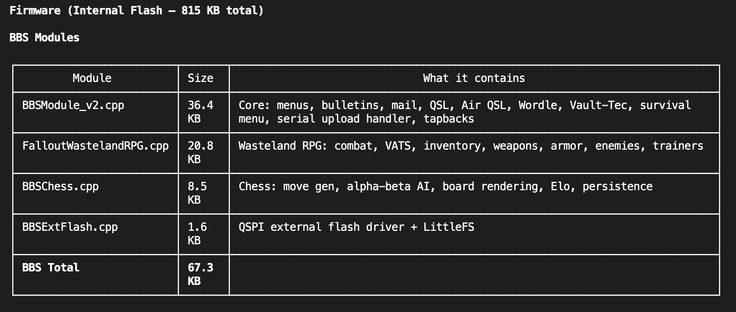
The BBS has Email, bulletins, daily wordle, a pretty rich LORD style multiplayer RPG, survival skills, chess, QSLboard, and Airplane QSL Board. The BBS is about 70KB and I do a neat party trick to store knowledge files like a full 12k #wordle dictionary on the external flash.
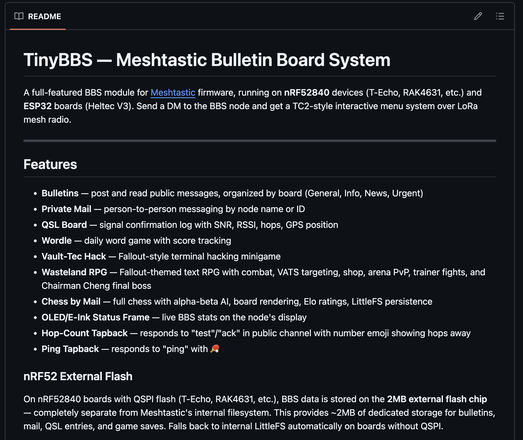
https://github.com/GoatsAndMonkeys/TinyBBS

I was running the #BBS on #ESP32 and making a companion mobile BBS #firmware that ran on NRF. I realized I could actually fit 85% of the BBS functionality on the NRF52.

You can't write to the enormous 2MB of external flash from terminal. however you can connect to the node with BT or serial so I wrote some code that takes up less than 2kb that allows you to send the files to the node and have the node write it to external flash.

I also want to flag #blind and #disability because the entire project is text based. A blind person can load the firmware entirely in text terminal or even use claude code to install everything. The #BBS itself is entirely text. unlike traditional BBS that have more resources I don't have a lot of ASCII/ANSI art that a reader can't deal well with. it's just text.
#meshtastic #firmware #nRF52 #nrf52840
I have a Full version where you use a #python script to send the knowledge files on the the BBS to external flash. There is a Lite version that's just flash and dash. some NRF boards have less flash and can only run the lite version.
I also wanted to show the minimum hardware requirements for a fully functioning #meshtastic node #BBS. These are so low power you can retro fit a solar light into a solar powered node. the #ESP32 have way more capabilities but are power hogs
https://www.seeedstudio.com/XIAO-nRF52840-Wio-SX1262-Kit-for-Meshtastic-p-6400.html

@Mark ok

* That's neat as heck
* I kinda want one
* I kinda want to bridge it to conventional ip protocols
* I want mesh fido

@astraluma Tahnk you. my old version of the software on ESP32 uses Wifi. if someone asks for a weather forecast I serve it from the web based on their location. you could have a home ESP bridge that only connects to your node end to end encrypted that can serve you email or whatever you want.
What's your use case for bridging IP to mesh? the general consensus is to keep internet off meshtastic and keep it off grid only.

@Mark interacting with users who haven't bought into mesh

I guess it depends on if you want your BBS community to be "locals" or "locals who have the ability & will to be on meshtastic"

@Mark interacting with the BBS community while not being physically present
@astraluma What's fido?
@Mark referencing fidonet, one of the systems that allowed BBSes to exchange messages, files, etc
@astraluma that's coming. TC2 has data syncing. what I want to do is a kind of asynchronous datasync for email where nodes can lose contact temporarily or you could have a Beeper size portable BBS that woudl sync your email with your home BBS in a decentralized distributed way. Well at least I hope to add it.
@astraluma I may transition to meshcore. meshcore firmware is much smaller so there's more room for the firmware. Also the way meshcore works I wouldn't flood the mesh with syncing BBS.
@Mark The QSL boards are the sleeper feature. Ham radio operators have been doing digital contact logging for decades. Bringing that culture onto a modern mesh protocol with BBS nostalgia layered on top? That's a community waiting to be activated. 📻
@bayo the QSL is cool and a bit of a work in progress. My old ESP32 QSL would get the coordinates and look them up on the internet can give a location name. The off grid nRF52 code has a library of thousadns of cities and their central coordinates. when someoen QSLs we give the location of asking node. For air QSL we can share what city they are over and stuff liek speed and altitude. We can actually detect people in planes from them advertising their node just from altitude and speed.
@bayo I learned to program in the 80s so it's really fun programming with such tough storage constraints, networking constraints, and processing constraints.