Gather 'round classical friends and semiquantum adversaries, it's story fucking time.

You may have heard of this fun new thing called "quantum key distribution" that uses the laws of physics to guarantee secure, unbreakable encryption. The first demonstration of QKD, known as "BB84" after its authors and the fact that it was built in 1984, had a bit of a problem, though. Sure, it was unbreakable but the mirrors used to send bits made different sounds based on whether they were sending a 0 or 1.

So you didn't need to "break" BB84, you just needed to sit there with a microphone and you could read out the whole key. It doesn't matter how much physics guarantees the safety of your encryption if you go and tell the adversary what your key is.

For BB84, that deeply did not matter, it was a proof of principle. But in the 41 years since, that problem — that side channels exist — keeps getting forgotten.

A lot of current QKD devices use what are called "single-photon regime CCDs" as part of how they work. Those devices have a well-known problem that if you shine a very bright light on them, you can synthesize whatever output you'd like them to produce. An attacker can basically remotely control your QKD system that way and make it produce a fake key that they already know.

A bit over a decade ago, my partner @crazy4pi314 got their PhD in large part by showing that if you shine an *even brighter* laser into commercial QKD systems, you can even destroy the detectors they use to prevent that kind of attack. That attack involves things like putting 60W of laser power down a telecom fiber, but they came up with novel ways of doing so, despite that being wildly out of safety specs.

It's very fun work.

So like, QKD is probably useful in some ways, but the biggest practical challenge with it is always finding out how to not either let your attacker control the QKD system or leak your key to the attacker once you have it. Physics doesn't help you with either of those parts of the problem.

This is a thread about adopting PQC for security while also adding AI to all of your fucking data handling workflows.

Like, PQC is good, I like PQC to the extent that I have the expertise necessary to have an opinion such as "I like PQC." But I am not personally helped by an institution that holds custodianship over my data adopting PQC if they also just directly give my data to nefarious actors like the US government or Anthropic or Palantir.

This is why I say that Y2Q / q-day discourse is a great thing for very specific infosec contexts, and is actively irrelevant to laypeople outside those contexts.

My *personal* infosec posture is not affected by quantum computing, full stop. It's affected by that my data is held by people who do not share my interests, who do not hold that data responsibly, who do wildly fucking malicious things with that data, and who extract that data from me by using designed-in vulnerabilities like "tracking pixels," "facial recognition cameras," "AI transcription of doctor's appointments," and "routers that funnel shit to the NSA."

Your infosec posture may be affected by QC and thus you might be more interested in questions like whether FTQC at cryptographically relevant scales is closer to 20 or 100 years away. I'm not you, I'm not an infosec expert, and while I was once one of the world's foremost experts on several topics within QC that are relevant to the discussion I have since retired from that field. I'm also not your consultant, and I do not accept liability for you.

I'm talking about my personal posture.

@xgranade oh yeah the comparison to Y2K is actually really good. thanks for that. that helps us clarify our feelings about it.....

we agree with the rational argument that acting now to prevent an eventual compromise makes perfect sense, it just felt strange to us

but! with the comparison in mind, that's clearly just the bias towards not doing things that aren't urgent, which is a big problem for humanity in general and us in particular

handling it years in advance is a good thing!

@ireneista It's not my analogy, it's due to one of the worst people I have the displeasure of having known personally, he can go fuck off. But yeah, I do think doing something about PQC before QC becomes real is a good thing, by and large.

I'll leave that to the actual infosec experts — my point is only about how that discussion leaks out into broader awareness and how that affects individuals who are not in that discussion.

@xgranade well we try not to pay attention to awful people, so we probably wouldn't have heard about it had you not mentioned it, so thank you!
@ireneista Sorry about that, then... I bring it up in the spirit of criticism rather than endorsement. While I don't think this about "q-day," I have yet to see "Y2Q" used in a context that wasn't an outright scam.
@xgranade that's good to know
@xgranade yes, we can for sure see how the nature of the migration creates an opportunity for exploitative assholes to pretend it's more urgent than it is, and financially profit from that pretense. we're .... glad? we think? that our immediate social environ has been so totally lacking in that particular grift, but it's kind of startling to realize we've been so totally removed from it that we didn't know anyone was actually doing the grift

@ireneista I think what pisses me off the most about it was that the people doing that particular grift knew it was wrong, they had the expertise to know that they were dramatically overestimating the threat in order to sell consulting hours, and did it anyway.

It's sleazy af, and I'll admit does tend to bias me on claims about PQC readiness timelines, perhaps unfairly.

@xgranade that makes a lot of sense

yeah like we do NOT understand quantum but we know damn well that nobody is even pursuing any lines of research that are going to lead to this on a knowable timeline

@xgranade the last we heard it turned out that Shor's algorithm is actually not as good as had been assumed. we're vague on that though.
@xgranade it may be that the fact it's such an obscure field is a thing that specifically attracts people to focus on it? because they recognize that it will be pleasant for them to have strong knowledge asymmetry with everyone they talk to? that would sadden us :(
@ireneista I have some detailed thoughts here that are long and not for sharing in public. The brief version, though, is that an examination of scamming in quantum computing is incomplete without an analysis of sexual harassment and assault in the same culture.
@xgranade that makes sense. thanks.

@xgranade

To account for executive hype over PQC, we've been asking vendors about "cryptographic agility", that is "how quickly can you swap out the algorithms and ciphers with different ones, including PQC?" In fact, "cryptographic agility" is something we should have already been asking for. Instead, we have vendors trying to tell us the only way to upgrade the available cryptographic options is to buy a new version.

The point is, it's an immediately useful feature or metric that doesn't rely on hitting "Q-Day".

@xgranade There's also the... recurring problem in any sort of crypto setup of... you can give a human a very strong key, but if they have to be responsible for it, a lot of them will just... give it to a random person with a clipboard, when asked.
Or store the key (unencrypted/not meaningfully encrypted) on their google drive so they don't lose it or whatever.
Adding some LLM with file-system access that might just announce it to the world for unknown reasons certainly doesn't help either.
@miss_rodent Yeah, exactly. QKD protects one very important step in that process, but it's not a cure-all panacea.
@xgranade Yeah, it helps against attacks on the *math* parts of encryption - and does very well at that - but doesn't solve... any of the actual hard parts like humans being easily manipulated, poorly designed data-management setups, malicious actors being the recipients of that data in the first place, ... microphones and lasers existing, etc.
@miss_rodent @xgranade
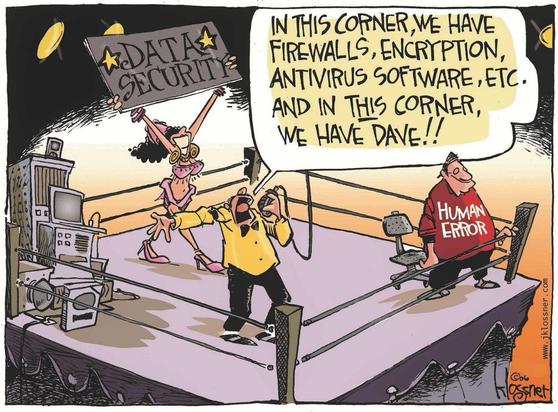
And this comic continues being sadly relevant
@xgranade > AI to all of your fucking data handling workflows.
oh lol
@xgranade @crazy4pi314 power-over-fibre is real! Also, when I was deploying a QKD system one of the old research posters on the wall was about degradation rates for COTS fibre under power-over-fibre conditions. TL;DR it's fine for a bit (days to years depending on the bend radius)
@crazy4pi314 @xgranade how tf did they not melt the fiber
@psistarpsiii @crazy4pi314 By aligning it very *very* carefully and making sure interfaces are perfectly clean. Any misalignment starts a reverse propagating plasma fire, which is fun to watch.
@xgranade @crazy4pi314 that’s exactly what I’ve heard! (My own lasers are putting a thousandth of that into fiber on their best day.)
@psistarpsiii I don't have a link, but I think @crazy4pi314 has a video of it? Anyway, yeah, it's an absolutely absurd amount of power compared to what these devices are rated at,

@xgranade @psistarpsiii
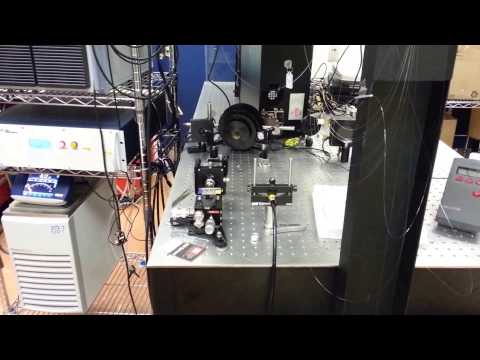
This was the one I could find quickly, ft. my supervisor proving the beam is there by burning his had lol
https://youtu.be/ORaBbEM9M4E?si=2m62ljW3PIbeakLS

In this we were working with 1440nm light at ~30W CW (testing ranges of 20-60W). The fiber is just standard telecom optical fiber and we had to try really hard to get it to fail here, specifically grinding the end on a shiny table to start the fuse. Normally they start from excess bending/cracks/thermal damage

Fiber fuse montage

YouTube

@crazy4pi314 @xgranade @psistarpsiii Ooh! I once blew up a fiber like this, but it was way back in the early 1990s (fiber was used for chirping YAG pulses to drive a ultrafast spectrometer). I thought it was pretty cool; the grad student tasked with realignment did not.

This is the first time I’ve seen the phenomenon on video. Pretty!

@xgranade @cmdrmoto @crazy4pi314 as a monolithic PIC girlie, I shudder every time I see the word “alignment” (ok I’ve done a little in free space but I do try to avoid it)
@crazy4pi314 @xgranade WHAAAAAAAT that’s so cool!!!
@crazy4pi314 @xgranade @psistarpsiii
No, no, that's the intarwebz traveling through the fiber, you see! 😏