Gather 'round classical friends and semiquantum adversaries, it's story fucking time.

You may have heard of this fun new thing called "quantum key distribution" that uses the laws of physics to guarantee secure, unbreakable encryption. The first demonstration of QKD, known as "BB84" after its authors and the fact that it was built in 1984, had a bit of a problem, though. Sure, it was unbreakable but the mirrors used to send bits made different sounds based on whether they were sending a 0 or 1.

So you didn't need to "break" BB84, you just needed to sit there with a microphone and you could read out the whole key. It doesn't matter how much physics guarantees the safety of your encryption if you go and tell the adversary what your key is.

For BB84, that deeply did not matter, it was a proof of principle. But in the 41 years since, that problem — that side channels exist — keeps getting forgotten.

A lot of current QKD devices use what are called "single-photon regime CCDs" as part of how they work. Those devices have a well-known problem that if you shine a very bright light on them, you can synthesize whatever output you'd like them to produce. An attacker can basically remotely control your QKD system that way and make it produce a fake key that they already know.

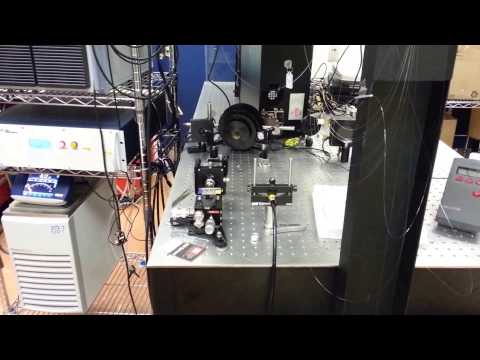
A bit over a decade ago, my partner @crazy4pi314 got their PhD in large part by showing that if you shine an *even brighter* laser into commercial QKD systems, you can even destroy the detectors they use to prevent that kind of attack. That attack involves things like putting 60W of laser power down a telecom fiber, but they came up with novel ways of doing so, despite that being wildly out of safety specs.

It's very fun work.

@crazy4pi314 @xgranade how tf did they not melt the fiber
@psistarpsiii @crazy4pi314 By aligning it very *very* carefully and making sure interfaces are perfectly clean. Any misalignment starts a reverse propagating plasma fire, which is fun to watch.
@xgranade @crazy4pi314 that’s exactly what I’ve heard! (My own lasers are putting a thousandth of that into fiber on their best day.)
@psistarpsiii I don't have a link, but I think @crazy4pi314 has a video of it? Anyway, yeah, it's an absolutely absurd amount of power compared to what these devices are rated at,

@xgranade @psistarpsiii
This was the one I could find quickly, ft. my supervisor proving the beam is there by burning his had lol
https://youtu.be/ORaBbEM9M4E?si=2m62ljW3PIbeakLS

In this we were working with 1440nm light at ~30W CW (testing ranges of 20-60W). The fiber is just standard telecom optical fiber and we had to try really hard to get it to fail here, specifically grinding the end on a shiny table to start the fuse. Normally they start from excess bending/cracks/thermal damage

Fiber fuse montage

YouTube

@crazy4pi314 @xgranade @psistarpsiii Ooh! I once blew up a fiber like this, but it was way back in the early 1990s (fiber was used for chirping YAG pulses to drive a ultrafast spectrometer). I thought it was pretty cool; the grad student tasked with realignment did not.

This is the first time I’ve seen the phenomenon on video. Pretty!

@xgranade @cmdrmoto @crazy4pi314 as a monolithic PIC girlie, I shudder every time I see the word “alignment” (ok I’ve done a little in free space but I do try to avoid it)