Gather 'round classical friends and semiquantum adversaries, it's story fucking time.

You may have heard of this fun new thing called "quantum key distribution" that uses the laws of physics to guarantee secure, unbreakable encryption. The first demonstration of QKD, known as "BB84" after its authors and the fact that it was built in 1984, had a bit of a problem, though. Sure, it was unbreakable but the mirrors used to send bits made different sounds based on whether they were sending a 0 or 1.

So you didn't need to "break" BB84, you just needed to sit there with a microphone and you could read out the whole key. It doesn't matter how much physics guarantees the safety of your encryption if you go and tell the adversary what your key is.

For BB84, that deeply did not matter, it was a proof of principle. But in the 41 years since, that problem — that side channels exist — keeps getting forgotten.

A lot of current QKD devices use what are called "single-photon regime CCDs" as part of how they work. Those devices have a well-known problem that if you shine a very bright light on them, you can synthesize whatever output you'd like them to produce. An attacker can basically remotely control your QKD system that way and make it produce a fake key that they already know.

A bit over a decade ago, my partner @crazy4pi314 got their PhD in large part by showing that if you shine an *even brighter* laser into commercial QKD systems, you can even destroy the detectors they use to prevent that kind of attack. That attack involves things like putting 60W of laser power down a telecom fiber, but they came up with novel ways of doing so, despite that being wildly out of safety specs.

It's very fun work.

So like, QKD is probably useful in some ways, but the biggest practical challenge with it is always finding out how to not either let your attacker control the QKD system or leak your key to the attacker once you have it. Physics doesn't help you with either of those parts of the problem.

This is a thread about adopting PQC for security while also adding AI to all of your fucking data handling workflows.

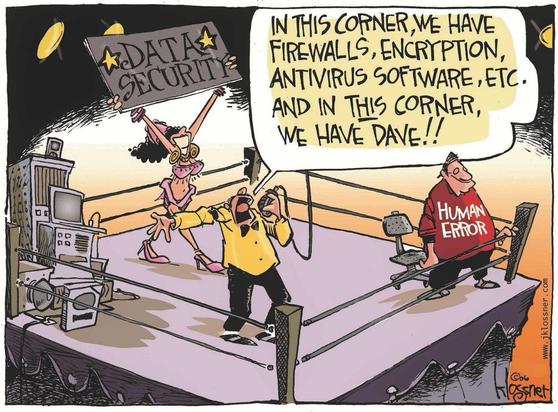
@xgranade There's also the... recurring problem in any sort of crypto setup of... you can give a human a very strong key, but if they have to be responsible for it, a lot of them will just... give it to a random person with a clipboard, when asked.
Or store the key (unencrypted/not meaningfully encrypted) on their google drive so they don't lose it or whatever.
Adding some LLM with file-system access that might just announce it to the world for unknown reasons certainly doesn't help either.
@miss_rodent Yeah, exactly. QKD protects one very important step in that process, but it's not a cure-all panacea.
@xgranade Yeah, it helps against attacks on the *math* parts of encryption - and does very well at that - but doesn't solve... any of the actual hard parts like humans being easily manipulated, poorly designed data-management setups, malicious actors being the recipients of that data in the first place, ... microphones and lasers existing, etc.
@miss_rodent @xgranade
And this comic continues being sadly relevant