
A while ago I started into a rant about "object oriented #programming", #OOP as it's nicknamed, because I was on a lengthy train and bus trip and that's usually when I write the most on social media—and that's a pity perhaps because after the trip is over, if I haven't finished the rant, only rarely do I feel like wrapping it up properly.

I feel a bit uncomfortable on this particular subject, too, because it's not my field really, despite the SDSU computer science (not a real #science) degree I got over a quarter-century ago. I got so burned out by trying to work in #software that I gave it up almost completely, even as a hobby. I've probably spent more time in the past quarter-century attempting to perfect my apple-pie baking technique than trying to keep up with computer programming.

[1/???]
Maybe that says something about why I developed a #programming habit in the first place and maintained it for a while: I started out in childhood, digging through library books and Scientific American columns and similar sources looking for stuff I could try to do in Commodore BASIC, and it was a hobby I could carry on at home when living with my parents. It was something I could do alone for hours, closeted in my room, requiring little more than the computer itself (hooked up to a TV, at first) and because personal #computing was still fun and straightforward and uncluttered, I actually enjoyed what I was doing.

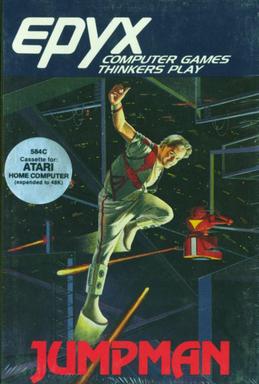
I was strongly influenced by the example of my RL father (peace be upon him), a biologist who had perforce become a decent Fortran programmer: if you wanted to do lots of scientific #maths on a VAX minicomputer, Fortran was the stuff! Because of him, and my general interests in the sciences, I conceived of the personal computer chiefly as a device for doing difficult math and scientific modelling. I rarely played games, although there were a couple that grabbed me for a while, like Jumpman (q.v. https://en.wikipedia.org/wiki/Jumpman_%28video_game%29).

[2/???]

Jumpman (video game) - Wikipedia

I don't know how my own childhood experiences with hobby #programming compare to others'. I would be willing to guess that very few teenagers get into personal computing these days because they want to do #science on them, not in an era where #gaming has popular geek culture in its suffocating grasp. Indeed I feel like I have been privileged, or cursed, to behold the era of the great transition—the day when a lot of bright but easily tempted children suddenly lost their interest in doing more substantial and constructive work in science or maths, because now there was a glittery new prospect in sight: making a zillion bucks by programming a game.

I grew up wanting to be Gauss perhaps, or Marie Curie. If I'd been born just a few years later maybe I would have wanted to be John Carmack (spits excuse me) tooling around in his ill-gotten Ferrari. Even as it was, nineteen years old when #DOOM was released—and yes, I played way too much of it, because it was preferable to enduring Caltech's idea of undergrad education—I was briefly drawn into the idea of escaping from my unpleasant future prospects into instant riches via game programming. I would never have admitted openly in 1993-1994 that my hopes of a scientific career were dead as a coffin-nail...but I was definitely inoculated with the idea that maybe computer programming could be a bolthole. Many other Caltech undergrads were excited by the idea of making a mint in computer games.

[3/???]

@mxchara @mxchara

a lot of bright but easily tempted children suddenly lost their interest in doing more substantial and constructive work in science or maths, because now there was a glittery new prospect im not saying cs or game programming is bad but this definitely rings true

this was me, it often does feel simultaneously like i broke free from some kind of siren but also that I gave up something that shines brilliantly

@xeno Since then I have played too many computer games which succeed brilliantly as narrative, even as social commentary, for me to dismiss game-programming as a merely frivolous or mercenary pursuit. Even as early as 1993-94, it was probably already a mistake to regard computer games solely as though they were a temptation away from constructive pursuits. Now, videogames are (in my mind) simply another medium for elaborately staged storytelling, on par with cinema or opera.

But the unsavory aspect is still there. DOOM was arguably about as socially responsible as marketing cigarettes to adolescents: its programmers (especially the reprehensible Carmack) held the idea of narrative in contempt, because their idea of what a "game" was, was little more than endless addictive repetition of a questionable power fantasy. That style of videogame is still prevalent and lucrative, e.g. in gacha games.