On the rails again
 #Interrail

I have a spare Interrail day left on my pass that expired today, mostly thanks to the valiant efforts of the luge athletes of #TeamDE in the Milan Winter Olympics. As it was also an own-country day, I decided to do a random day trip to a station and city I hadn’t been to before: Castelló de la Plana

Today’s Itinerary: https://moof.space/trip/2026-03-25

I’ll be doing this on a couple of Euromeds, though I did flirt with the idea of taking an Intercity out and a Euromed back, the timing was a little weird.

Unusually for Renfe in Barcelona Sants, we were checked into the platform before the train arrived, and as the train arrived from Figueres, people exited the train causing massive chaos on the platform, as people here aren’t used to that.
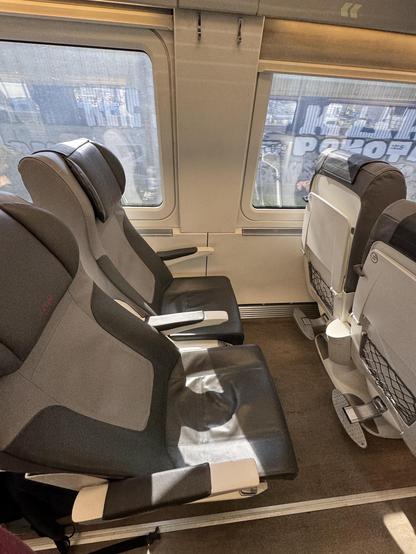
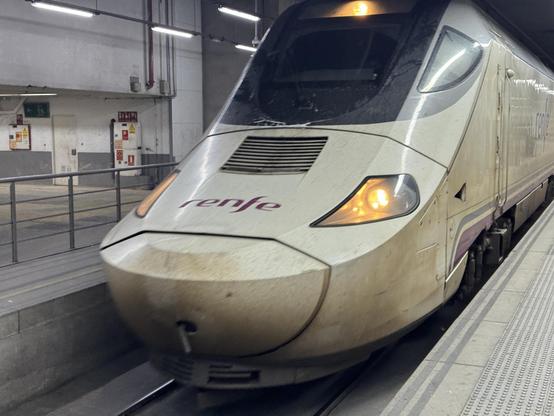
We have just left Camp de Tarragona, a wheat field (olive grove?) station set up for this high speed line. We are now heading towards Reus airport, where this Euromed train will change gauge.

Renfe has a large number of gauge-changing trains, as the old “conventional speed” speed network is all in 1668mm Iberian Gauge, and the new high speed network is 1435 Standard Gauge, and trains need to go between them

This particular one is a Talgo-made Series 130, but there are also CAF-made gauge changing trains, and many of the gauge changing machines are configurable to use either one of the competing gauge changing technologies.

The actual gauge changing operation has to be done slowly, it takes about 5 minutes between stopping and going through the machine. It’s a relatively quiet process, you hear a little clanking, but other than that, if you don’t know, you won’t realise it’s happening.

The gauge-changing technology we use today was originally developed by Talgo. The first trials were made in 1967, with a public demonstration in IrĂșn in 1968, and entering commercial service with a gauge changer at Portbou, on the French border with CerbĂšre in 1969. The machine is still there, but has been decommissioned.

It was originally used for passenger service in appropriately built Talgo carriages, in what became known as “Catalan Express” TEE trains that would leave Barcelona, change gauge at Portbou, and then continue on to Paris, Milan, Geneva and Brussels. There were also night trains, run through a number of partnerships. I have taken Trenhotel services to Barcelona from Milan when interrailling in 1998 and Paris because of the 2010 Eyjafjallajökull volcano eruption.

Sadly, these services were progressively cancelled with the advent of TGV marking a change in SNCF’s priorities, and them pointedly doing everything they could to discourage the continuation of these services

This Renfe class 130 train, nicknamed “Mini Pato” (Mini Duck), made by Talgo is capable of speeds of up to 250km/h on standard gauge 25kV AC lines, and up to 220km/h on Iberian gauge 3kV DC lines. The current stretch of track between the gauge changer, and Castelló de la Plana has been newly constructed or reconditioned to allow for 220km/h operation.

There is a variant of this train, class 730, that has diesel generators in carriages behind each power car, supplying traction current for the train on unelectrified tracks. It still has pantographs to run on electrified sections.

There have been successful trials in the North West of the country to see if speeds of 300km/h can be reached safely on Iberian gauge lines, but it would require large amounts of investment into changing signalling, amongst other things.

And we are, of course, running late.

Our conductor has come on the tannoy to tell us that we are running 30 minutes late in Spanish, and 20 minutes late in English.

We’ve also received a text message telling us we are running 33 minutes late (spoiler: it’s going to be longer, we should have arrived by now with that delay).

Both the text message and the announcement were careful to point out that the delay was due to “issues in the infrastructure”. This is because Renfe currently don’t have to pay out for delays due to infrastructure problems, as they know Adif has hundreds of temporary speed restrictions on the lines as a result of the actions taken after the Adamuz and GĂ©lida disasters. They let you know about this when you buy a ticket.

Either way, Adif is currently showing my arrival at 13:05, which is +48. And we keep stopping on the line, so who knows when we actually will arrive.

Having arrived in Castelló, I’m headed for lunch with a friend in the Port district- the Grau.

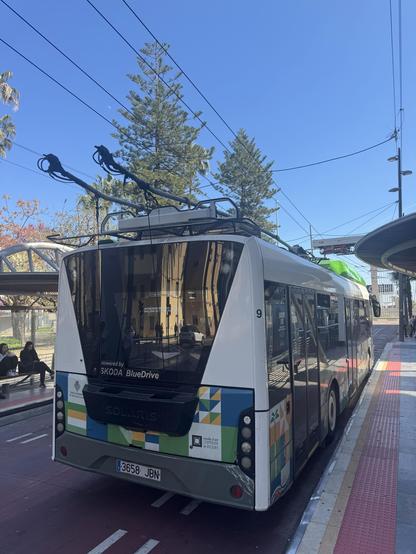
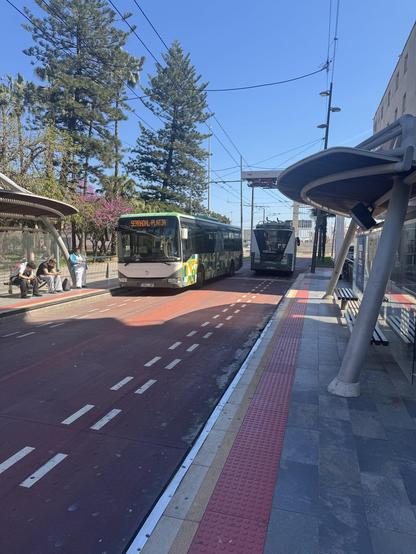
Citymapper tells me that the easiest way to get there is on Tram T1, which when it arrives turns out to be a Trolley Bus!

It does, at least, have dedicated lanes on some of the main roads, and it stops at all the stops on the way, which unnervingly means no stop button on the bus.

It also seems to not be 100% overhead powered. This one has its chopsticks down when it arrives at Grau.

Keeping with outdated technology, you only seem to be able to pay with cash on board, though there does seem to be some sort of contactless pass for the locals.

@moof From what I've seen of Gdynia, those new trolleybuses with high battery capacity are run in battery mode for whole trips on end from time to time, I guess to ensure they use the full capacity at least once in a while?
@HaTetsu I suspect also because lifting the chopsticks is a non-trivial operation
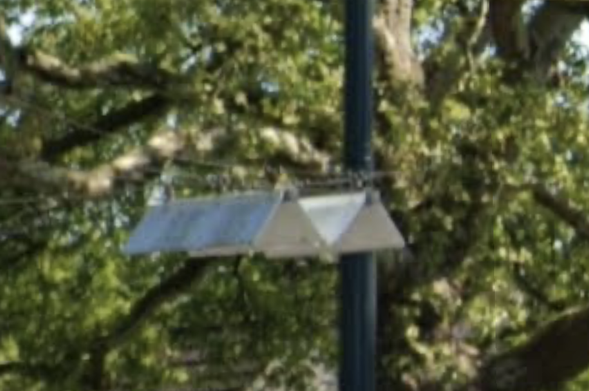
@moof Nah, they set up little roof things that guide the poles to the wires where that's routinely done. All the driver needs to do then is hold down a button on the dashboard and the poles are released and slammed into those
@moof It's a very low tech solution and correcting for a failure resulting from misalignment or lifting the poles at a place not equipped with it does require going out to the back and aiming manually, I think

@HaTetsu @moof We also get these in Zurich. The detach/attach procedure commonly runs when there are construction works on the road (e.g. needing to use a different lane), or even diversion of the route via a different street (that doesn't have suitable overhead wires).

I even once saw a dedicated worker posted at one stop to attach the wires on every bus passing every 10 minutes, to save the driver some back and forth & keep the schedule (this was an extra long articulated bus).

@cycling_on_rails @HaTetsu @moof Indeed, Arnhem is also installing some of those gutters to make automatic railing of the trolley poles possible, now that regional buses that will use the trolley wires inside the city are coming soon. One line is already using them.