 /\ndy
/\ndy Richard Griffiths
 George Dinwiddie
@dectentoo You don't even need to track it precisely, or all the time. I've had a team track their time in such buckets for a week, and only in increments of an hour or more, preferably in half-days.
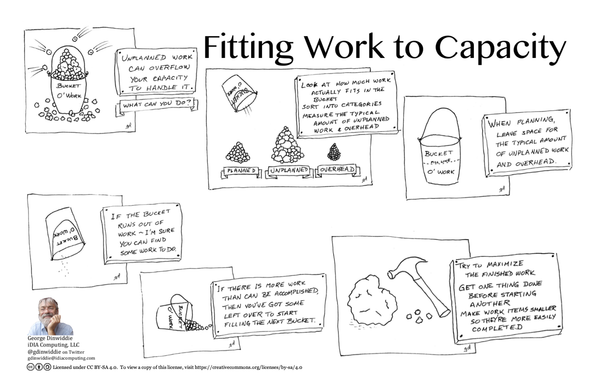
@gdinwiddie Useful diagram. I agree and I've also seen worse, where teams had a timesheet code to track the time for entering timesheets 🤯
@dectentoo I once asked for such a code at an employer that wanted to subdivide work into way too many categories. That requirement went away, though, after I split my programming 50/50 between programming and testing since I was doing TDD. They didn't like that because they couldn't capitalize testing.
 Alex Fürstenau
@dectentoo how do you fix the system? I mean, you won‘t achieve 100% planned work. You can‘t avoid interruptions completely and you can‘t get grid of all meetings, can you?
@afuerstenau I know what I meant in my head :-) “Fix the system” in an agile context isn’t about pushing individuals to work harder, it’s about improving the environment and flow of work, so teams can move to deliver value more predictably and sustainably.
Strengthen backlog refinement, so work is ready before it starts.
Improve production stability (fewer bugs/incidents driving surprise work).
Introduce WIP limits to avoid over commitment.
Create clear policies: what interrupts the team vs what waits. Which can be a political minefield.
Introduce roles like a rotating “on-call” or “expediter” - we had a support person per week who worked on lower level items that could be dropped if needed.
Reduce context switching (a major hidden cost)
The biggest shift: stop treating these percentages as a people problem.
AKA W. Edwards Deming - most issues are caused by the system, not the individuals.
@dectentoo What' s a realistic goal to strive for regarding planned work? 50%, 70%, 80%? If I "plan" to fix the upcoming bugs and reserve 10% of my capacity for it, is this planned work or unplanned work? 😉
@afuerstenau Scrum Master answer #1 "It Depends" 😜
It depends on the level of work and types of work, so @gdinwiddie picure is a good one.
If planned work is only 40%, your system is overloading the team
Fixes include:
More realistic forecasting
Explicit capacity allocation (e.g., reserving space for unplanned work)
Better stakeholder expectation management
And if you have time to take on other things, nice one, and readjust the forecast for the next time.
@dectentoo @afuerstenau
The nice thing is that making the situation visible tends to correct the unrealistic expectations. In my experience, those with unrealistic expectations tend to be the ones causing a lot of unplanned work and overhead tasks.
The nice thing is that making the situation visible tends to correct the unrealistic expectations. In my experience, those with unrealistic expectations tend to be the ones causing a lot of unplanned work and overhead tasks.
@afuerstenau @dectentoo Planned work only taking 40% of the effort might be completely reasonable. Perhaps there is a lot of high priority on-demand work.