 Beep
BeepFaithful
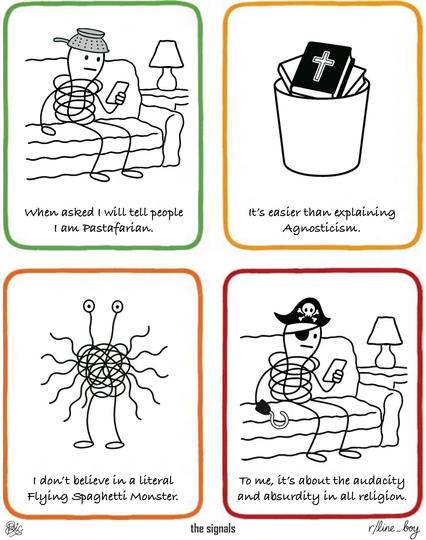
i call myself a devout agnostic. the justaposition of those words is inherently absurd since part of agnosticism and identifying as such is believing there is value to studying theology even if you yourself don’t believe the theologies you’re studying because ultimately prior to colonization, religion was how groups of people encoded and passed along their wisdom. however saying “devout agnostic” throws people enough off balance enough to introduce them to these concepts since so many say with their whole chest that they’re something when traditionally these terms have meant something else to the people who use them.
for example, an astounding (at least to me) number of people say quakers and unitarians aren’t christians. when you dig down on this you often find that this position is rooted in a believe (both positive and negative) that the fundamental mechanism and experience of christianity is trauma. however, when you look at the broader world of religion, you find that that’s mostly only Christian denominations rooted in the theologies of the roman empire such as roman catholicism and the various european orthodoxies like Greek and russian. however, the oldest denomination, Ethiopian Orthodox, would i think to the people who say quakers and unitarians aren’t christians, seem very unchistian. for that matter, i think so would Native America Christianity, Oriental Orthodox, and Armenianism. (fun fact, the Unitarian church is rooted in Oriental Orthodox, which is either the second or third oldest christian denomination)
I was an agnostic for a very long time.
My main view of things - I couldn’t know if there was a god or if there wasn’t. But all that ultimate judgement shit never made any sense for me. If you’re just behaving decently because of fear of ultimate judgment, then you’re not a decent person. Ok if god would want me not to be an asshole, I’d need to be that out of my free will. And if a god demanded adherence to some random rules out of the blue - that god wouldn’t have a moral compass and I wouldn’t want to have to do anything with them in my life, being smitten down at the end would have been a consequence for me anyways.
I just want to be no asshole. So the question of there’s a god or not. I don’t care. God is irrelevant.
Thus: agnostic
You can be an agnostic deist. Agnostic just means you have no firm belief. Most people who identify as “nones” in polls are technically agnostic, even if they personally believe in a higher power. Its a lack of certainty.
Most atheists are also technically agnostic atheists. A gnostic athiest would be someone who holds the absence of any higher being or spirituality as an almost axiomatic belief. Though they merely can be so certain that the small chance they’re wrong seems irrelevant to them.
Eh, I think there’s a decent semantic dispute for it. It’s of course dependent on your definition of deity and is mostly an exercise of pedantry. However, with the size of the universe I think there’s a pretty decent chance that there exists an intellectual being that could be interpreted as being god-like to the human perspective.
Now I’m not making claims that this proposed being has ever had anything to do with humans, nor are they responsible for any universal creation. Just that the universe is big enough for the existence of something significantly more advanced than humans. That being said, the size of the universe that allows for the possibility of this proposal also makes it possible existence mostly pedantic.
Atheism: I don’t believe in the existence of god(s)
Agnosticism: I haven’t seen any proof for god thus can’t believe in one
It’s the same thing really, but without the “negative” connotations usually attributed to atheism or atheists
“See, I’m not really an atheist but agnostic. It means I’m not to be expelled from this community as a heretic”
I identity with this. When I was younger I identified as agnostic, as I saw it as a more socially acceptable option than atheism which allowed me to not have to pretend to be religious.
But I’ve identified as atheist for many years now. In my case by the time I did, everyone of significance in my life was nonreligious.
It’s the same thing really, but without the “negative” connotations usually attributed to atheism or atheists.
Atheists and Agnostics would obviously disagree. There’s a core philosophical difference between being convinced in the negative and being unconvinced in the affirmative.
That said, what are the consequences of being a Theist, an Atheist, or an Agnostic? I might argue that Theists and Atheists have history of leveraging their confidence into an active policy of discrimination and bigotry. Whether you’re a Chinese Communist cracking down on under-18 church attendance or an Israeli Zionist conducting a pogrom against Palestinians, there’s a habit of imbuing your personal beliefs with political teeth.
“See, I’m not really an atheist but agnostic. It means I’m not to be expelled from this community as a heretic”
The flip side of this being, “I’m not expelling you from the community for excessive display of religious ferver”.
It’s easier to sympathize with avowed Atheists in nations where atheism is a disenfranchised minority. But as soon as you give someone like Christopher Hitchens or Sam Harris an ounce of political capital, they start cheer leading a genocide.
That, I think, is a real tangible difference. Agnostics tend not to begrudge other ideologies in the same way.
Who says that atheism involves being convinced of the negative?
The textbook definition: disbelief in the existence of God or gods.
I’m an atheist because I’m not a theist.
That doesn’t logically follow. You’re ignoring the third option of simply not having an opinion.
I’m agnostic because I’m neither convinced of the negative nor the affirmative
Agnosticism is the view or belief that the existence of God, the divine, or the supernatural is either unknowable in principle or unknown in fact.
That’s very different from a strict disbelief.
Disbelief just means not believing something. Not believing that a claim is true is not the same as believing that that claim is false. A lack of belief in any deities is not the same as a belief in a lack of any deities.
The prefix a- means without. If one is without theism, then they are a-theist. There is no third option. You have theism or you don’t. Having no belief one way or the other means you don’t have it.
you don't need to accept either claim. you can suspend judgement.
try reading into epistemology
Disbelief just means not believing something
Disbelief means rejecting it, not having no thoughts or opinions on it
I’m about to flip a coin.
Can we make sure we’re on the same page regarding the definition of belief? As I understand it, belief means accepting a claim. Disbelief means not accepting a claim.
Do you accept the claim that this coin will land heads? This is a yes or no question. If you withhold judgment, that means you do not accept that claim. You do not believe it will land heads. This is notably different from accepting the claim that it will land tails. Not believing that it will land heads is not the same as believing that it will land tails.
The most reasonable position is to not accept either claim. It’s a 50/50 chance.
Theism means accepting the claim that there is at least one deity. You either do that or you don’t. Any option you take that involves not accepting the claim that there is at least one deity means that you aren’t theist. You are without theism. There’s a word for that.
The prefix a- means without.
Also, it often means “on,” “in,” or “at” (e.g., abed, ashore) or indicates a state of being (e.g., ablaze). It can also mean “in a manner” (e.g., aloud)
But now you’re getting into etamology, not colloquial application.
Atheism, at it’s heart, is an ideology. Agnosticism isn’t.
You want to get into colloquial application? Here’s some colloquial application
Here’s some more. If you know who Rationality Rules is and don’t like him, then it’s worth noting that this came out before his controversy
Here’s Wiktionary’s take. That page lists both definitions.
Colloquially, I call myself an atheist. That’s not an ideology, it’s just an answer to the question of whether or not I accept the claim that there is at least one deity.
It’s the same thing really, but without the “negative” connotations usually attributed to atheism or atheists. “See, I’m not really an atheist but agnostic. It means I’m not to be expelled from this community as a heretic”
This, basically. At least that’s how I used it. As a kid living in the bible belt, admitting you were an atheist was, in their eyes, literally no different than being a cannibalistic devil worshipper. Agnostic was easier for them to swallow (albeit because odds are high that most of them didn’t even know what it meant, and figured it was some sect of Christianity they were unfamiliar with).
When I got older, and escaped the institutional bigotry woven into nearly every facet of society down in the bible belt…the lovely place where our biology teacher also headed the bible club and refused to teach evolution yet somehow still had a job as a biology teacher in the public school system, as a small example…that was when I finally gained the confidence to self-describe as an atheist.
I rest my case
It’s impossible to prove a negative, but if you were as clever as you think you are, you’d already know that
I’m not even going to bother with the whole “burden of proof” thing because I don’t think you’re capable of understanding it
Theism is belief in gods; atheism is the opposite of that: non-belief in gods.
Gnosticism is knowledge of gods; agnosticism is the opposite of that: no knowledge of gods. (There is also a religious movement called gnosticism. That doesn’t relate here.)
The first is about belief and the second is about knowledge.
These are not incompatible. You can believe in something and claim to have knowledge of it (gnostic theism) or you can believe and claim to not have knowledge of it (agnostic theism). I have encountered Christians of both varieties.
For atheists, many (perhaps most) claim to have no knowledge of gods (agnostic atheism), and some claim that gods certainly do not exist (gnostic atheism). The latter demonstrate that the Christian exist, because logically an omniscient and omnipotent God can’t also be omni-benevolent, since suffering obviously exists.
I think we largely agree. Your comment is essentially a restatement of my point. Theism is a belief that they are gods, and atheism is a lack of belief that there are gods. That lack of belief can either come from a positive belief that there are no gods, or a withholding of belief one way or the other.
Speaking about myself specifically, it is equally untrue to say that I believe there are gods as it is to say that I believe there are no gods. The former means I am an atheist, and the latter means I am an agnostic. Both labels apply to me.
 Lucidlethargy
 zemo
zemo Tonava
 The D Quuuuuill
 zarkanian
 UnderpantsWeevil
 starman2112
 insurrection