 Beep
BeepFaithful
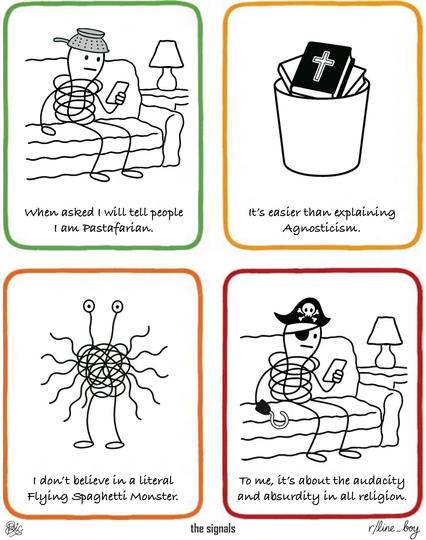
Atheism: I don’t believe in the existence of god(s)
Agnosticism: I haven’t seen any proof for god thus can’t believe in one
It’s the same thing really, but without the “negative” connotations usually attributed to atheism or atheists
“See, I’m not really an atheist but agnostic. It means I’m not to be expelled from this community as a heretic”
I identity with this. When I was younger I identified as agnostic, as I saw it as a more socially acceptable option than atheism which allowed me to not have to pretend to be religious.
But I’ve identified as atheist for many years now. In my case by the time I did, everyone of significance in my life was nonreligious.
It’s the same thing really, but without the “negative” connotations usually attributed to atheism or atheists.
Atheists and Agnostics would obviously disagree. There’s a core philosophical difference between being convinced in the negative and being unconvinced in the affirmative.
That said, what are the consequences of being a Theist, an Atheist, or an Agnostic? I might argue that Theists and Atheists have history of leveraging their confidence into an active policy of discrimination and bigotry. Whether you’re a Chinese Communist cracking down on under-18 church attendance or an Israeli Zionist conducting a pogrom against Palestinians, there’s a habit of imbuing your personal beliefs with political teeth.
“See, I’m not really an atheist but agnostic. It means I’m not to be expelled from this community as a heretic”
The flip side of this being, “I’m not expelling you from the community for excessive display of religious ferver”.
It’s easier to sympathize with avowed Atheists in nations where atheism is a disenfranchised minority. But as soon as you give someone like Christopher Hitchens or Sam Harris an ounce of political capital, they start cheer leading a genocide.
That, I think, is a real tangible difference. Agnostics tend not to begrudge other ideologies in the same way.
It’s the same thing really, but without the “negative” connotations usually attributed to atheism or atheists. “See, I’m not really an atheist but agnostic. It means I’m not to be expelled from this community as a heretic”
This, basically. At least that’s how I used it. As a kid living in the bible belt, admitting you were an atheist was, in their eyes, literally no different than being a cannibalistic devil worshipper. Agnostic was easier for them to swallow (albeit because odds are high that most of them didn’t even know what it meant, and figured it was some sect of Christianity they were unfamiliar with).
When I got older, and escaped the institutional bigotry woven into nearly every facet of society down in the bible belt…the lovely place where our biology teacher also headed the bible club and refused to teach evolution yet somehow still had a job as a biology teacher in the public school system, as a small example…that was when I finally gained the confidence to self-describe as an atheist.
 Lucidlethargy
 alekwithak
 UnderpantsWeevil
 starman2112