TOPIC> Mercury Messenger

2026 March 22

Leaving Earth
* Video Credit: NASA, JHU Applied Physics Lab, Carnegie Inst. Washington, MESSENGER
https://www.nasa.gov/
https://messenger.jhuapl.edu/
https://carnegiescience.edu/
https://science.nasa.gov/mission/messenger/

Explanation:
What would it look like to leave planet Earth? Such an event was recorded visually in great detail by the MESSENGER spacecraft as it swung back past the Earth in 2005 on its way in toward the planet Mercury. Earth can be seen rotating in this time-lapse video, as it recedes into the distance. The sunlit half of Earth is so bright that background stars are not visible. The robotic MESSENGER spacecraft orbit around Mercury from 2011 to 2015 has conducted the first complete map of the surface. On occasion, MESSENGER peered back at its home world. MESSENGER is one of the few things created on the Earth that will never return. At the end of its mission, MESSENGER was purposefully crashed into Mercury's surface.
https://messenger.jhuapl.edu/Explore/Videos.html
https://science.nasa.gov/mercury/facts/
http://www.youtube.com/watch?v=rFDjAfwmWKM
http://www.badastronomy.com/bad/tv/foxapollo.html#stars
http://messenger.jhuapl.edu/About/Spacecraft-and-Instruments.html#spacecraft
https://apod.nasa.gov/apod/ap190428.html
https://en.wikipedia.org/wiki/MESSENGER
https://apod.nasa.gov/apod/ap130723.html
https://apod.nasa.gov/apod/ap220206.html
http://messenger.jhuapl.edu/About/Mission-Design.html#final-extended-mission
https://www.nasa.gov/press-release/nasa-completes-messenger-mission-with-expected-impact-on-mercurys-surface

https://apod.nasa.gov/apod/ap260322.html

#space #earth #astrophotography #photography #NASA #science #physics #nature #education #apod
All of Mercury
* Image Credit: NASA/JHU Applied Physics Lab/Carnegie Inst. Washington
https://messenger.jhuapl.edu/
https://carnegiescience.edu/about
https://www.nasa.gov/

Explanation:
About thirteen years ago, the entire surface of planet Mercury was finally mapped. Detailed observations of the innermost planet's surprising crust began when the robotic MESSENGER spacecraft first passed Mercury in 2008 and continued until its controlled crash landing in 2015. Previously, much of the Mercury's surface was unknown as it is too far for Earth-bound telescopes to see clearly, while the Mariner 10 flybys in the 1970s observed only about half. The featured video is a compilation of thousands of images of Mercury rendered in exaggerated colors to better contrast different surface features. Visible on the rotating world are rays emanating from a northern impact that stretch across much of the planet, while about half-way through the video the light colored Caloris Basin rotates into view, a northern ancient impact feature that filled with lava. Recent analysis of MESSENGER data indicates that Mercury has a solid inner core.

https://apod.nasa.gov/apod/ap190428.html

#space #mercury #astrophotography #photography #NASA #science #physics #nature #education #apod
Mercury

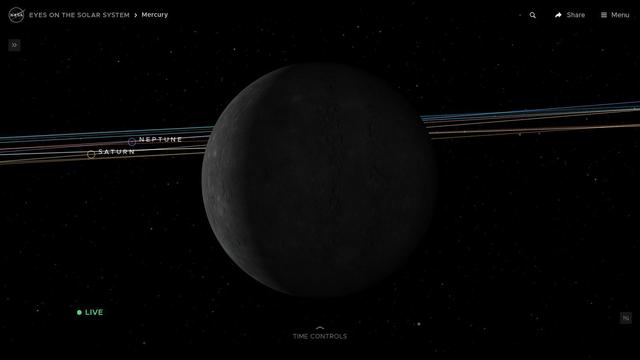
The smallest planet in our solar system and nearest to the Sun, Mercury is only slightly larger than Earth's Moon.
Mercury's surface temperatures are both extremely hot and cold. Because the planet is so close to the Sun, day temperatures can reach highs of 800°F (430°C). Without an atmosphere to retain that heat at night, temperatures can dip as low as -290°F (-180°C). From the surface of Mercury, the Sun would appear more than three times as large as it does when viewed from Earth, and the sunlight would be as much as seven times brighter. Despite its proximity to the Sun, Mercury is not the hottest planet in our solar system – that title belongs to nearby Venus, thanks to its dense atmosphere. But Mercury is the fastest planet, zipping around the Sun every 88 Earth days. Mercury's surface resembles that of Earth's moon, scarred by many impact craters resulting from collisions with meteoroids and comets. The first spacecraft to visit Mercury was Mariner 10, which imaged about 45 percent of the surface. NASA's MErcury Surface, Space ENvironment, GEochemistry, and Ranging (MESSENGER) mission flew by Mercury three times in 2008-2009 and orbited the planet from 2011 to 2015, mapping the entire surface.

>> You may like to try out this interactive 3D API:
https://eyes.nasa.gov/apps/solar-system/#/mercury?embed=true

CREDIT
NASA's MESSENGER spacecraft
NASA/Johns Hopkins University Applied Physics Laboratory/Carnegie Institution of Washington

#space #earth #mercury #astrophotography #photography #NASA #science #physics #nature #education

MESSENGER Spacecraft
2004 - 2015

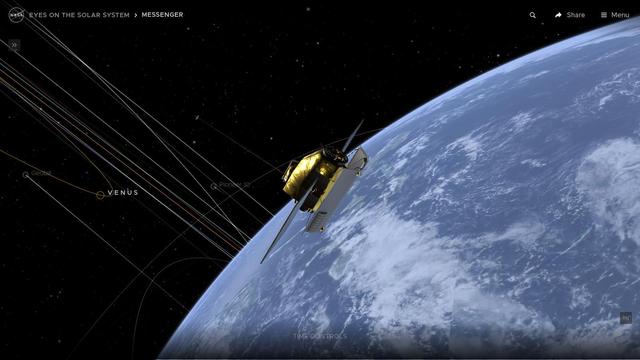
MESSENGER was a NASA robotic space probe that orbited the planet Mercury between 2011 and 2015, studying Mercury's chemical composition, geology, and magnetic field.
MESSENGER (Mercury Surface, Space Environment, Geochemistry and Ranging) was the first spacecraft to orbit Mercury. Among its accomplishments, the mission determined Mercury’s surface composition, revealed its geological history, discovered details about its internal magnetic field, and verified its polar deposits are dominantly water-ice. The mission ended when MESSENGER slammed into Mercury’s surface

>> You might like to join MESSENGER on its orbit with this interactive 3D API:
https://eyes.nasa.gov/apps/solar-system/#/sc_messenger?embed=true

CREDIT
NASA's MESSENGER spacecraft
NASA/Johns Hopkins University Applied Physics Laboratory/Carnegie Institution of Washington

#space #earth #mercury #messenger #astrophotography #photography #NASA #science #physics #nature #education