 Curiosity Drive 🚐
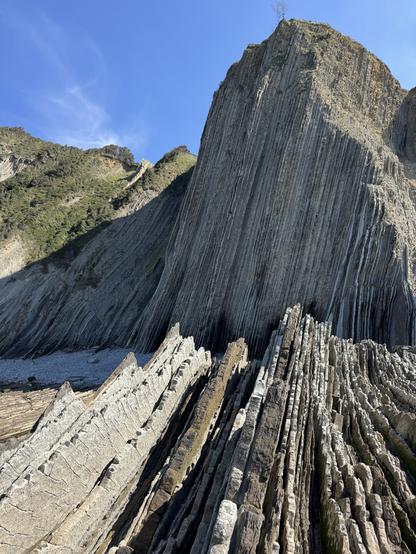
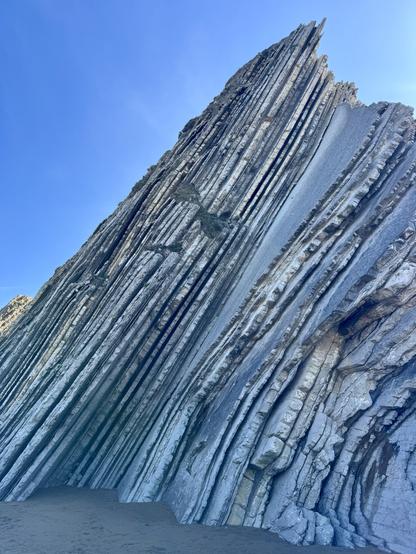
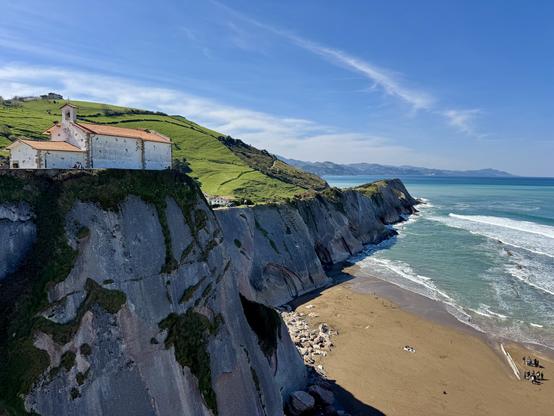
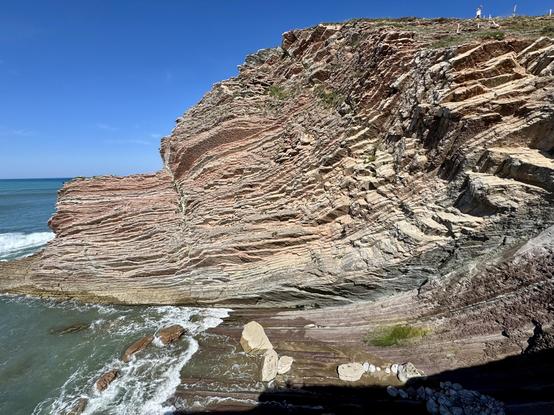
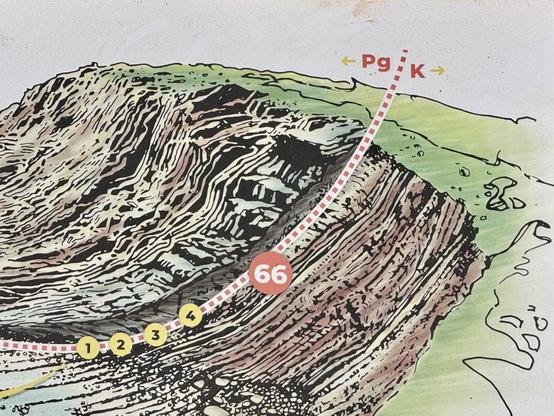
Our first stop in southern Basque Country was to be Donostia | San Sebastián, but after a stressful tour of the city looking for open-air 🅿️ (we’re 3m tall) we gave up & left—without Basque cheesecake from La Viña. Westward to Zumaia, specifically Flysch de Zumaia, a cliff formation of near vertical strata within the UNESCO Geoparkea Zumaia. These strata formed from sediment/ shells that spent 50M years under the sea between Iberia & the European continent until their collision uplifted the flysch layers (marl, limestone & sandstone). At the eastern end of the beach is the Paleocene–Eocene Boundary, where 56M yrs ago a large release of greenhouse gases caused a 5-10°C temperature increase; the adjacent strata march down into the sea (📷1). Moving back in time, towards the middle of the beach are the Selandian–Thanetian Stratotype at 59.2M yrs ago, when Earth’s magnetic poles flipped polarity, & the Danian–Selandian Stratotype at 61.6M yrs ago, when sea level dropped ~80m; you can walk right up to these strata below San Telmo chapel (📷2). Ascend to the chapel & walk along the cliff (📷3); at the end of the rocky headland is the Cretaceous-Paleogene (K–Pg) Boundary, marked by a thin dark layer (📷4). This layer is rich in iridium, corresponding to the Chicxulub asteroid impact in the Yucatan 66M years ago that wiped out ~75% of Earth’s biota—most famously the non-avian dinosaurs. The return route notes that every one of your steps equates to the passage of about 500,000 yrs in geologic time. That’s a small step for a human; a giant step for humankind (less than 1 step = modern humans; 5 steps = the span of our existence in the Homo genus).
🇪🇸#spain #BasqueCountry 🇪🇺#europe 🚀#travel 🚐 #camperVan #nomad #roadTrip #vanLife #nature 🌍#unesco
 Phil Stevens
 minino
 quixote