 Eugene

Whoops, #ImageMagick was updated in the #FreeBSD repos 
Sadly, it is a #slopware version — time to make "pkg lock".
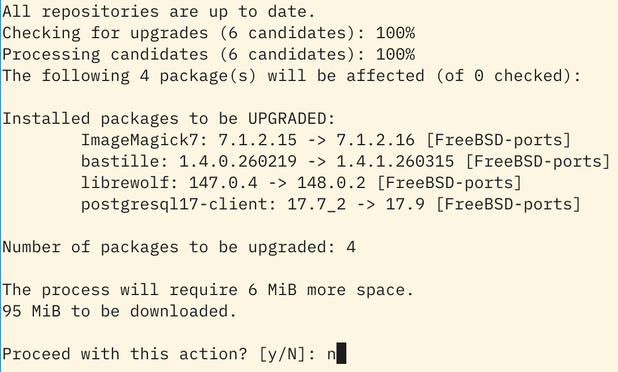
Whoops, #ImageMagick was updated in the #FreeBSD repos
Sadly, it is a #slopware version — time to make "pkg lock".

Is your feature request related to a problem? Please describe. commit bd4a469 was recently merged which makes use of the Claude Opus LLM model the acceptance of such models for open source contribu...
@dvl Ah, then I misunderstood your toot — English is not my first language.
#Slopware is a term for software made with use of LLM(s). And I'm trying to avoid possible decline in quality of such software — while it may be without critical bugs in the next releases, I'm afraid of stupidly stupid bugs which will broke my habits and routines in the future. Because I already saw decline in quality like this with Windows 11 updates, or with Cloudflare outages, caused by "AI" "programming".
But the main problem for me lies not in the future bugs — people could make dangerous bugs too. The much more important thing for me — the intent of programmer who made some changes. If programmer make something fully with it's own mind — then I presume that this programmer had some fun from making things and I fully understand this intent: "have fun and make something useful meanwhile".
But, if programmer used #LLM while making a commits to #opensource program — I become extremely suspicious — why it was done this way? Programmer doesn't care about modified software? Or programmer is a "passer-by commiter" and don't want to look into the codebase at a necessary level? Or mentality "move fast and break things" deeply rooted in his mind? All of these are precursors for badly made software with bad UI and UX, as I think.
Obviously I'm a big fan of "move slow and make things" mentality and don't like programs made with "make fast and break things" mentality, which is the main reason to use LLMs in programming, as I see (e.g. in corporate world) 
@fosdembsd Here the one commit, "coauthored" with Claude (see the https://mastodon.bsd.cafe/@evgandr/116228990041612662 for screenshot). Yes, it is the only one (for now), but I don't trust software, which weren't created by people who love programming and reducing the complexity of the world. For me, if LLM was used to make not a commercial software, it is a sign that a developer don't like programming and reassign task to chatbot instead of thinking and doing something themselves.
Also, interesting info from their bugtracker: https://piaille.fr/@kaikai/116256399591208229
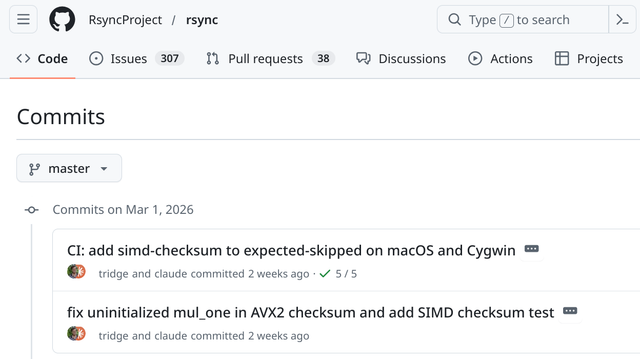
Attached: 3 images Checked all little utilities, which I'm using in my daily computing, are they still good old programs or slopware? I prefer to use little programs, which were created to please the needs of it's creator. And/or some folks which has the same needs. The process of such little program creation usually, if author in sane state of mind, doesn't mimick process of commercial software creation, where developers need to rush to "deliver features" to please management and investors. For now this leds to forcing developers to use LLMs on the workplace — all to "deliver features" faster. So one developer for the same price (salary) able to make more features. Profit! So, when I see how opensource programmer uses LLM to create some opensource program — it is a red flag for me and I'll try to avoid using such program. Because it means to me that programmer doesn't like the process of creation. Like an artist who don't like to draw or photographer, who don't like to make photos. Also, (s)he possibly has a "corporate mindset" (deliver value and features faster, no fun allowed). So, looks like his/her creature is not a pet, but a cattle. When I prefer to use "pet"-programs — usually they are nicer, simpler and doesn't bring me a lot of problems. Results are pretty good — only three programs are slopware now. These three programs, installed from repositories of my OS, have versions, when these programs were coded by humans. Here they are: 1) rsync — version 3.4.1 is good, but the next versions will be slopware, since programming happens with Claude LLM. 2) ImageMagick7 — installed good version 7.1.2-15. But since 7.1.2-16 it become a slopware. LLM the same — Claude, was used in one commit. 3) python3 — installed version 3.11.15. Since 3.13.6, according to commits and release dates, it become a slopware too — there are some commits, where the same Claude LLM was used. #slopware #rsync #ImageMagick #Python3
@emilianosandri Strange, first comment for this toot somehow disappeared, but there were a mention of GraphicsMagick fork. As I read it was forked from ImageMagick at near 2002, because developers didn't make an agreement about project's future.
Since, gm is developed in slow pace (and at the SourceForge), then, I think, there is a low possibility of turning it into slopware. Looks like developers don't pursue frequent releases, new features 24/7 and other habits from commercial application development
@evgandr I suspect that eventually, as you upgrade non-locked packages, the locked application will lose functionality or become unusable.
Maybe jail it sooner rather than later; and allow the jail to become (seriously) outdated.
 vermaden
 kevin
kevin Dan Langille
 fosdembsd
 chesheer
 emilianosandri
 Pedro Bufulin
 Graham Perrin