 Zetta
Zetta 
In case you needed more reasons to avoid using AI, perhaps the very means to think are enough to consider; unless it's too late to consider...
 Chris Goss
Thx Zetta!
 Reg
Reg Jesse
Jesse brainwashed by lentils
 mozzribo
Badly communicated science about AI may be doing more damage to public understanding than the AI use it's warning about. Let's talk about what this study actually says:
https://arxiv.org/abs/2506.08872
The sample is tiny. 54 participants split across three groups, and only 18 completed the final session. That's not enough to draw conclusions from.
The linked article is misinterpreting the results of thr study. The study found differences in brain connectivity and essay quality between groups, but that's not the same as proving that AI is "taking over our minds."
None of this is new, either. It's well established that passive learning leads to worse retention than active recall or writing in your own words. The role of handwriting in learning retention specifically has a strong evidence behind it.
The study also used AI to help score essays, though to be fair, the authors are transparent about this. If we're investigating whether AI produces lower-quality writing, using AI as part of the evaluation instrument is a circularity problem. The validity of that scoring method needed to be established before relying on it as an outcome measure.
The concern about AI and cognitive load is legitimate and worth investigating seriously. But sensationalising a preliminary study doesn't help, it just trivialises the conversation.
If this topic matters to anyone, please read the source paper directly. It's hard work, but you'll walk away with a much more accurate picture than any headline can give you.
There's something quite ironic about forming strong opinions on AI and cognitive independence based purely on someone else's interpretation of the data. The antidote to the problem the study describes is likely in engaging with the evidence yourself.

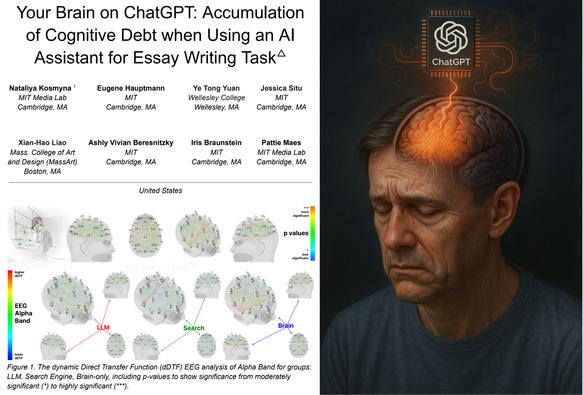
Your Brain on ChatGPT: Accumulation of Cognitive Debt when Using an AI Assistant for Essay Writing Task
This study explores the neural and behavioral consequences of LLM-assisted essay writing. Participants were divided into three groups: LLM, Search Engine, and Brain-only (no tools). Each completed three sessions under the same condition. In a fourth session, LLM users were reassigned to Brain-only group (LLM-to-Brain), and Brain-only users were reassigned to LLM condition (Brain-to-LLM). A total of 54 participants took part in Sessions 1-3, with 18 completing session 4. We used electroencephalography (EEG) to assess cognitive load during essay writing, and analyzed essays using NLP, as well as scoring essays with the help from human teachers and an AI judge. Across groups, NERs, n-gram patterns, and topic ontology showed within-group homogeneity. EEG revealed significant differences in brain connectivity: Brain-only participants exhibited the strongest, most distributed networks; Search Engine users showed moderate engagement; and LLM users displayed the weakest connectivity. Cognitive activity scaled down in relation to external tool use. In session 4, LLM-to-Brain participants showed reduced alpha and beta connectivity, indicating under-engagement. Brain-to-LLM users exhibited higher memory recall and activation of occipito-parietal and prefrontal areas, similar to Search Engine users. Self-reported ownership of essays was the lowest in the LLM group and the highest in the Brain-only group. LLM users also struggled to accurately quote their own work. While LLMs offer immediate convenience, our findings highlight potential cognitive costs. Over four months, LLM users consistently underperformed at neural, linguistic, and behavioral levels. These results raise concerns about the long-term educational implications of LLM reliance and underscore the need for deeper inquiry into AI's role in learning.
 Szabó Em, Enigma He-Art Director