#knitting

what are your favorite resources for learning magic loop? especially variations that avoid laddering.

bonus: ... how do I use stitch markers? do I just slide them onto the needle and hope everything works out later? if there's a getting started resource for these as well, I kind of need it.

@ansate I haven't learned magic loop so I can't help you there - I prefer to use double-pointed needles.

But in regard to using stitch markers, I do have experience with that.

First of all, there's more than one kind of stitch-marker. There are two main categories: closed, and open(able). Closed stitch markers can only be used one way: slide them onto the needle. They mark the space between two stitches. They "travel" with the needle; that is, while you are knitting, you get to the stitch marker, and you transfer it from one needle to the other, so it now marks the space between the stitch you just did and the stitch you are about to do.

Open stitch markers can be used in two ways: they can be slid onto the needle like closed markers, or they can be attached to a specific stitch in the knitting (and are able to be removed from it later). When attached to a stitch, rather than marking the space between stitches, it marks *that* stitch. Thus, it travels with the stitch, rather than travelling with the needle. When you get to that point in the row/round, the marker is attached to that stitch, in the row below the current row, and if you want to mark that spot again, you need to remove it from that stitch, and attach it to the new stitch that needs marking.

So, why would you use openable stitch markers, if they have to be moved all the time?

1. For marking the right side of the work. Closed markers can't do that, because they are not on the front or the back, they are between everything.

2. For marking the start of a round. Yes, you could use closed markers for that, but because one is likely to pause the knitting at the start of a round, unless you are very meticulous with needle-protectors, a closed marker could just fall off the needle, and you will have lost it. Attaching an openable marker to the actual stitch which marks the start of a round means it won't fall off; you don't need to move it every row, once every five rows is fine.

#knitting @knitting

@kerravonsen @ansate

+1
I prefer DPNs as well. To mark the start of row, I often put the stitch marker before the last stitch, so it doesn't fall off at the end of the row. The actual start is where the needle starts.

Often I will use a color coded chain of (openable) markers if I need to alternate rows, for example a red and a green for gusset increases. When I move the marker, I also flip the color on the needle. Red means, the next round is an increase, green is normal knit.

@goleztrol @ansate Oh, that's an interesting way of marking alternate rows!
What I've often done is put on a specific coloured stitch marker on increase rows, and take it off for normal rows.
@kerravonsen @ansate
That works as well, but I often knit on the bus, and I'm sure I'd lose it 😅

@goleztrol @ansate Oh dear! Good point.

Mind you... my long hair, in braids, has often made a good temporary holder for locking stitch-markers. 😉

@kerravonsen @ansate In addition to open and closed stitch markers there's also running stitch markers. That's a simple thread in a contrasting colour that you flop to the other side of the work (or not) when you come passed it. You may want to look uses for that up on Youtube.
I prefer simple stitch markers such as bulb markers and thin metal rings. When using markers on your needles it's important to have thin markers, because otherwise it can affect the size of the stitch after the marker.

@lisettedeboer @ansate I've never used running stitch markers, though I have seen them used every now and then.

In regard to closed stitch markers, some people do prefer thicker rings rather than thinner ones, because they stand out more, are more visible. But I, like you, lean towards the thinner metal rings, because they don't get in the way as much.

One of my favourite styles of stitch marker is an open-loop marker made of metal. Most open-loop markers are thick plastic, and I find them too chunky. The metal ones are nice and thin, and more versatile than closed metal rings, since they are open-style. This can be Very Important if one is knitting with a forethought lifeline and slide-on-the-needle markers, since you can slip them off the lifeline while still keeping them on the needle.

@ansate @knitting #knitting Then there are the decorated stitch-markers. These can be either closed or openable, though I've seen them most often be openable (using a lobster-clasp to attach to the knitting).
A decorated stitch-marker has a decoration attached to it, dangling off the stitch marker. The decoration can be a charm, or a bead, or beads; something that is decorative!

I don't use them myself; I feel they would get in the way too much, and in the worst case, might drag on the knitting if they are too heavy.

For those who do use decorated stitch markers, why do you use them? I'm curious.

@kerravonsen @ansate @knitting

I use a decorated one on a closed (or openable...) ring, to indicate 'start-of-round'. Plain markers to indicate 'start-of-repeat-of-pattern' or 'change stitch here' and so on. I don't like clipping anything heavy *into* the knitting; I'll use a plastic 'safety-pin' style (or a bulb pin, though I don't like them much) if I need to do that.

@Knitronomicon @ansate @knitting #Knitting

I do prefer the plastic safety-pins also, because they are not as sharp as the bulb-pins, and thus less likely to split the yarn. I do like bulb-pins when I want something thinner and lighter than the plastic ones, though.

@kerravonsen @ansate because they are prettyyyyyyyyyyyyyyyyy

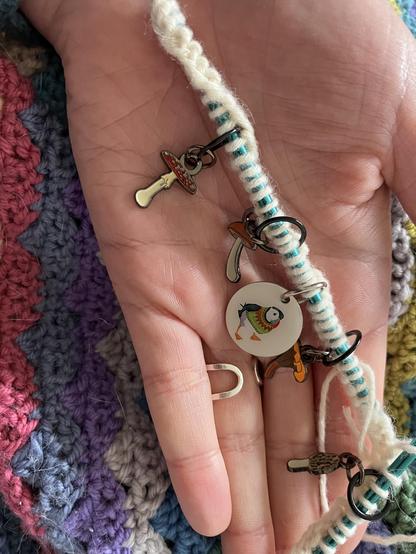
I use both my non-decorated (coloured) and decorated stitch markers to mark the same thing in different projects. Pink undecorated or one of my Emma Ball decorated stitch markers for beginning of round. Blue undecorated or one of the sea shell decorated for raglan lines. Green or the mushrooms for pattern repeats. If there are lots of pattern repeats, I make a little rainbow so I can notice I’m getting through the row.

@venite @ansate I was very much expecting someone to say "because they are pretty"... 😁

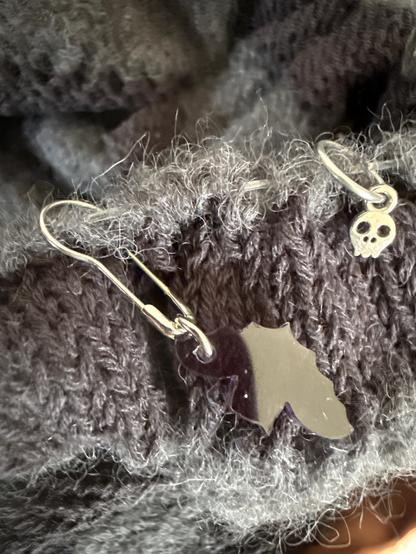
@kerravonsen @ansate @knitting I’m in the because they’re pretty camp. My favourite ones are these closed loop tiny little skulls which comes with one larger headstone one with it that I use to mark the beginning of a row when knitting in the round. I use the small ones to mark every set or two of a pattern so I can easily tell if I’ve screwed up.

The bat one next to it is a bulb pin with an acrylic marker. I use them to mark dropped stitches mostly.

@threadandbone @kerravonsen @ansate @knitting omg I NEED them sooooo bad!!

May I ask where you got them?

@Ppppawa @kerravonsen @ansate @knitting <3 the skulls are from Made by Catkin who has an Etsy store. I can’t remember the name of the amazing lass who does the acrylic bats but everything she makes is awesome. I’ll find her for you.
@Ppppawa @kerravonsen @ansate @knitting found her. Mavis Handmade for the bats. She’s currently on hiatus due to recently becoming a first time mum, but is apparently coming back this year sometime.
@kerravonsen This is great! I happen to have a set of closed stitch markers and couldn’t really picture how they would work. Thank you

@kerravonsen @ansate @knitting adding to this: I also use removable stitch markers for:

3. Marking rows to make it easier to count either for doing repeats or things like sweaters where I might need to do 20 rows and it's much faster to see when I'm done if I mark them off in 5s or something. Also good for repeated charts to make checking progress faster.

4. Grabbing a dropped stitch or marking a mistake so I can fix it when I get back around to that part of the knitting. Very helpful for mistakes where you need to drop back a bunch and reknit.

5. Marking off a larger cast or place where my repeats change I forgot to use the other type of stitch marker on the previous row. Turns out I really hate counting some days.

6. Holding up my pants hem when I inevitably rip it out after 5 years and don't want it to get caught on my bike on the way home. 😂