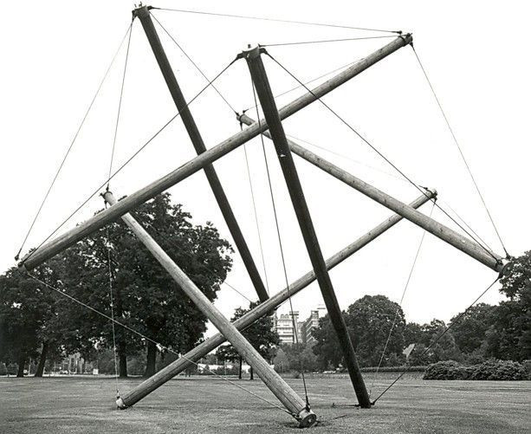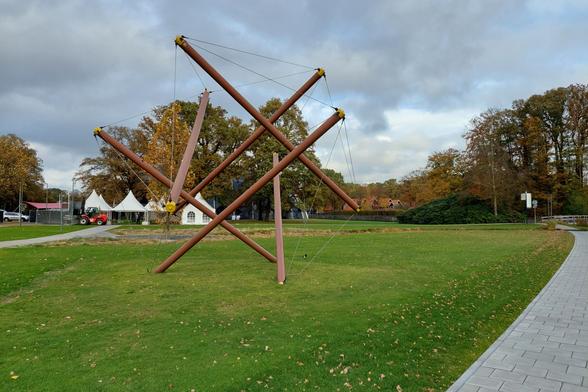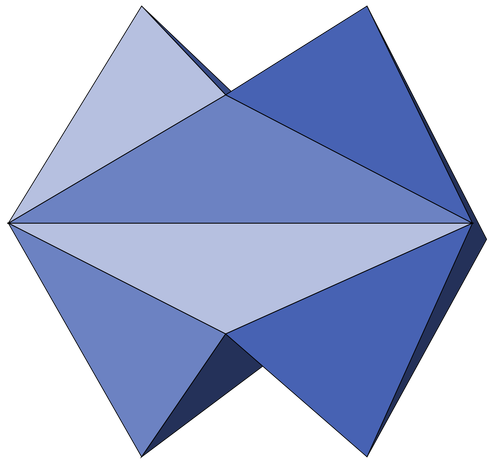
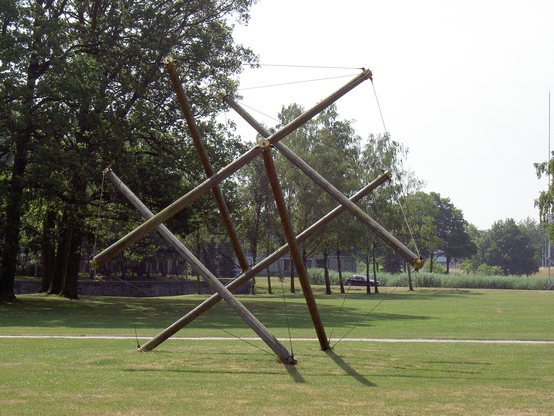
TIL. In April 1974, in the middle of the night, a small group of conspirators secretly installed a large tensegrity icosahedron made from discarded telephone poles on the campus of Twente University in the Netherlands.

It’s still there. People call it Het Ding (“the thing”).

https://www.utwente.nl/en/alumni/inspiring-alumni/ut-canon/stories/het-ding/
A funny detail, via @11011110:

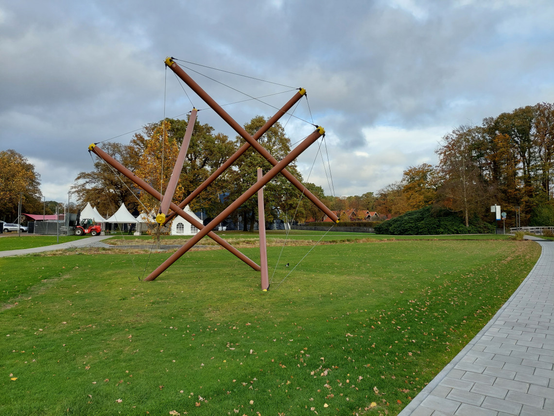
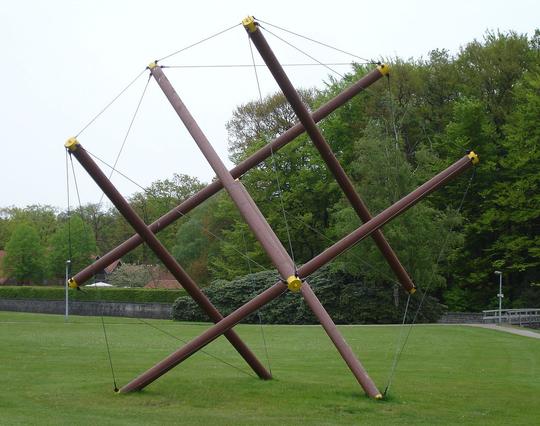
In 2008, the university temporarily removed Het Ding for maintenance – and they accidentally put it back the other way up!

See before and after photos here, taken from https://www.utoday.nl/campus-life/74074/student-prank-and-artwork-het-ding-exists-50-years

@robinhouston And it's had its own (Dutch) Wikipedia article since 2017: https://nl.wikipedia.org/wiki/Het_ding_(kunstwerk)
Het ding (kunstwerk) - Wikipedia

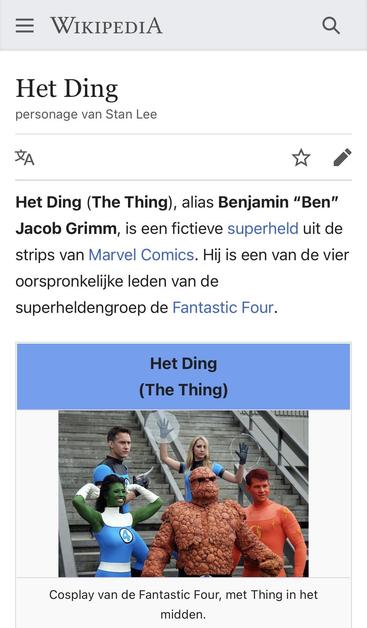
@11011110 Not to be confused with
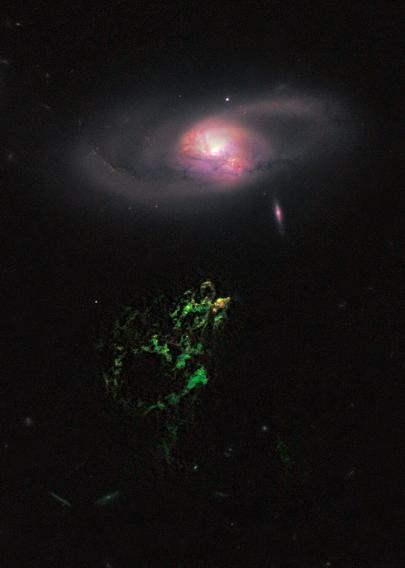
@robinhouston @11011110 And not to be confused with still another Dutch “thing”: https://en.wikipedia.org/wiki/Hanny%27s_Voorwerp
Hanny's Voorwerp - Wikipedia

@mrdk @robinhouston @11011110 ...or the Thing from Another World, or Thing which is part of the Addams' Family household.
@ElBeeToots @robinhouston @11011110 There is a lot of things that are called “thing”. 🙂
@robinhouston Maybe those two are not to be confused, but now I'm confused by something else. The Wikipedia article (read in translation) says that it was mistakenly renovated in mirrored form. But the 6-bar tensegrity is not chiral? Do they maybe mean that it was placed on a different three pole ends than before?

@11011110 I wonder if we can find before and after photos to compare.

*Edit*: Yes, this article has comparison photos: https://www.utoday.nl/campus-life/74074/student-prank-and-artwork-het-ding-exists-50-years

I can see why he called it ‘mirrored’ – the transformation applied is equivalent to reflection in a horizontal plane – though it is also equivalent to a rotation.

Student prank and artwork Het Ding exists 50 years

Exactly 50 years ago, students placed artwork 'Het Ding' near the university's main entrance as a joke. Today, the structure of six discarded telephone poles and steel wire still stands there, but mirrored since 2008. Read an article from our archive on the unusual history of Het Ding here.

@11011110 @robinhouston I was even more confused when I read the Dutch Wikipedia article in Firefox's translation, because it said

"Together they form a twenty-plane with fourteen equilateral and six equilateral triangles."

That seemed like a strange way of saying "twenty equilateral triangles"! But reverting to the Dutch, it's actually using two different words, fourteen "gelijkbenige" and six "gelijkzijdige". According to Wiktionary, the first of those means "isosceles", not "equilateral". Firefox's translation made a goof.

So this is apparently not a _regular_ icosahedron. Does that affect the question of whether it's chiral, perhaps?

@simontatham I think the tensegrity has the same geometry as Jessen's icosahedron, which is not the same as a regular icosahedron but not chiral either.
@simontatham Incidentally, if you read Jessen's paper he actually describes a multiparameter continuous family of orthogonal icosahedra, most of which *are* chiral – but everyone seems to have forgotten all of them apart from the simplest one.

@robinhouston that would explain why I couldn't quite see some of the icosahedron edges in the photos! I found it quite hard to work out what was going on, because the wires are so thin and often the same colour as the background.

I did remember a construction I'd seen in a Johnny Ball book as a child, in which you make a regular icosahedron by slotting three 1 × φ rectangular cards together and then connecting the 12 corners of the cards with string. If you changed the aspect ratio of those cards, that would also be a way to make an icosahedron with 14 isosceles faces and 6 equilateral which was still not chiral.

@simontatham @robinhouston I want to know how they put it up in the first place. How does one get it off the ground? Are there special instructions? Is it wired together in a big heap, then raised up with ropes and pulleys like a marionette, and then the wires are tightened?
@mjd @simontatham @robinhouston the Wikipedia article just says it was designed and built by five students. I'd have thought you'd need a crane or something, telephone poles are probably heavy.
@ghouston @mjd @simontatham The article I posted has a few more details, but on the assembly procedure it says only that it was ‘carried out by hand, using ladders’.

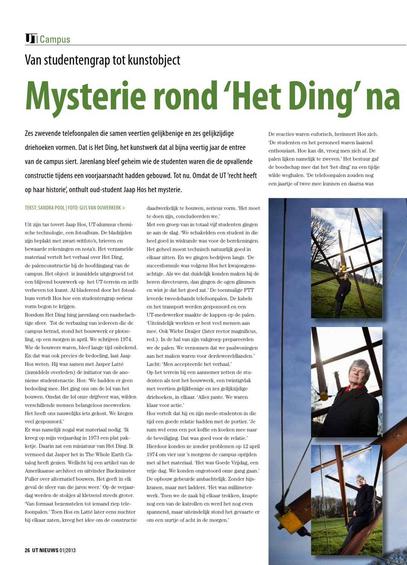
@mjd @simontatham @robinhouston yes, and the article that Wikipedia cites has another photo; the poles are perhaps not as heavy as what I have on my street.

https://issuu.com/utnieuws/docs/utnieuws-13-02-07/26

UT Nieuws Magazine Februari 2013

het februarinummer van UT Nieuws Magazine

Issuu
@robinhouston @simontatham Yes, it is through editing the Wikipedia article https://en.wikipedia.org/wiki/Jessen%27s_icosahedron in 2021 that I learned about this sculpture
Jessen's icosahedron - Wikipedia

@11011110 @robinhouston on reflection, I also don't believe those counts! If this sculpture has the form of Jessen's icosahedron, then surely it has _twelve_ isosceles triangles and _eight_ equilateral ones?

An easy mistake; clearly the equilateral triangles have something to do with a cube or its dual octahedron, and all you have to do is forget whether it's the faces or the vertices. I didn't spot it yesterday for that reason. But I got there in the end!

@robinhouston Cool, I know that thing, first saw it 19 years ago, and have recently seen it again - never knew it was prank though!
@robinhouston "The Thing" ... very Dutch
Node: ‪Het ding‬ (‪1834502858‬)

OpenStreetMap is a map of the world, created by people like you and free to use under an open license.

OpenStreetMap
@robinhouston Guerrilla art installation! I love it!
@robinhouston I've spent quite a few years there and I never knew until now!
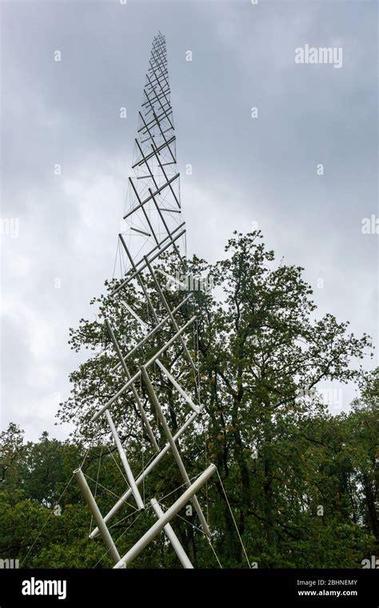
@robinhouston that is, of course, a mere summary of that other Thing, the Needle Tower by Kenneth Snelson. In the garden of the Kröller-Müller Museum.
@josgeluk @robinhouston I lived there, a wonderfully stimulating environment. Older students told me that a concrete container (precisely calculated) had been sunk in the pond of the (then) applied mathematics building. It would surface at the time of the new moon (the sun and moon are in direct line from the Earth). Unfortunately, the container never surfaced.
Even a bit of dirt or resistance from sticking in mud would throw that off. I think the only way to get that to work is if your body of water is large enough to have tides.
@robinhouston I walk by it every day on my lunch walk. I think it's a beautiful piece of mathematical art
@robinhouston do that in the United States and the SWAT and bomb squad will show up

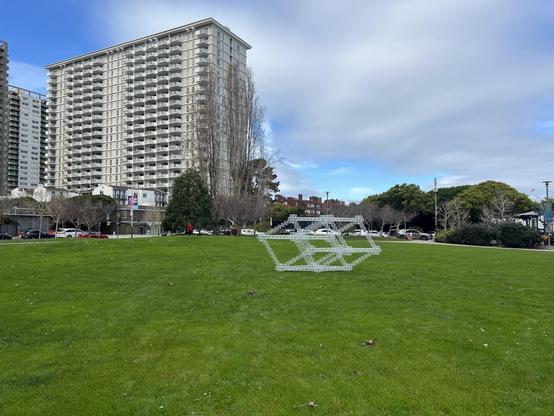
@xan You might think so! But when some people did something similar recently in San Francisco there was no such overreaction. (It had been removed by the following day, though: I don't know by whom.)

https://mathstodon.xyz/@robinhouston/116122084537901660

robinhouston (@[email protected])

Attached: 3 images Some of the Zometool crowd made a large sculpture of a projection of a tesseract and yesterday, in the tradition of Drop Art from which zometool was born, installed it guerilla-style in a nearby park.

Mathstodon
@robinhouston Us Dutch certainly have a way with naming stuff, don't we? Reminds me of "Hanny's Voorwerp" (Hanny's Object): https://en.wikipedia.org/wiki/Hanny's_Voorwerp
Hanny's Voorwerp - Wikipedia